
What Is Property Management Software: Types, Features, Considerations
Managing properties at scale means juggling leases, rent, maintenance requests, accounting, and tenant communication at once. Property management software exists to pull all of that into a single system so a small team can run a large portfolio without errors or missed tasks.
The category is growing because the work is digitizing fast. Market-size estimates vary by scope, from around USD 3.6 billion in 2025 (Grand View Research) to USD 6.5 billion in 2026 (Mordor Intelligence), but the firms agree on the direction: steady growth and a decisive shift to the cloud. This article explains what the software is, who uses it, the main types, the features that matter, and how to choose one.
Key Takeaways:
- Property management software centralizes leasing, accounting, maintenance, payments, and tenant communication into one platform, replacing scattered spreadsheets and disconnected tools.
- The market is growing steadily. Estimates vary by scope, from around USD 3.6 billion in 2025 (Grand View Research) to USD 6.5 billion in 2026 (Mordor Intelligence), with forecasts of mid-to-high single-digit annual growth through the early 2030s.
- Cloud-based deployment now dominates, holding roughly 61% (Grand View Research, 2025) to 72% (Mordor Intelligence, 2025) of the market, because it removes upfront hardware cost and updates continuously.
- The three useful ways to classify property management software are by deployment (on-premise versus cloud), by application (residential, commercial, hospitality), and by end-user (landlords, agents, property managers, investors).
- Hospitality is a distinct branch of property management software. A hotel PMS adds reservations, front desk, and channel management on top of the core feature set.
What Is Property Management Software?
Property management software is a program or cloud platform that automates the administrative and back-office work of managing properties. Its common functions are electronic leases, maintenance tracking, online tenant portals, document storage, accounting, and online payment processing.
Instead of running accounting in one tool and tenant records in another, the software brings these functions into one place. That removes duplicate data entry and the synchronization errors that come with disconnected systems. Whether a business manages ten units or ten thousand, the goal is the same: less manual work, fewer mistakes, and a single source of truth for every property, tenant, and transaction.
Who Uses Property Management Software?
The software serves several distinct user groups, and each weights features differently.
- Property owners and landlords: Owners who manage their own portfolio use it to automate back-office tasks and oversee multiple properties without a large team.
- Managing agents: Residential and commercial agents who manage properties on behalf of owners use it to run day-to-day operations and report back to clients.
- Property managers: Dedicated managers rely on it for accounting, rent collection, maintenance scheduling, and tenant communication in one workflow.
- Commercial occupiers: Businesses tracking their own rent, maintenance, and finances use the maintenance-tracking and payment features to stay organized.
- Housing associations and co-owners: Community-style entities use it to split management responsibilities, handle shared finances, and keep board members and co-owners aligned.
Signs Your Business Needs Property Management Software
The clearest indicator is portfolio size: the more properties you manage, the harder manual methods become. Beyond size, a few common triggers signal it is time to adopt or switch:
- Your current system is outdated or no longer supported, which risks downtime and locks you out of new features.
- You run separate accounting and property management systems, causing data duplication and synchronization errors.
- Your existing system does not fit your portfolio type or size, so you are forced into workarounds that waste time.
Benefits of Property Management Software
The value of property management software shows up as recovered hours, fewer errors, and better tenant retention.
- Security and transparency: Cloud platforms store data in managed data centers with dedicated security teams, rather than on a vulnerable local server. Strong solutions encrypt sensitive financial data and add safeguards such as one-time passwords for payment transactions.
- Better maintenance tracking: When a work order enters the system, the software alerts the right people automatically and lets tenants raise and track requests through a portal. This prevents small repairs from turning into expensive building problems.
- Easier payments: Online rent payment removes in-person handling and gives both tenants and the business a clean record, which resolves payment disputes quickly. Over 70% of tenants now prefer digital channels for these interactions (Global Growth Insights, 2026).
- Higher tenant satisfaction: Tenant portals, online applications, lease e-signatures, and self-service reduce friction across the whole tenancy and improve retention.
- Cleaner reporting: Centralized financial and operational data turns reporting from a manual chore into an on-demand dashboard, which matters most at scale.
Types of Property Management Software
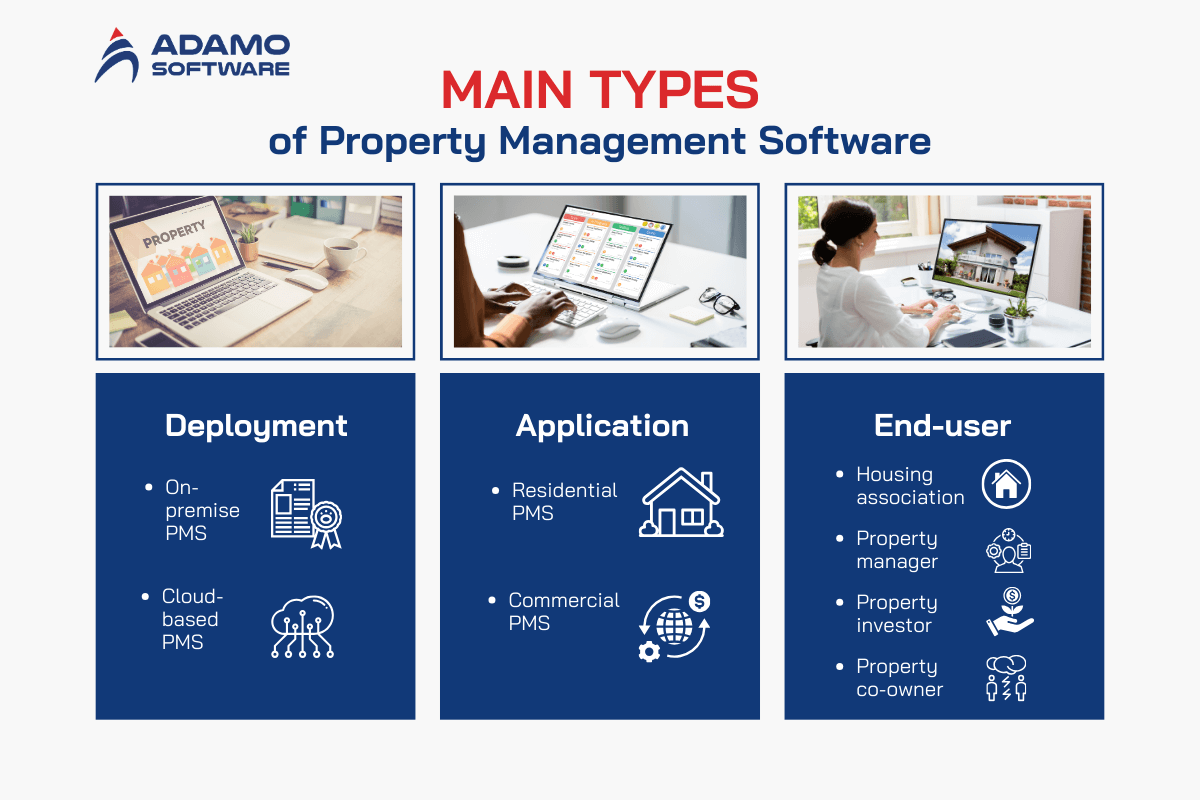
There are three useful ways to classify property management software: by deployment, by application, and by end-user. Understanding where a product sits in each helps you match it to your needs.
1. By Deployment: On-Premise vs Cloud
On-premise PMS is installed locally on a specific computer or server. Its advantage is complete control over hardware, data, and customization, which suits businesses with strict data-control requirements. The trade-off is higher upfront cost and ongoing maintenance.
Cloud-based PMS runs on a Software-as-a-Service model and is accessible from any device, including smartphones. It dominates the market, holding roughly 61% (Grand View Research, 2025) to 72% (Mordor Intelligence, 2025) of deployments, because it removes upfront hardware cost, updates automatically, and lets managers work on the go. A modern cloud PMS typically covers tenant communication, maintenance planning, accounting, and analytics in one platform.
| Factor | On-Premise PMS | Cloud-Based PMS |
|---|---|---|
| Upfront cost | High (hardware and licenses) | Low (subscription) |
| Access | On local machines only | Any device, anywhere |
| Updates | Manual, scheduled | Automatic, continuous |
| Data control | Full, in-house | Managed by provider |
| Maintenance | Your responsibility | Handled by vendor |
| Best for | Strict data-control needs | Most businesses, especially multi-site |
2. By Application: Residential, Commercial, and Hospitality
Residential PMS is built for rental housing and prioritizes tenant screening, rent collection, maintenance management, and basic accounting. Residential is the leading application segment of the market (Grand View Research, 2025).
Commercial PMS serves retail, office, and industrial properties, adding advanced accounting, marketing analytics, and financial-statement management. Commercial managers need a full view of leasing and tenant mix, for example to avoid placing two competing businesses in the same property.
Hospitality PMS is a distinct branch built for hotels and short-stay properties. It layers reservations, front-desk operations, and channel management on top of the core feature set. Because hospitality has its own requirements, it is worth treating separately. See our guide to the hotel property management system for a deeper look at hospitality-specific features.
3. By End-User: Housing Associations, Managers, Investors, and Co-Owners
Each end-user values a different feature set:
- Housing associations prioritize financial transaction management, easy access to tenant and owner details, board collaboration, and third-party integration.
- Property managers need comprehensive accounting, rent collection, maintenance scheduling, and tenant communication channels.
- Property investors focus on financial analysis: generating statements, predicting market trends, assessing risk, and managing listings to maximize return.
- Property co-owners need rent collection, tenant notifications, inspection management, co-owner communication, and compliance tracking.
Core Features of Property Management Software
While feature sets vary by product, a capable property management platform covers a consistent core:
- Accounting and trust accounting: Handling transactions, banking details, mortgages, and debts in one secure, auditable location.
- Tenant and owner portals: Self-service for payments, requests, applications, and document access, which cuts inbound calls and emails.
- Maintenance management: Logging, assigning, and tracking work orders from request to completion.
- Online payments: Secure rent collection with automatic records and reconciliation.
- Lease and document management: Electronic leases, e-signatures, and centralized document storage.
- Reporting and analytics: Financial and operational dashboards for faster decisions.
Hospitality platforms extend this core with reservation management, front-desk and point-of-sale operations, and channel management across OTAs and GDSs. Those features are specific enough to deserve their own treatment, which we cover in the hotel PMS guide.
How to Choose the Right Property Management Software
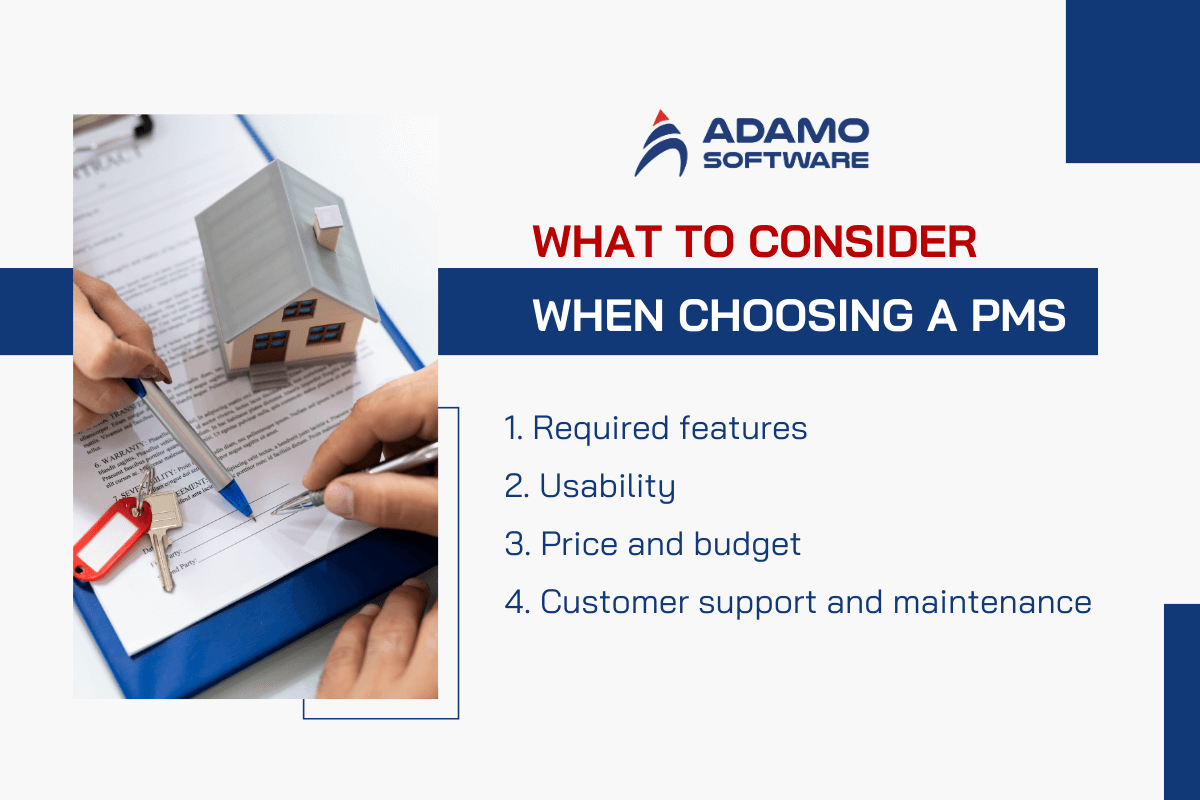
Choosing or building the right system comes down to four checks:
- Required features: Separate must-have features that run your core business, such as maintenance tracking and online payments, from nice-to-have features you can compromise on for a better price.
- Usability: Use free trials or demos to simulate a real workflow. A modern interface and shortcuts for common tasks make a measurable difference to daily efficiency.
- Price and budget: Pricing ranges widely, from free tiers to enterprise per-unit pricing. Match the cost to the sophistication you actually need, not the longest feature list.
- Support and maintenance: Check whether the vendor offers live chat, phone, and email support, one-on-one onboarding, and whether support is included across plans. This matters most during onboarding.
If an off-the-shelf product cannot fit your workflow, a custom build is the alternative. For an idea of what that involves and costs, see our breakdown of PMS development budget and ROI.
Common Mistakes to Avoid
- Evaluating software that is not designed for your portfolio type.
- Choosing a system that does not match the size of your portfolio.
- Failing to separate must-have from nice-to-have features.
- Skipping free trials and product walkthroughs before committing.
Frequently Asked Questions
What is property management software?
It is a program or cloud platform that automates the back-office work of managing properties, including leasing, rent collection, maintenance tracking, accounting, document storage, and tenant communication, in a single system.
What are the main types of property management software?
The three useful classifications are by deployment (on-premise versus cloud), by application (residential, commercial, hospitality), and by end-user (landlords, managing agents, property managers, investors, and co-owners).
Is cloud or on-premise property management software better?
Cloud dominates the market because it removes upfront hardware cost and updates automatically. On-premise gives full control and customization but requires higher investment and maintenance. The right choice depends on your data-control needs and budget.
What is a hotel PMS?
A hotel PMS is hospitality-specific property management software that adds reservations, front-desk operations, point-of-sale, and channel management to the core feature set, built for hotels and short-stay properties.
Conclusion
Property management software earns its place by replacing scattered tools with one system: leasing, accounting, maintenance, payments, and reporting in a single platform. The market has moved decisively to the cloud, with 61% to 72% of deployments now cloud-based, and the right choice depends on matching deployment, application, and end-user fit to your portfolio. For hospitality operators, the requirements go further, since a hotel PMS adds reservations, front desk, and channel management that general systems do not cover.
Build a Hospitality PMS Tailored to Your Properties With Adamo Software
Off-the-shelf systems rarely fit a hotel or hospitality operation exactly. Adamo Software builds custom hospitality and hotel property management systems, covering reservations, front desk, channel management, payments, and the integrations that connect them. Our team scopes your workflows, recommends the right architecture, and delivers a system designed to scale with your portfolio.
– Explore our Property Management System development service: https://adamosoft.com/travel-and-hospitality-software-development/property-management-system/
– See our full Travel and Hospitality Software Development capabilities: https://adamosoft.com/travel-and-hospitality-software-development/
– Contact us for a free consultation: https://adamosoft.com/contact-us/

 adamosoft.com
 (+84) 373 11 44 88