

GDS Integration: How to Integrate GDS API with Other Platforms
The scale behind this is significant. The global online travel market was valued at over 700 billion U.S. dollars in 2025 (Statista, 2025), and the three dominant GDS providers (Amadeus, Sabre, and Travelport) still control around 97% of the indirect booking market (software.travel, 2025). GDS is one type of travel API within a broader travel API landscape that also includes NDC, flight, and XML APIs. This guide covers what a GDS is, the key features of GDS integration, how the main GDS APIs compare, the integration steps, and where NDC and other alternatives fit.
Key Takeaways:
- GDS integration connects a booking platform to a global distribution system (Amadeus, Sabre, or Travelport), giving access to airline, hotel, and car inventory through one connection instead of contracting each supplier directly.
- The three dominant GDS providers (Amadeus, Sabre, and Travelport) control roughly 97% of the indirect booking market (software.travel, 2025), so provider choice shapes your inventory reach.
- More than 60% of airlines now use the NDC standard (software.travel, 2025), making a GDS-plus-NDC hybrid the realistic distribution model rather than GDS alone.
- Integration follows five steps: choose the right GDS, use a standard interface (OTA XML), add a middleware layer, optimize the user experience, and maintain the connection.
- The global online travel market was valued at over 700 billion U.S. dollars in 2025 (Statista, 2025), keeping GDS connectivity central to most travel platforms.
I. What is GDS (Global Distribution System)?
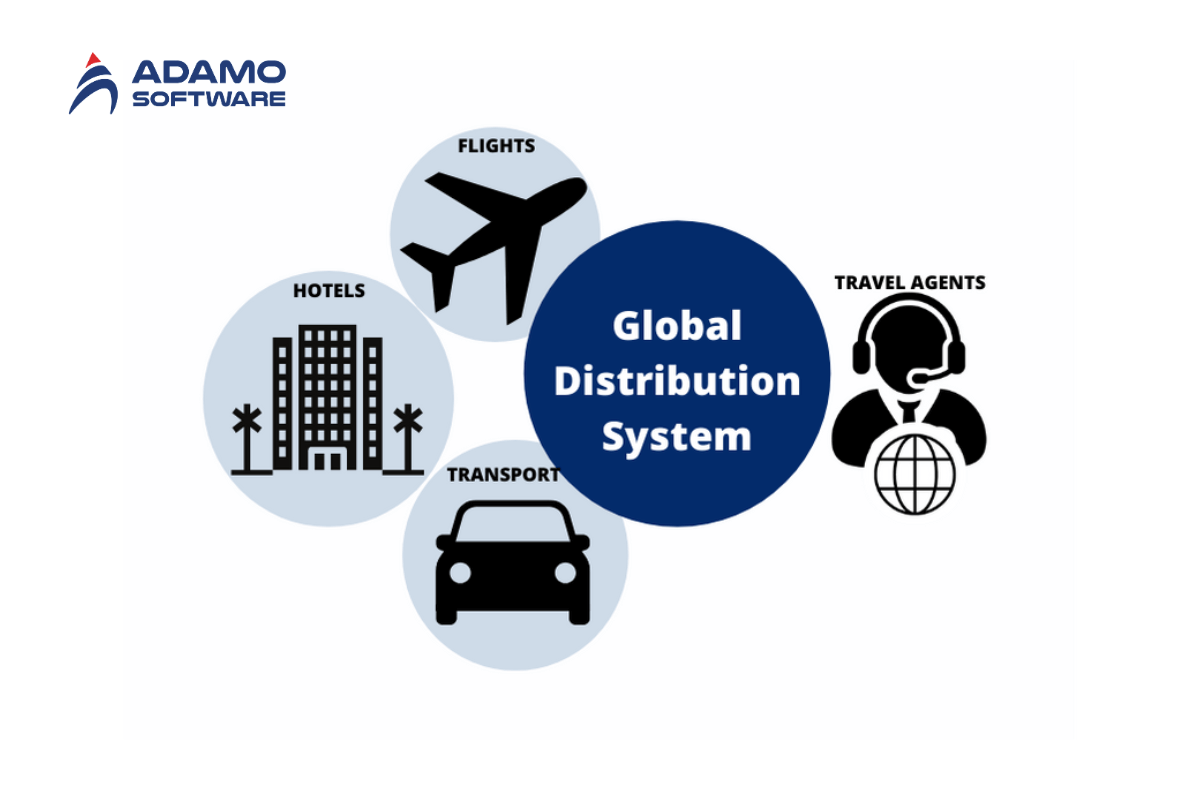
A global distribution system (GDS) connects reservation inventories into one computer-based network. It is widely used in the tourism industry, mainly for airlines, hotels, and car rental companies, so that travel agencies and online travel agencies can sell tickets for the same flight, hotel room, or car rental in real time.
GDS in travel also acts as a middleman between vendors such as hotels and airlines and service providers such as online travel agencies. Most large GDS networks are linked to major travel agencies, while smaller and cheaper systems connect to fewer agencies.
Travel businesses sign up and connect their inventory to a GDS integration. Once connected, users can buy from a vendor through different portals associated with the GDS. This prevents overbooking, and service providers receive real-time inventory updates from the airline or hotel. Companies can also display their inventory and update products and rates automatically, which supports dynamic pricing that propagates instantly across every connected portal.
Even with the rise of third-party online travel agencies (OTAs) such as Booking.com and Expedia, GDS systems remain a leading way to promote inventory to the corporate travel market and reach travelers globally. You can also explore how to connect a GDS system from airlines to hotels in our dedicated guide.
II. Key Features of GDS Integration
A complete GDS integration usually delivers more than raw inventory access. The features below are what most agencies and OTAs expect from a production-ready GDS-connected platform:
- B2B and B2C online booking portal for both agency and direct-consumer sales.
- Advanced flight booking engine with real-time search and fares.
- Integrated CRM system to manage customer records and history.
- Online payment gateway for secure transactions.
- Promo code management for marketing campaigns.
- B2C and B2B profile management, including booking lists, vouchers, and cancellations linked to each booking.
- Post-sale support for rescheduling and cancellation.
- Mid-office system covering booking management, front desk, supplier management, and service fee management.
- Mobile applications for iOS and Android.
III. GDS API Integration: Amadeus vs Sabre vs Travelport
Amadeus, Sabre, and Travelport are the dominant GDS providers in the travel industry, together controlling roughly 97% of the indirect booking market (software.travel, 2025). Each gives access to a vast inventory, and the right GDS API depends on your target region, segment, and content needs.
1. Amadeus GDS integration
Operating in over 190 countries, Amadeus is one of the world’s leading distribution systems and the backbone for many European national carriers. It lets travel agents, companies, and their customers compare prices, book options, check schedules, and access inventory across airlines, car rentals, hotels, holidays, and bus fares.
The Amadeus web service API delivers content through SOAP/XML messages, so agents can integrate travel content into booking engines, websites, front-office tools, and corporate self-booking platforms. When integrated into a reservation system, the Amadeus GDS API consolidates availability and pricing into your own booking flow:
- Airline: IT solutions that streamline transactions, booking, ticket reservations, inventory control, departure control, and e-commerce.
- Hotel: A hotel search API that connects with hotels and small chains and surfaces them across the major global distribution systems.
- Car rental: A cars API that lets rental companies reach multiple client segments through global multi-channel technology.
2. Sabre GDS integration
Sabre is a popular GDS for OTAs and travel management companies, and it is the strategic stronghold for the North American agency market. Through the Sabre GDS API, platforms access flight, hotel, car, rail, and cruise reservation systems, with worldwide rates, inventory, deals, and real-time availability.
- Airline: Data solutions that help airlines serve customers efficiently and reach both leisure and corporate travelers cost-effectively.
- Hotel: Sabre hotel GDS integration lets agents shop and book properties at competitive prices across more than 175,000 locations worldwide, with reliable supplier connectivity and real-time rate and room status.
- Car rental: Easy-to-use rental content with a real-time interface for both leisure and corporate bookings.
3. Travelport GDS integration
Travelport aggregates content from three legacy systems (Apollo, Worldspan, and Galileo) and positions itself around modern retailing, including the aggregation of fragmented NDC content. With Travelport GDS integration, agencies access airlines, hotels, car rentals, and holidays with real-time seat availability, price changes, and flight status.
- Airline: Enriched air content for booking flights with real-time data and competitive offers.
- Hotel: A reservation system used by independent hoteliers, global chains, and boutique properties, connecting them to travel and corporate agencies in more than 180 countries.
- Car rental: A platform that lets agencies and corporate travelers book multiple vehicle classes and helps suppliers reach global tour operators.
IV. Step-by-Step Guide to Integrate GDS in Travel
GDS integration requires careful planning and execution. Here is a breakdown of the key steps:
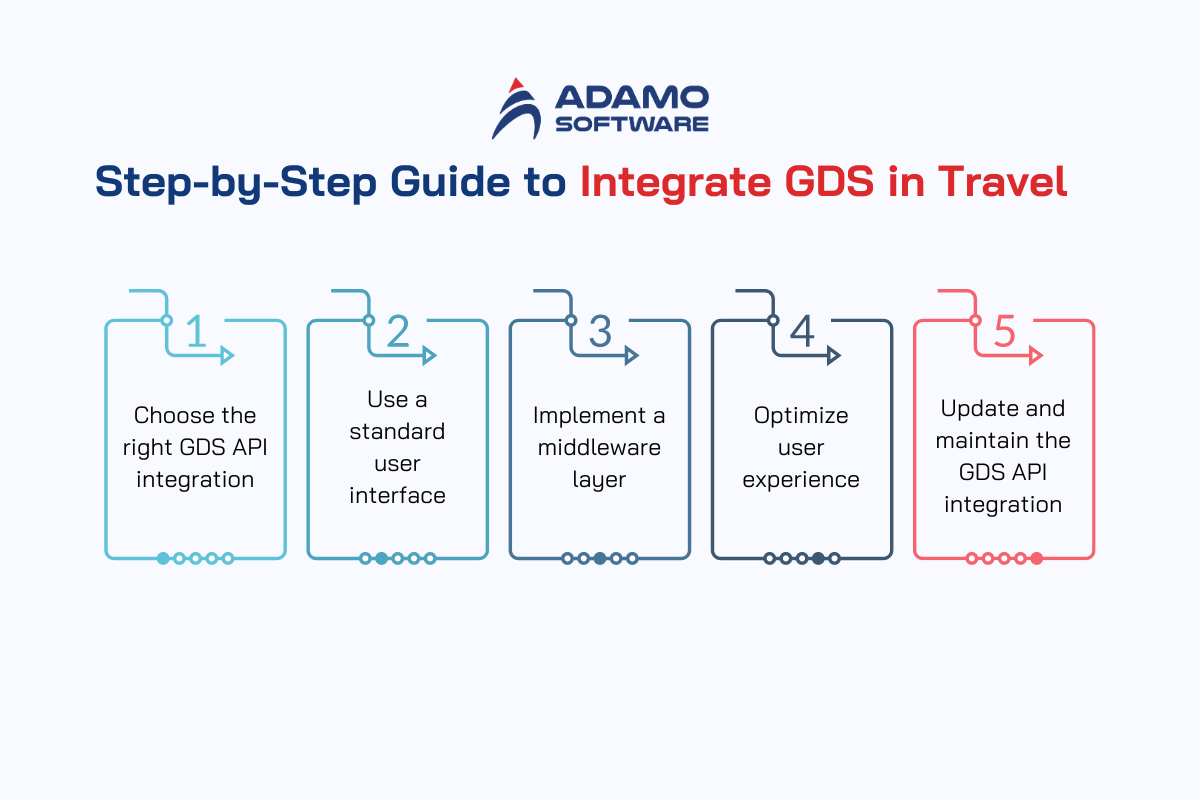
1. Choose the right GDS
Start by selecting the GDS that best fits your business. Amadeus, Sabre, and Travelport each have different strengths, coverage areas, and rates. Some offer better inventory for specific regions or segments, while others provide richer features such as dynamic pricing or ancillary services. Compare them on cost, content depth, and compatibility with your business model and target market.
2. Use a standard interface
Use a standard interface to communicate with the GDS so data is exchanged consistently. The most common standard is the Open Travel Alliance (OTA) XML specification, which lets you send and receive messages for availability, fares, booking, and ticketing using structured XML.
3. Implement a middleware layer
Add a middleware layer between your platform and the GDS. This component acts as a bridge: it translates and validates data, caches results to reduce repeated requests, applies business logic to customize content and pricing, and manages the connection for reliability and security.
4. Optimize the user experience
A strong user experience converts and retains customers. Design an intuitive interface for search, comparison, and booking, and present accurate content such as images, descriptions, ratings, and reviews. Offer flexible filters, sorting, payment methods, and cancellation policies, and ensure fast, reliable confirmation, notification, and support.
5. Update and maintain the GDS integration
Regular updates keep the integration running smoothly and aligned with the latest GDS and interface specifications. Test and debug regularly to catch issues, monitor performance to optimize efficiency, and gather feedback from users and partners to keep improving the platform.
V. GDS vs NDC and Other Alternatives
GDS integration serves two main purposes: helping agencies, OTAs, and TMCs cover their full travel management needs, and providing a primary source of inventory for air distribution. It is a strong default, but it is no longer the only option. Depending on your goals, consider the alternatives below.
1. NDC (New Distribution Capability)
NDC, introduced by IATA in 2012, is an XML standard that lets airlines distribute richer fares, ancillaries, and personalized offers directly, beyond what the legacy EDIFACT protocol behind traditional GDS can transmit. More than 60% of airlines now use the standard (software.travel, 2025), and some carriers offer exclusive fares only through NDC channels. The practical result is a two-track environment: GDS provides broad, standardized coverage, while NDC offers airline-specific depth. Most platforms today run a hybrid of both. For the message schema, certification, and aggregator options, see our guide to NDC API integration.
2. Large OTAs
Expedia and Booking.com can provide significant distribution support to smaller businesses in exchange for a share of the revenue. Expedia Partner Solutions exposes a REST-based Rapid API with access to hundreds of thousands of global accommodations, while Booking.com’s Demand API supports XML and JSON, providing live rates, availability, content, and booking processing.
3. Wholesalers (bed banks)
Wholesalers, or bed banks, are a key inventory source for many OTAs. Players such as Hotelbeds offer large inventory, advanced APIs, and market expansion. In this model, a wholesaler contracts a fixed number of rooms from a hotel at a set price for a period, then resells them to OTAs and TMCs, often at negotiated rates.
4. Direct connection to providers
Direct connectivity to transport and hospitality providers, typically through two-way API communication, removes the middleman. OTAs get more relevant, up-to-date content and can offer more competitive pricing, at the cost of maintaining each connection individually.
VI. Why Partner With Adamo Software for Your Travel App and Website Development
As a software development company in Vietnam’s travel and hospitality industry, Adamo Software prioritizes quick market launches and cost-effective delivery for SMEs and corporations, with flexible resourcing for each project.

We design and build custom online booking engines and travel portals, and integrate web services across XML, GDS, and NDC, then handle testing, deployment, technical maintenance, and support. Our travel and hospitality software development teams build fully featured travel solutions, including hotel booking systems, car rental services, cruise bookings, holiday packages, central reservation systems, and flight reservation booking. If air content is your focus, we also cover dedicated flight API integration.
FAQs for GDS Integration
1. What is GDS in travel?
A global distribution system (GDS) is a computer-based network that connects the reservation inventories of airlines, hotels, and car rental companies with travel agencies and booking platforms, so they can access real-time availability, pricing, and bookings through a single connection.
2. What are the top GDS providers?
The three dominant GDS providers are Amadeus, Sabre, and Travelport, which together control roughly 97% of the indirect booking market (software.travel, 2025). Amadeus is strongest in Europe, while Sabre leads in North America.
3. What is the difference between GDS and NDC?
GDS uses the legacy EDIFACT protocol to distribute standardized content across thousands of suppliers, while NDC is a newer XML standard from IATA that lets airlines distribute richer fares and ancillaries directly. Most platforms now combine both: GDS for breadth, NDC for airline-specific depth.
4. How do you integrate a GDS API?
GDS API integration follows five steps: choose the right GDS, use a standard interface such as OTA XML, implement a middleware layer for translation and caching, optimize the booking user experience, and maintain the connection with regular testing and updates.
5. Is GDS still relevant with OTAs and NDC?
Yes. Despite the growth of OTAs and direct booking, GDS still handles the large majority of indirect bookings and remains central to corporate travel. The shift now is toward a hybrid model that pairs GDS coverage with NDC content rather than replacing GDS outright.
Conclusion
GDS integration remains the broadest single route to real-time airline, hotel, and car inventory, with Amadeus, Sabre, and Travelport controlling around 97% of the indirect booking market (software.travel, 2025). The practical decision today is not GDS or nothing, but how to combine GDS breadth with NDC depth, since more than 60% of airlines now distribute through NDC. Getting the provider mix, the standard interface, and the middleware layer right is what determines whether your booking platform delivers fast, accurate, and complete results.

 adamosoft.com
 (+84) 373 11 44 88