
How to estimate the budget and ROI for hotel PMS development

The hotel PMS development market is expected to reach nearly $6 billion by 2031. Businesses can enhance their consumer experience with hospitality PMS software.
It is impossible to overstate the importance of hotel PMS development that has been attentively designed in the modern digital landscape. This application has the potential to revolutionize the hotel industry. It enables hotels to interact with visitors seamlessly, thereby increasing the number of reservations.
Hotel PMS development is essential to the hospitality industry, as it serves as the central nervous system of hotel operations. Therefore, the inquiry is: How to calculate the budget for the development of a hotel PMS? This article will provide a detailed breakdown of the cost of hotel PMS development.
I. 6 popular hotel PMS developments that dominate the market
Before diving deeper into what is property management software, let’s have a look at some popular hotel PMS on the market.
1. ThinkReservations – Optimal solution for front desk operations
ThinkReservations is a powerhouse PMS that is specifically engineered to optimize hotel operations. It enables users to streamline check-ins, check-outs, and guest interactions. Therefore, it is an ideal solution for those who are committed to enhancing front desk operations. This is due to the clear emphasis on front desk duties.
Features & Integrations
ThinkReservations provides essential features, including integrated credit card processing, detailed visitor profiles, and a reservation calendar. Insightful data is also provided by its reporting and analytics capabilities to enhance operational efficiency. ThinkReservations has the ability to seamlessly integrate with a wide range of distribution channels, payment gateways, website platforms, and other useful hotel management tools.
Pricing
Pricing for ThinkReservations commences at $50 per user per month, with annual billing. This encompasses all standard features and customer support, with additional fees for sophisticated features and integrations.
2. Visual Lease – Effective method for managing lease obligations and costs
Visual Lease is a lease management solution that offers comprehensive analysis and control over lease obligations and costs. It is an exceptional instrument for monitoring property-related financial obligations, as it integrates data management and accounting regulations to assist hoteliers in efficiently managing leases.
Features & integrations
Visual Lease offers a range of useful features, such as lease accounting compliance, critical date tracking, and expense management. The software can easily integrate with ERP systems such as Oracle and SAP, allowing for smooth data exchange and enhancing operational efficiency.
Pricing
The price of Visual Lease starts at $100 per person per month. But please keep in mind that this is just the starting price. If you want more services or more users, you may have to pay more.
3. Little Hotelier – Efficient for small hotel businesses
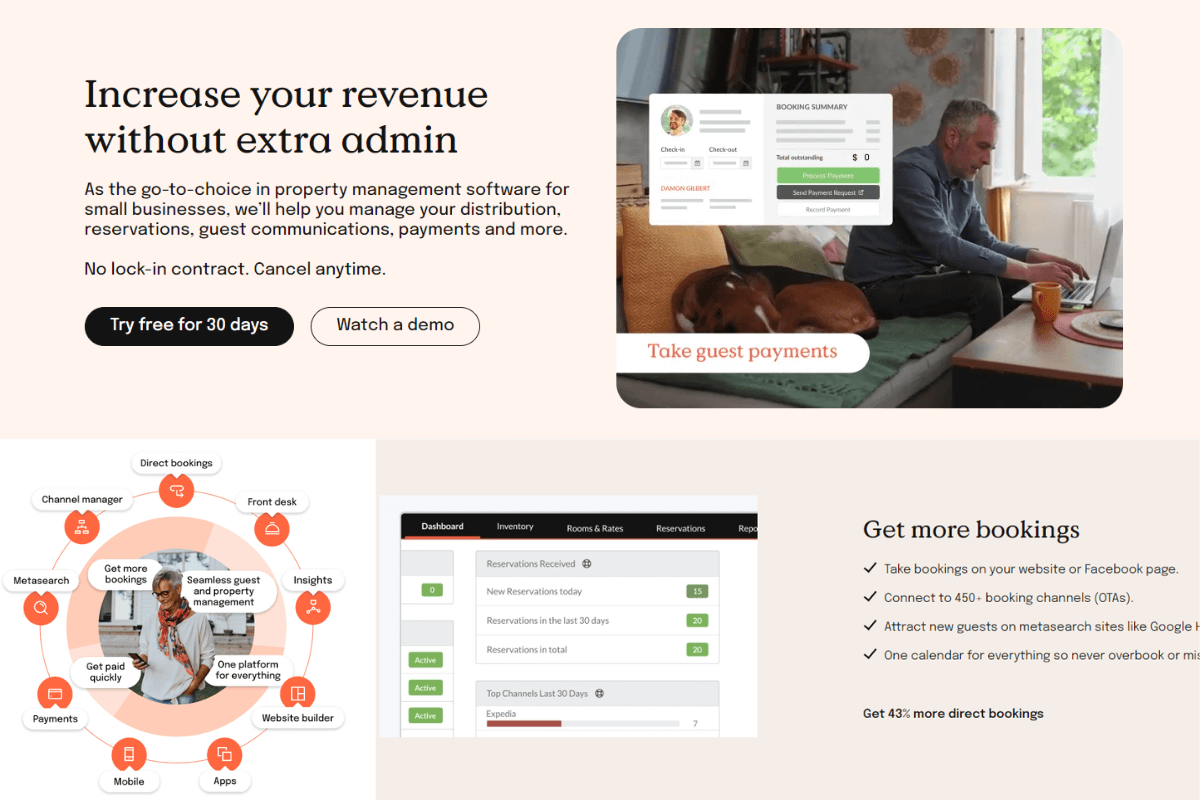
Little Hotelier is an easy-to-use, low-cost PMS development for small hotels like bed and breakfasts and inns. It has all the management tools you need.
Features & integrations
Little Hotelier has some handy features like a front desk system, reservation management, and a channel manager. It also works seamlessly with popular OTAs and global distribution systems, giving small businesses the opportunity to expand their reach and boost their online visibility.
Pricing
The price for Little Hotelier starts at $70 per user per month. Keep in mind that prices may change based on the unique features your business needs.
4. Sirvoy – Best known for its user-friendly interface
Sirvoy provides a range of property management tools, including a Property Management System, Booking Engine, Website Builder, and integrated Channel Manager. The system is easy to use and gives hoteliers flexibility to customize it for their property. Sirvoy’s setup is a breeze, and their Customer Service is always there for ongoing training and support, 24/7.
Features & Integrations
Sirvoy has all the necessary features you need, like booking management, invoicing, and multi-language support. It works seamlessly with popular platforms like Booking.com, Expedia, and Airbnb. Therefore, you can easily handle all your channels in one convenient location.
Pricing
Sirvoy offers pricing starting at $9 per user per month. The pricing is straightforward and clear, with no hidden or extra fees. Thus, it’s affordable for different budgets.
5. Resort Data – Easy for handling resort and timeshare properties
Resort Data is software that helps you manage your resort and timeshare properties with ease. This software is great because it can effectively cater to the specific requirements of these kinds of properties, making it the perfect fit for this specialized market.
Features & Integrations
The Resort Data system offers a range of useful features, including reservations management, front desk operations, owner accounting, maintenance management, and contract management. It seamlessly connects with popular payment gateways and accounting software such as QuickBooks, and even provides an API for personalized integrations.
Pricing
Our Resort Data pricing begins at just $50 per user per month. You’ll have access to all the modules you need to run a timeshare property smoothly.
6. Cloudbeds – Best for managing multiple hotel groups
Cloudbeds is software that helps hotels manage their operations and coordinate with other hotel groups. This tool is perfect for managing multiple hotel groups. It offers a user-friendly experience that is adaptable to your needs.
Features & Integrations
Cloudbeds provides a range of features that are crucial for effectively managing hotel groups. These include a property management system (PMS), a booking engine, and a channel manager. Moreover, the reporting features are great for making well-informed decisions.
Regarding integrations, Cloudbeds offers connections with various OTA, payment processors, and operational tools. This integration range allows for easy and effective management of multiple hotel groups.
Pricing
Pricing options range from $20 per user per month, offering a variety of tiers to meet different business requirements. The pricing for this model can change based on the number of rooms you’re managing.
II. Things to keep in mind when choosing hotel PMS
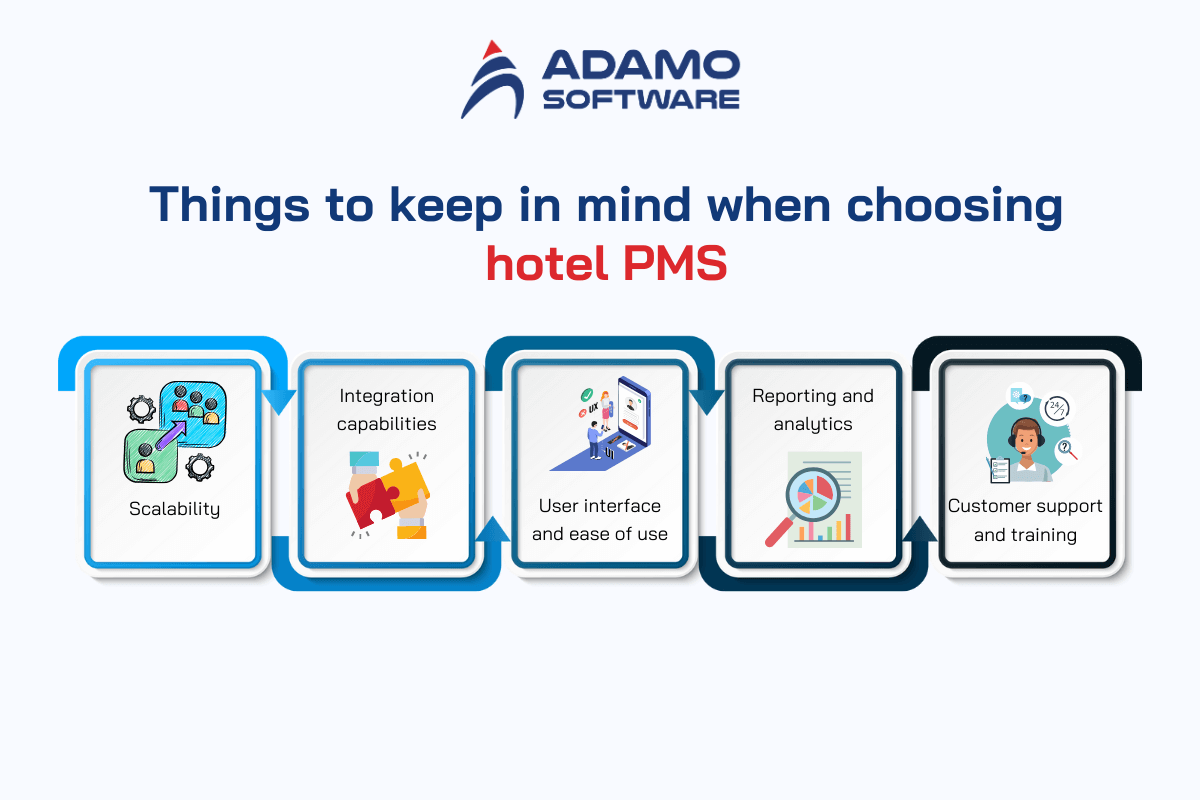
1. Scalability
– Make sure PMS development can grow with your hotel business, handling more properties and meeting higher operational demands as your business expands.
– Check out features such as multi-property management, channel management, rerouting of overbookings, and flexible pricing models that can easily adapt to your business expansion plans.
2. Integration capabilities
– Check if the PMS can easily work with other important systems like Online Travel Agencies (OTAs), and Revenue Management (CRM) tools (e.g., Salesforce).
– It’s important for APIs, hotel website integration, and middleware solutions to be strong so that data can flow smoothly, and operations can run effectively on various platforms.
3. User interface and ease of use
– Find a hotel property management system that has a user-friendly interface, making it easy for your hotel staff to use. This will save time on training and help prevent mistakes during day-to-day tasks.
– Features such as customizable dashboards, drag-and-drop functionality, and mobile compatibility can improve the usability and efficiency of a PMS.
4. Reporting and analytics
– Choose a PMS that offers detailed reporting and analytics features so you can easily keep tabs on important performance metrics like occupancy rates, RevPAR, and guest satisfaction scores.
– It’s important for PMS analytics tools to help you make data-driven decisions. Thus, you can spot trends, predict demand, and improve revenue strategies.
5. Customer support and training
– Assess the customer support provided by the PMS provider, such as the availability of round-the-clock assistance, dedicated channel managers, and online resources, to determine its quality and responsiveness.
– Training programs and documentation should be thorough, offering detailed guidance on PMS implementation, software maintenance management, updates, and troubleshooting to ensure smooth operations and minimize downtime.
III. Main factors that affect hospitality PMS development cost
You do already have acquired valuable insights into several well-known PMS available on the market and elements influencing hotel owners’ decisions on a suitable PMS. It is now time for your own PMS development. The initial inquiry pertains to the cost of hotel PMS.
Solid PMS development involves taking a comprehensive approach that includes different aspects to make it functional, scalable, and user-friendly. Let’s take a look at the costs involved and some real statistics to give you a better idea of the financial considerations:
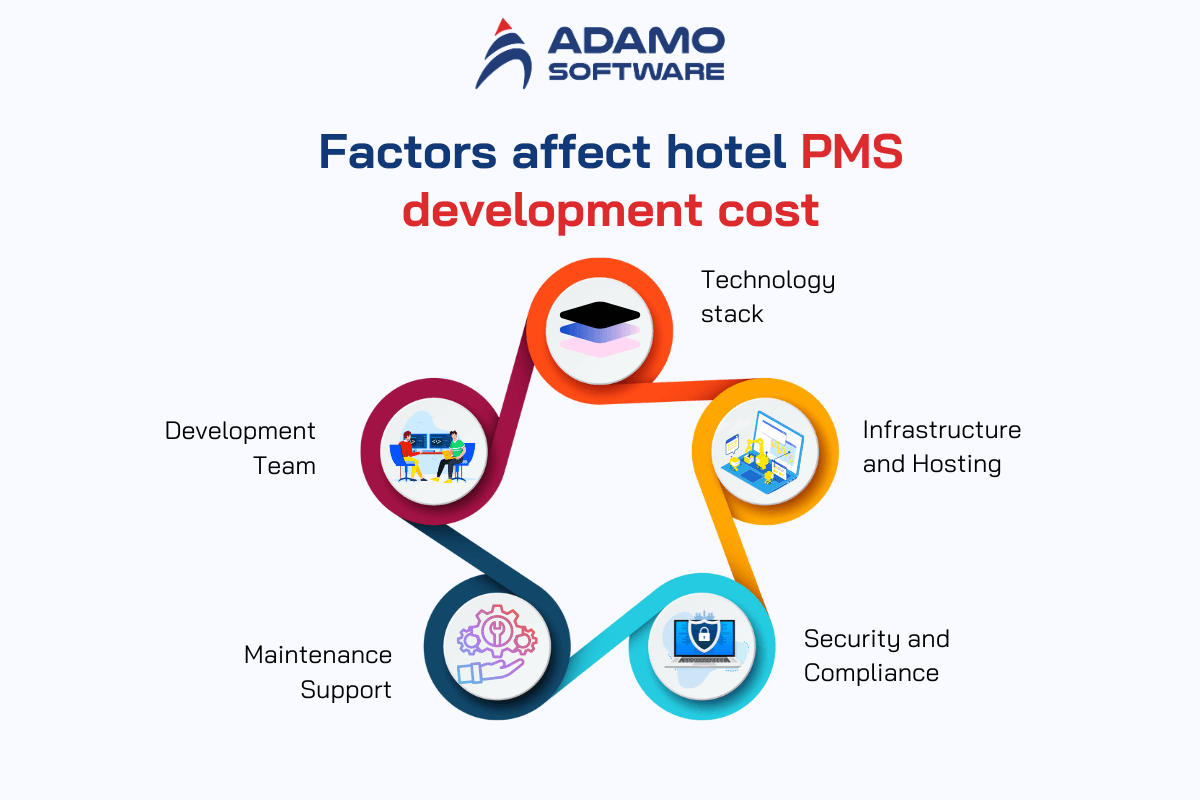
1. Development Team
Finding talented developers and engineers is a major cost in PMS development. The average cost of a developer in the USA can range from $75,000 to $150,000 per year, depending on their experience and expertise. However, you can cut down on these costs by considering a dedicated development team from Vietnam.
In order to create a complete PMS development solution, a development team usually includes front-end developers, back-end developers, UI/UX designers, quality assurance engineers, and project managers. The total yearly expense for a team like this can vary from $300,000 to $1,000,000, depending on the size of the team and where it’s located.
2. Technology Stack
The technology stack you choose can have a big impact on how much you’ll spend on development. Using popular frameworks and libraries like React.js for front-end development and Node.js for backend development can make PMS development processes more efficient and cost-effective.
There might be additional costs for using proprietary software or tools. The costs for these PMS development projects can vary from $10,000 to $50,000 per year, depending on the project’s complexity and the necessary tools.
3. Infrastructure and Hosting
Using cloud platforms such as Amazon Web Services (AWS), Microsoft Azure, or Google Cloud Platform (GCP) to host PMS software comes with monthly expenses that depend on usage and resource allocation.
The monthly hosting costs for a mid-sized PMS application can vary between $500 and $2,000. The final amount will depend on factors like server specifications, storage needs, and data transfer volume.
4. Security and Compliance
It’s important to have strong security measures and follow data protection regulations when it comes to PMS development, especially when dealing with sensitive project information.
The expenses for acquiring the required certifications, performing security audits, and setting up encryption protocols can vary from $20,000 to $100,000. The total cost depends on the desired level of security and compliance with regulatory standards.
5. Maintenance and Support
After the software is launched, it’s important to keep up with maintenance and support. This helps make sure everything runs smoothly, and any problems or updates are taken care of right away.
The yearly maintenance costs for a mid-sized PMS application usually fall between $45,000 and $250,000, which is about 15% to 25% of the initial PMS development cost.
IV. Return on Investment (ROI) of a Hotel PMS
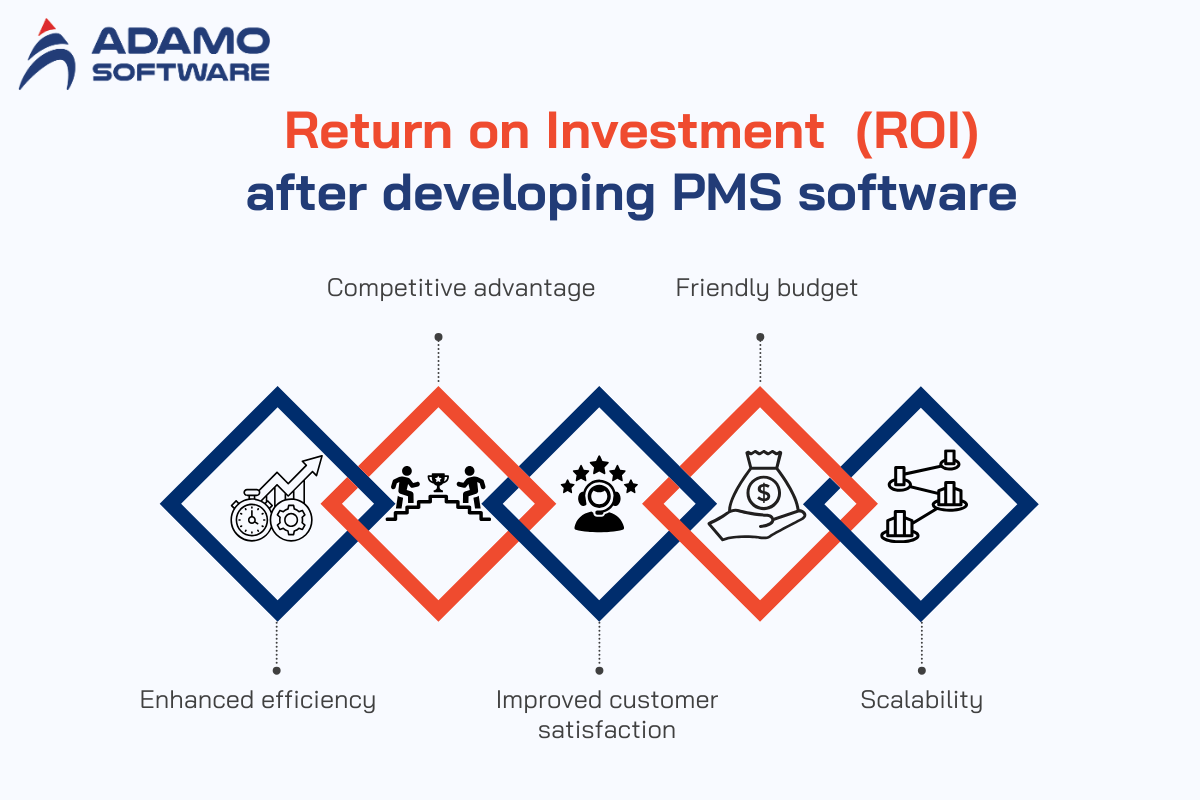
Once you invest in hotel PMS development, the next question is what it returns. The ROI of a hotel property management system comes from four levers: higher revenue per room, lower distribution cost, recovered staff hours, and stronger guest retention. Here is what the data shows.
1. Higher RevPAR through revenue management
The biggest revenue lever is dynamic pricing. Hotels that adopt a revenue management system report an average RevPAR increase of 7% to 20% (SiteMinder, 2026). When the RMS is integrated with the PMS, rates adjust from real-time demand instead of static seasonal pricing. Accor, for example, recorded an 18.4% RevPAR increase after replacing manual methods with an RMS (SiteMinder, 2026).
2. Lower distribution cost through direct bookings
OTA commissions typically run 15% to 25% per reservation (industry data, 2026), so every booking shifted to a direct channel improves your net revenue. A PMS with an integrated booking engine and channel manager makes that shift possible. For a 100-room hotel at 70% occupancy, moving just 20% of bookings from OTAs to direct can add more than USD 19,000 in annual net revenue without raising a single rate (SiteMinder, 2026).
3. Recovered staff hours and fewer errors
Automating reservations, check-in and check-out, housekeeping status, and billing removes manual work and the mistakes that come with it. 68% of hotels using a revenue management system report fewer pricing errors thanks to rule-based automation (SiteMinder, 2026). The same automation across the PMS frees front-desk and back-office staff to focus on guests rather than data entry.
4. Stronger guest retention and ancillary revenue
A PMS with CRM and loyalty features turns one-time guests into repeat ones, which is where long-term ROI compounds. Loyalty members spend 22.4% more and stay 28% longer than non-members (Revinate, 2025), and they accounted for 52.8% of occupied rooms in 2024 (CBRE, 2025). An integrated POS also captures restaurant, bar, and spa revenue that otherwise leaks off the guest folio.
5. Scalability without proportional cost
A well-built hotel PMS lets you add properties, rooms, and channels without a matching rise in headcount. That operating leverage is the core reason a custom system pays back over a packaged one as your portfolio grows, since you are not re-buying per-seat licenses for every new location.
V. How to choose the right PMS development company
No worries if you’ve checked out all the software solutions out there and haven’t found the perfect hotel PMS for your business. If you ever need a custom PMS built for the hotel industry, consider a dedicated hotel property management system development partner.So, how can I go about finding a trustworthy property management system development company? Here are some tips to keep in mind:
– Define the technical and functional requirements for the hotel PMS development.
– Determine the scope of your project and allocate your budget for hotel PMS development, considering the rates of offshore software development.
– Choose an appropriate pricing model for software development and commence collaboration.
Consequently, the most appropriate vendor for the development of your hotel application will be identified through a comprehensive evaluation of the hotel PMS development candidates and a precise articulation of your requirements.
VI. Why Choose Adamo Software to build the top hotel PMS software for your business?
Consider Adamo Software to be the most suitable vendor for travel and hospitality software development. Our agency has a distinguished reputation and has successfully completed many projects in these sectors, demonstrating its verified expertise.
We assure the development of GDPR-compliant PMS hotel software and compliance with ISO-certified processes. Our committed team is capable of bringing any of your concepts to fruition:
– Travel Portal Development
– Booking Engines
– Property Management System
– Travel Agent Software
– Travel Distribution Solutions
Adamo provides subscription-based services for PMS development in hotels. Our experts possess a wealth of knowledge regarding hotel PMS. Moreover, they are well-versed in the complexities of these platforms, having accumulated a significant amount of experience in this field. Therefore, please contact us to start your PMS development.

 adamosoft.com
 (+84) 373 11 44 88