

Medical Tourism App: A full guide on the game-changer in healthcare
Today, we live in an interconnected world, and healthcare is soaring fast, especially where the medical tourism apps are rising. These innovative tools make it simple for patients to learn about hospitals, doctors, costs, and travel when looking for overseas treatment.
More people are seeking high-quality care at competitive prices, which makes navigating this new landscape become more important than ever. In this guide, we will discuss the benefits and challenges of medical tourism apps, as well as providing their cost breakdown.
This guide will give you the power to make informed healthcare decisions, no matter if you’re considering elective surgery abroad or wellness treatments.
Key Takeaways:
- The global medical tourism market hit USD 34 billion in 2025 and is forecast to reach USD 126.2 billion by 2035 at 14.1% CAGR, with Thailand alone capturing 24.4% of global market share (Grand View Research, 2025).
- Medical tourism apps differ structurally from general telehealth apps: they must handle cross-border identity verification, multi-currency pricing, visa coordination, and care continuity across two regulatory jurisdictions.
- Two operator models drive build decisions: hospital-led apps prioritise EMR integration and direct patient acquisition; facilitator-led apps prioritise catalogue breadth, commission flows, and CRM-grade lead nurturing.
- The features that determine conversion are verifiable accreditation data (JCI, NABH, DHA), bundled package transparency (a USD 17,500 surgery quote often excludes USD 8,000 of bundled costs), multi-stage booking integrated with GDS and accommodation APIs, and post-treatment continuity that most apps skip in early versions.
- Compliance scope is the largest cost driver: HIPAA for US-bound patients, GDPR for EU flows, and country-specific regimes such as DHA must be designed in from the architecture stage, not bolted on later.
- Adamo Software builds medical tourism platforms combining healthcare engineering (telehealth, multi-role clinical workflows under DHA compliance) and travel software engineering (GDS integration, dynamic packaging), a dual-domain capability that few vendors offer in-house.
I. What is a medical tourism app? Understand the definition
1. The medical tourism market: Size, growth, and what it means for app demand
The global medical tourism market was valued at USD 34.0 billion in 2025 and is projected to reach USD 126.2 billion by 2035, growing at a CAGR of 14.1% (Grand View Research, 2025). Thailand alone captured 24.4% of the global market share in 2024, followed by India, Mexico, Malaysia, and Turkey as the top destinations for cross-border care.
This growth has a direct consequence for software demand. A patient evaluating a heart bypass in India or a dental implant in Costa Rica now compares providers across countries, currencies, and regulatory jurisdictions before booking. The decision involves clinical credentials, total cost (treatment plus travel plus recovery accommodation), visa requirements, language compatibility, and post-treatment follow-up logistics. A search engine cannot consolidate this. A travel agent cannot manage it. A medical tourism app is the only interface that can.
For hospitals and medical tourism facilitators, the equation is simpler: cosmetic procedures account for 24.2% of all medical tourism revenue, dental and orthopedic treatments follow closely (Grand View Research, 2025), and inbound patient acquisition is increasingly digital-first. Without a dedicated app, providers compete on aggregator listings where margins compress and patient relationships belong to the platform, not the hospital.
2. What is a medical tourism app? A working definition
A medical tourism app is a multi-sided digital platform that connects three core participants: patients seeking treatment abroad, accredited healthcare providers in destination countries, and the travel and logistics services that bridge them. Unlike general telehealth apps, which serve patients within one regulatory jurisdiction, medical tourism platforms must handle cross-border identity verification, multi-currency pricing, treatment package comparison across hospitals, visa and travel coordination, and continuity of care from pre-departure consultation through post-treatment recovery in the patient’s home country.
The functional scope sits at the intersection of three software categories: a healthcare booking platform (appointment scheduling, doctor matching, medical record exchange), a travel booking engine (flights, accommodation, ground transport, visa support), and a patient relationship management system (multi-channel communication, post-treatment monitoring, billing in multiple currencies).
3. Who builds medical tourism apps, and why does the build approach matter?
Two operator types dominate the market. The first is the hospital-led app, owned by a single accredited provider such as Apollo Hospitals or Bumrungrad International, designed to drive direct international patient acquisition and reduce facilitator commissions that typically range from 10% to 25% of treatment cost. The second is the facilitator-led app, operated by a medical tourism agency that aggregates multiple providers, monetises through commission, and competes on package depth and concierge service.
The two models have different technical priorities. A hospital app prioritises integration with existing hospital information systems, EMR interoperability, and clinical workflow accuracy. A facilitator app prioritises catalogue breadth, real-time pricing comparison, and CRM-grade lead nurturing. Understanding which model you are building is the first architecture decision, and it determines almost every choice that follows, from the database schema to the regulatory compliance scope.
II. Core features that determine whether a medical tourism app converts
A medical tourism app is not a feature checklist exercise. Most apps that fail in this category fail because they were built as generic appointment-booking tools with a few translation overlays bolted on. The features below are the ones that determine whether a patient completes a booking or drops off at the comparison stage.
1. Provider directory with verifiable accreditation data
Patients evaluating cross-border care do not trust marketing copy. They trust accreditation bodies, in particular the Joint Commission International (JCI), which accredits more than 1,000 hospitals across 70 countries, along with country-specific equivalents such as the National Accreditation Board for Hospitals (NABH) in India and the Dubai Health Authority (DHA) for UAE-based providers.
A provider directory must surface this accreditation prominently, link to the certifying body’s public registry for verification, and display doctor-level credentials including medical board registration, years of specialisation, and procedure-specific case volume. Apps that hide this data behind paywalls or vague claims see drop-off rates above 60% at the provider profile stage. Apps that surface verifiable third-party credentials in the first scroll perform substantially better.
2. Treatment cost comparison with bundled package transparency
The single largest driver of medical tourism is cost. A heart valve replacement costs USD 170,000 in the United States, USD 35,000 in India, and USD 17,500 in Thailand for the same clinical outcome. Patients want this comparison visible, but they want it accurate.
Effective cost comparison requires three layers. The first is procedure pricing in the local currency of the provider. The second is real-time conversion to the patient’s home currency, refreshed at least daily through a currency API such as Open Exchange Rates or Fixer. The third, and most overlooked, is bundled package transparency: a USD 17,500 surgery quote in Bangkok may not include the pre-surgical workup, the five-night hospital stay, the seven-night recovery accommodation, the airport transfers, or the post-discharge follow-up consultations. Apps that present the full bundled cost upfront convert better than those that surface a low headline figure and add fees during booking.
3. Multi-stage booking flow with travel coordination
A medical tourism booking is not a single transaction. It is a sequence: initial consultation request, medical record submission, doctor review and treatment plan, deposit payment, visa support documentation, flight and accommodation booking, on-arrival reception, treatment, and follow-up scheduling. Each stage has different stakeholders and different data requirements.
The app architecture must support this multi-stage flow without forcing the patient to restart at each step. Saved-state booking, integrated document upload, and clear stage-by-stage status visibility are foundational. Integration with travel APIs such as Amadeus or Sabre for flights and Booking.com or Expedia Partner Solutions for accommodation allows the app to present a complete itinerary within a single checkout, which is a meaningful conversion lever.
4. Secure communication with telemedicine pre-departure
Most medical tourism patients want to speak to their treating doctor before flying. This is a clinical safety requirement (the doctor needs to confirm the patient is a viable candidate for the procedure) and a trust-building requirement (the patient needs to confirm they are comfortable with the doctor).
The communication layer must support asynchronous secure messaging for routine questions, file exchange for medical record review, and synchronous video consultation for the pre-departure assessment. The video stack should be HIPAA-compliant for US-bound patient flows and GDPR-compliant for EU patient flows. Build options range from licensed components such as Twilio Video and Vonage Video API to open-source WebRTC stacks for cost-sensitive operators. The decision is a trade-off between development time, ongoing licensing cost, and the compliance audit burden.
5. Multi-currency, multi-jurisdiction payment infrastructure
Payment is where many medical tourism apps lose patients in the final stage of conversion. A patient in the United States paying a Thai hospital is dealing with two banking systems, currency conversion, and potentially a deposit-now, balance-on-arrival structure. The app must support split payments (deposit through the app, balance through the hospital’s local merchant account), multi-currency settlement, refund workflows for cancelled bookings, and clear receipt generation for insurance reimbursement claims where applicable.
Stripe Connect and Adyen MarketPay handle the multi-party flows well for facilitator apps. Hospital-led apps with simpler single-merchant flows may use a regional payment gateway with lower per-transaction costs. Compliance with PCI DSS Level 1 is non-negotiable.
6. Post-treatment continuity of care
The patient journey does not end at discharge. A patient flying home after surgery in Bangkok needs continued monitoring, prescription management, and access to the treating doctor for follow-up questions. This is the feature category most often skipped in early app versions, and it is also the one that determines whether a patient returns for future treatment and refers others.
Continuity of care features include digital discharge summaries shared with the patient’s home-country GP, follow-up appointment scheduling (either virtually through the same app or via referral to a local provider), prescription tracking, and a clear escalation path for post-discharge complications. Apps that handle this well develop strong word-of-mouth referral loops, which lower customer acquisition cost over time.
Also read: Medical tourism CRM: What is it, key features and who should use
III. Some challenges that medical travel app developers have to cope with
Medical travel apps are an emerging solution to the problem of patients searching for affordable, accessible, and quality healthcare beyond their home countries. These apps aim to make it easier for you to participate in medical tourism right from the start. From finding the best hospitals and doctors, booking flights and a place to live, to arranging post-treatment care and follow-ups. However, many difficulties and risks are involved in developing and launching a successful medical travel app.
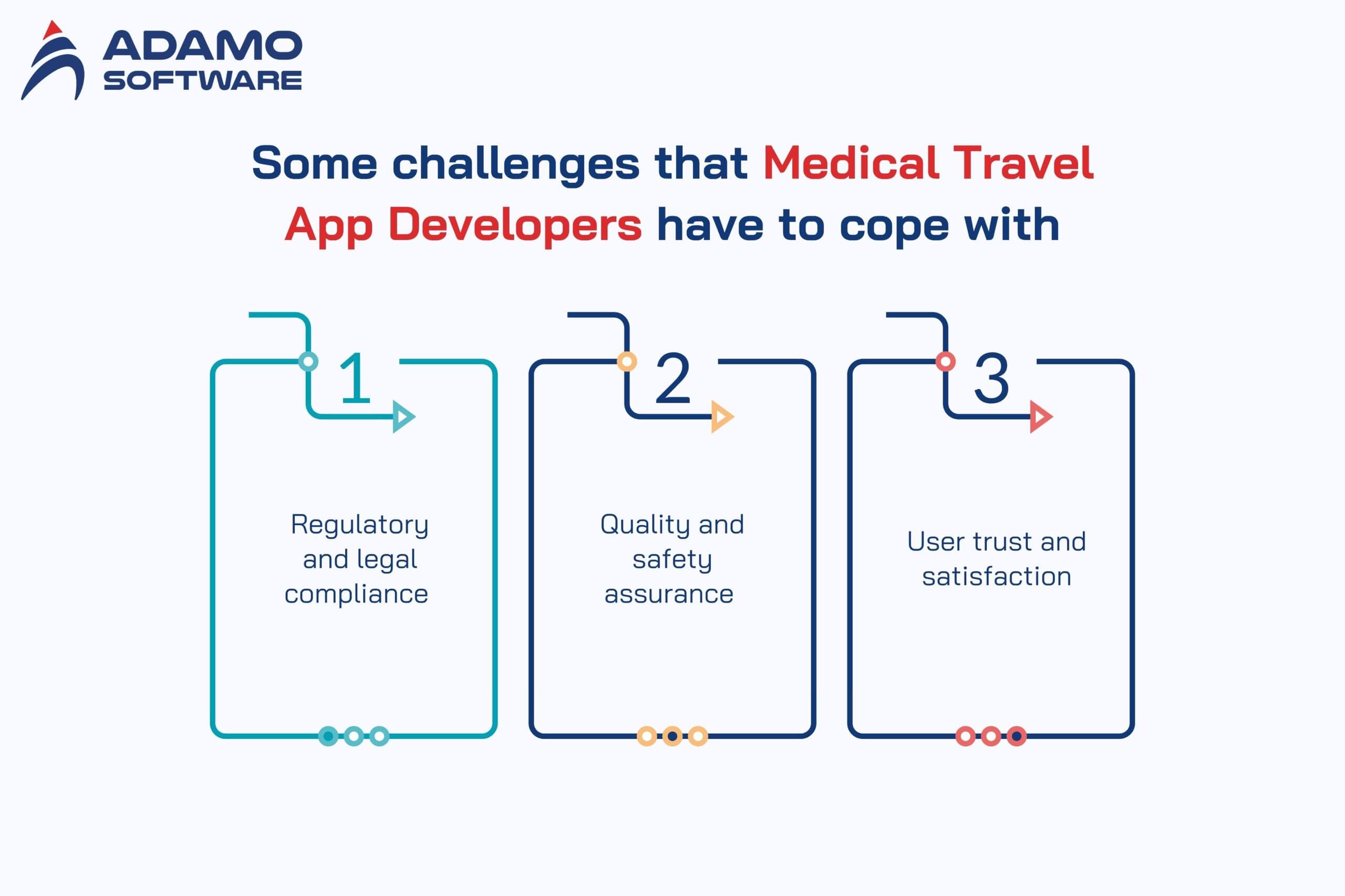
Here are a few challenges that developers of medical travel apps must address:
1. Regulatory and legal compliance
A medical travel app developer must consider many aspects because it regards not only national laws and regulations but also international ones. These include data protection, privacy, security, taxation, licensing & accreditation, insurance, etc. These regulations vary widely and change often, making it difficult for developers to stay current with compliance.
An example would be the European Union’s General Data Protection Regulation (GDPR). It requires very tight rules for data collection, data processing, and transfer of data within the EU area. This may influence how medical travel apps handle personal data and medical records of patients.
2. Quality and safety assurance
Medical travel apps must ensure their services and facilities meet high quality and safety standards that align with user expectations. This requires in-depth research, validation, and assessment of the hospitals, clinics, and the healthcare professionals they work with. Besides, developers need to present clear and honest information and reviews for users.
A good example of a good quality indicator is the Joint Commission International (JCI). It accredits hospitals in all parts of the world and functions as a standard for medical quality and safety in the medical travel sector.
3. User trust and satisfaction
Measuring and growing our medical travel app for user trust and satisfaction is crucial for reaching our growth and retention goals. Developers should focus on delivering exceptional customer service and a great user experience. They should also ensure a strong value proposition while addressing issues or complaints as they arise.
IV. Adamo Software’s approach to medical tourism app development
Adamo Software builds custom software across two domains directly relevant to medical tourism platforms: healthcare technology and travel and hospitality systems. Cross-border patient platforms sit at the intersection, which is where our project experience compounds.
1. Healthcare experience that maps to medical tourism requirements
Our healthcare portfolio includes telehealth platforms with multi-role workflows, AI-assisted clinical tools, and operations data pipelines for healthcare clients in the United States, Australia, the United Kingdom, and the UAE. The technical patterns that medical tourism apps require, including multi-role permission systems linking patients to doctors to administrators, secure document exchange for medical records, video consultation infrastructure with regulatory compliance, and audit-grade logging for clinical decisions, are the same patterns we have built in production for clients such as ZenDXB (an at-home testing and telehealth platform operating under Dubai Health Authority compliance) and confidential telehealth platforms serving cross-border medico-legal assessment workflows.
The DHA compliance work for ZenDXB is particularly relevant. Medical tourism platforms must handle regulatory frameworks across multiple jurisdictions simultaneously, which is fundamentally the same architecture problem as building one platform that satisfies one regional health authority. The toolset, separation of patient data residency, configurable consent workflows, jurisdiction-specific audit logs, generalises directly to medical tourism use cases.
2. Travel software experience that handles the booking and logistics layer
The travel side of a medical tourism app, treatment package booking, flight and accommodation coordination, visa support workflows, and ground transport scheduling, draws on the same engineering as the travel booking platforms we build for tour operators and online travel agencies. Integration with GDS systems, real-time inventory availability, multi-currency pricing, and dynamic packaging are features our travel team has shipped repeatedly.
Few software vendors have both domain stacks in-house. Most healthcare software firms cannot handle the GDS integration and dynamic packaging side. Most travel software firms cannot handle the HIPAA, GDPR, and clinical workflow side. Adamo’s dual-domain capability is structural to the company, not a recent addition, and it is the reason medical tourism operators considering a custom build typically shortlist vendors with combined experience.
3. What a medical tourism app build with Adamo looks like
A typical engagement begins with a four-to-six-week discovery phase: regulatory scope (which patient origin countries and which destination countries trigger which compliance regimes), provider onboarding model (hospital-led versus facilitator-led, which determines the database schema and the commission model), and core feature prioritisation against a realistic MVP budget.
Development follows in two-week sprints with a dedicated team that typically includes a project manager, business analyst, mobile developers (React Native is our default for cross-platform medical tourism builds, with native Swift or Kotlin for performance-critical modules), backend developers (Node.js, Laravel, or Python depending on the integration surface), a QA lead, and a DevOps engineer. Compliance review and penetration testing are scheduled as gates, not as afterthoughts.
We work under engagement models including fixed-scope MVP delivery, ongoing dedicated development teams for operators building toward platform scale, and staff augmentation for in-house teams that need specialist healthcare or travel engineering capacity. Project details for healthcare and travel platforms are protected under client NDAs, but our team can walk through anonymised architecture decisions, compliance patterns, and feature implementation specifics in a discovery call.
V. Estimated cost breakdown for medical tourism app development
Creating a medical tourism app is a process that comprises many phases, and each phase has a scope of work and associated costs. Every stage of planning, design, development, testing, and post-launch maintenance contributes to a seamless user experience. The table below breaks down the key cost components and estimated ranges for each.
| Cost Component | Details | Estimated Cost |
| Initial Consultation and Planning | Covers gathering project requirements, defining the scope, and initial planning activities. | $1,000 – $2,500 |
| Design and Prototyping | Creating user-friendly designs, wireframes, and prototypes to ensure a smooth user experience. | $3,000 – $5,000 |
| App Development | Building essential app features like booking systems, user directories, and account management. | $10,000 – $25,000 |
| Backend Development | Developing server-side functionalities, ensuring data security, and integrating with healthcare systems. | $5,000 – $12,000 |
| Testing and Quality Assurance | Performing thorough testing to guarantee app reliability, performance, and security. | $2,000 – $4,000 |
| Deployment and Launch | Final preparations for app release, including app store submissions and deployment. | $1,000 – $2,000 |
| Ongoing Maintenance and Support | Providing continuous updates, bug fixes, and technical support after the app goes live. | $1,000 – $3,000 per year |
These are just estimates; the actual costs can differ based on a software company’s location. To name a few, outsourcing work to Asia, especially Vietnam, is cheaper than hiring teams in Europe or North America. The right region can make a difference to your budget without sacrificing quality.
VI. Consider Adamo as your trusted partner for custom medical travel software development

Adamo Software can be considered as your trusted app development partner for custom medical tourism. We have the experience in healthcare technology to develop tailor-made solutions for your healthcare technology. We know how tricky medical travel can be and have features that help patients and make busy lives easier.
Our medical tourism app helps you manage bookings, monitor patient interactions, and communicate better. Adamo is committed to data security while protecting sensitive information throughout the process.
If you choose us, you can improve your medical tourism services and stay competitive. For more information regarding medical tourism app development, contact Adamo today!
FAQs
1. Why is investing in a medical tourism app a smart move?
Investing in a medical tourism app simplifies the journey for patients seeking treatment abroad. This increases customer satisfaction and expands your business’s reach. It offers an all-in-one solution for managing medical travel effectively.
2. What essential features should a medical tourism app have?
Features include appointment booking, health care provider directories, travel and accommodations planning, secure messaging, multilingual, and instant notifications.
3. How long does it take to create a medical tourism app?
Its complexity and requirements depend on the development timeline. Building a fully functional medical tourism app takes 3 to 6 months.
4. Which platforms should my medical tourism app support?
To maximize user accessibility, it’s a good idea to develop your medical tourism app to be available for both the iOS and Android platforms. This will assist you in reaching the maximum number of individuals possible.
5. How can I secure patient data in a medical tourism app?
Security in protecting patient data is based on things like encryption, secured logins, and following data protection standards (for example, GDPR or HIPAA).
6. Can a medical tourism app be tailored to my business needs?
Absolutely! Medical tourism apps can be tailored completely to suit your business’s unique needs, including app features, branding, and integration with existing systems.
7. What makes a user-friendly design essential for a medical tourism application?
A good start is a user-friendly design that makes navigation easy and allows easy access to major features. This generally provides a good user experience, which leads to higher engagement and happier users.
8. How do I effectively market my medical tourism app?
Promotion is a must for any app. Tools like SEO optimization, social media campaigns, partnerships with providers, and targeted ads help promote your app so you can find the right audience.
9. Can the medical tourism app connect with healthcare systems?
The app can be integrated directly into the existing healthcare systems, allowing secure communication between patients and medical providers. It also helps manage bookings and keep track of recent updates.
10. What ongoing maintenance does a medical tourism app require?
It’ll require ongoing maintenance, which means frequent updates to fix bugs, and monitor performance. This helps ensure your app is always on top of technology and user desires.
11. How do I incorporate multilingual support into a medical tourism app?
The app needs to cater to global users by providing language options and ensuring high-quality translations. Additionally, it should localize the content to meet the needs of users from many different regions.
12. What support is available after the medical tourism app goes live?
Post-launch support includes technical assistance, troubleshooting, regular updates, and adding enhancements based on user feedback and evolving business requirements.
13. How can I measure the performance and engagement of my medical tourism app?
Track app performance, monitor the activity of users that you have, and engage the users you have with analytics tools. They indicate areas that need improvement and how marketing strategies can be optimized.
14. Can new features be added to the medical tourism app after launch?
Sure enough, you can add new features post-launch based on user feedback and changing business needs. Updates to the app are regular to keep it up-to-date and functional.
15. What benefits does a medical tourism app offer?
The medical tourism app makes it easy for patients to schedule appointments, better manage patients, enhance communication, and easily access healthcare information and travel logistics.
16. Can payment processing be integrated into the medical tourism app?
Absolutely! The transaction can be built into the app to handle payments securely. This will allow purchases for medical treatments, travel arrangements, and other expenses to be managed effectively.
17. How do I ensure my medical tourism app complies with medical regulations?
You need to keep updated with relevant medical and data regulations, employ legal experts, and add compliant components, such as HIPAA or GDPR.
18. What factors should I take into account when selecting a development partner for a medical tourism application?
When searching for a development partner, look for someone who has experience with medical tourism apps and a solid portfolio. It’s essential that they know how to build secure, compliant products and deliver high-quality, user-focused solutions.

 adamosoft.com
 (+84) 373 11 44 88