

Travel Booking Software: 9 costly development mistakes and how to avoid

In today’s digital market, travel agencies and tour operators increasingly want their own travel booking software to automate bookings, filter accommodations and tour packages, improve customer satisfaction, and optimize revenue. The stakes are high: the global online travel market was valued at over 700 billion U.S. dollars in 2025 (Statista, 2025), and online channels generate more than 70% of travel and tourism revenue. But when building this software, businesses can make costly mistakes that slow development and weaken the product. This guide covers the benefits of getting travel booking software right, then the 9 most common development mistakes and how to avoid them.
Key Takeaway:
- Travel booking software automates reservations, payments, and upselling, letting agencies and tour operators run 24/7 without manual processes.
- The global online travel market was valued at over 700 billion U.S. dollars in 2025 (Statista, 2025), with online channels generating more than 70% of travel revenue, making a reliable booking platform essential.
- The most common development mistakes include poor UX, thin functionality, outdated data, a complex booking flow, weak security, and ignoring mobile, where 63% of online travel bookings now happen (TravelPerk, 2025).
- Avoiding these starts with discovery workshops and MVP planning, then a dedicated team or specialized travel-tech partner experienced in GDS, PMS, and OTA integration.
- Security and compliance (GDPR, PCI-DSS) must be built in from day one, not bolted on later.
I. Why getting travel booking software right matters
For a travel agency, the right software streamlines operations, reduces cancellations, and improves resource and schedule management. That lets you meet demand, boost customer satisfaction, attract repeat customers, and scale without the stress of manual processes. Here is what a well-built platform delivers:
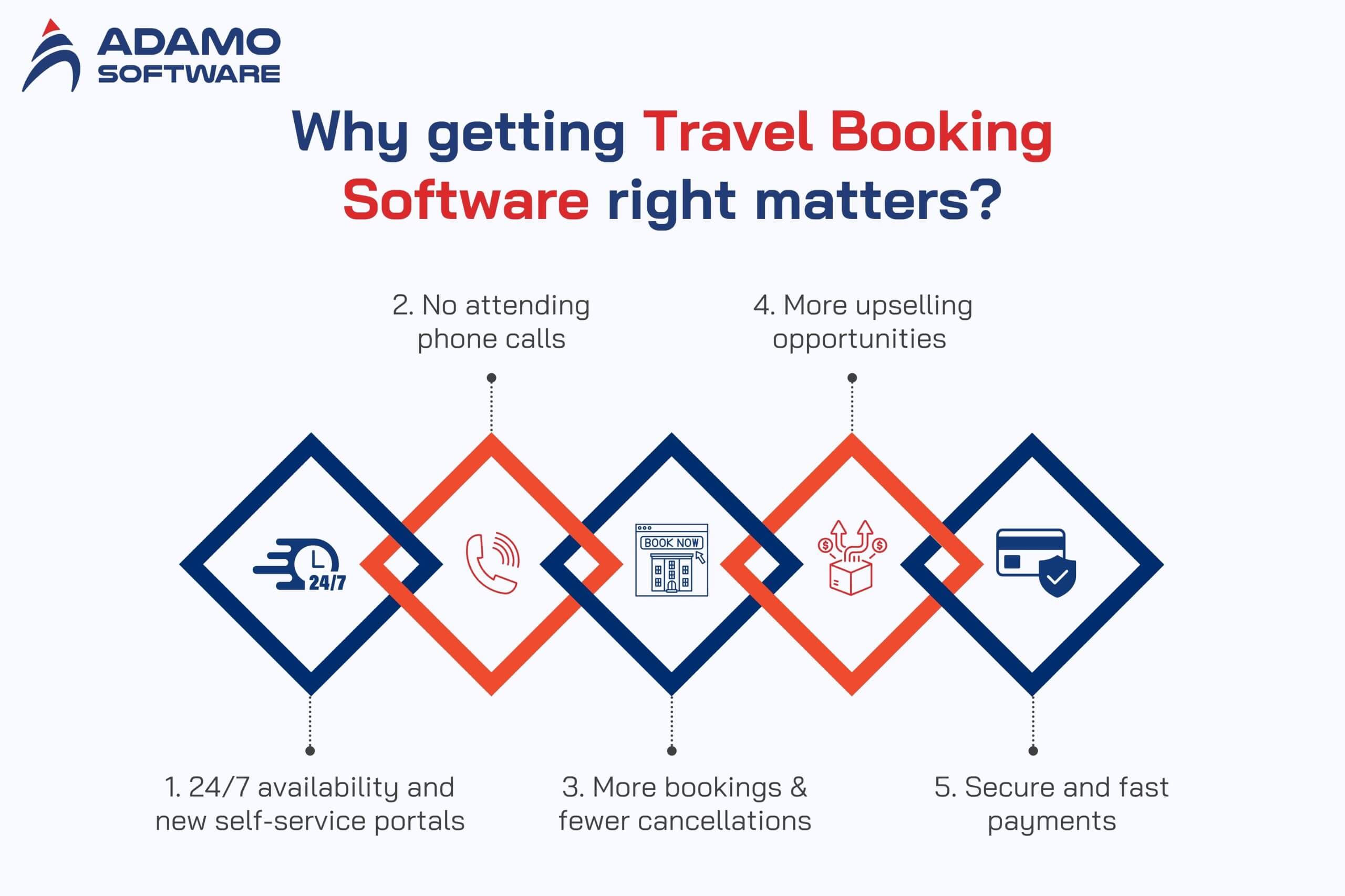
- 24/7 availability and self-service: A reliable online booking system keeps your business accessible around the clock. Self-service portals let customers search, book, and pay without staff support, improving experience and reducing pressure on employees.
- Fewer phone calls: Customers get real-time access to availability, rates, timings, and dates, so they self-serve instead of calling, which also cuts errors from phone conversations.
- More bookings, fewer cancellations: A clear, transparent booking process with real-time availability and automated reminders helps customers decide accurately and show up, reducing wrong bookings and no-shows.
- More upselling: Smart suggestions automatically offer add-ons such as baggage, shuttle service, or travel insurance during booking, lifting revenue while tailoring the experience.
- Secure, fast payments: Partial or full deposits through a secure gateway, with cards, e-wallets, and bank transfers, protect customer data and shorten transaction time.
Together, self-service, secure payments, and upselling let a business grow sustainably without manual overhead. These capabilities usually sit on top of an online booking engine that powers real-time search and reservations.
Ready to Outsource?
Discover how we can transform your business with expert IT solutions.
II. 9 common mistakes in travel booking software development
Building travel booking software is not easy. The mistakes below hurt performance, security, and scalability, and they are the ones teams make most often.
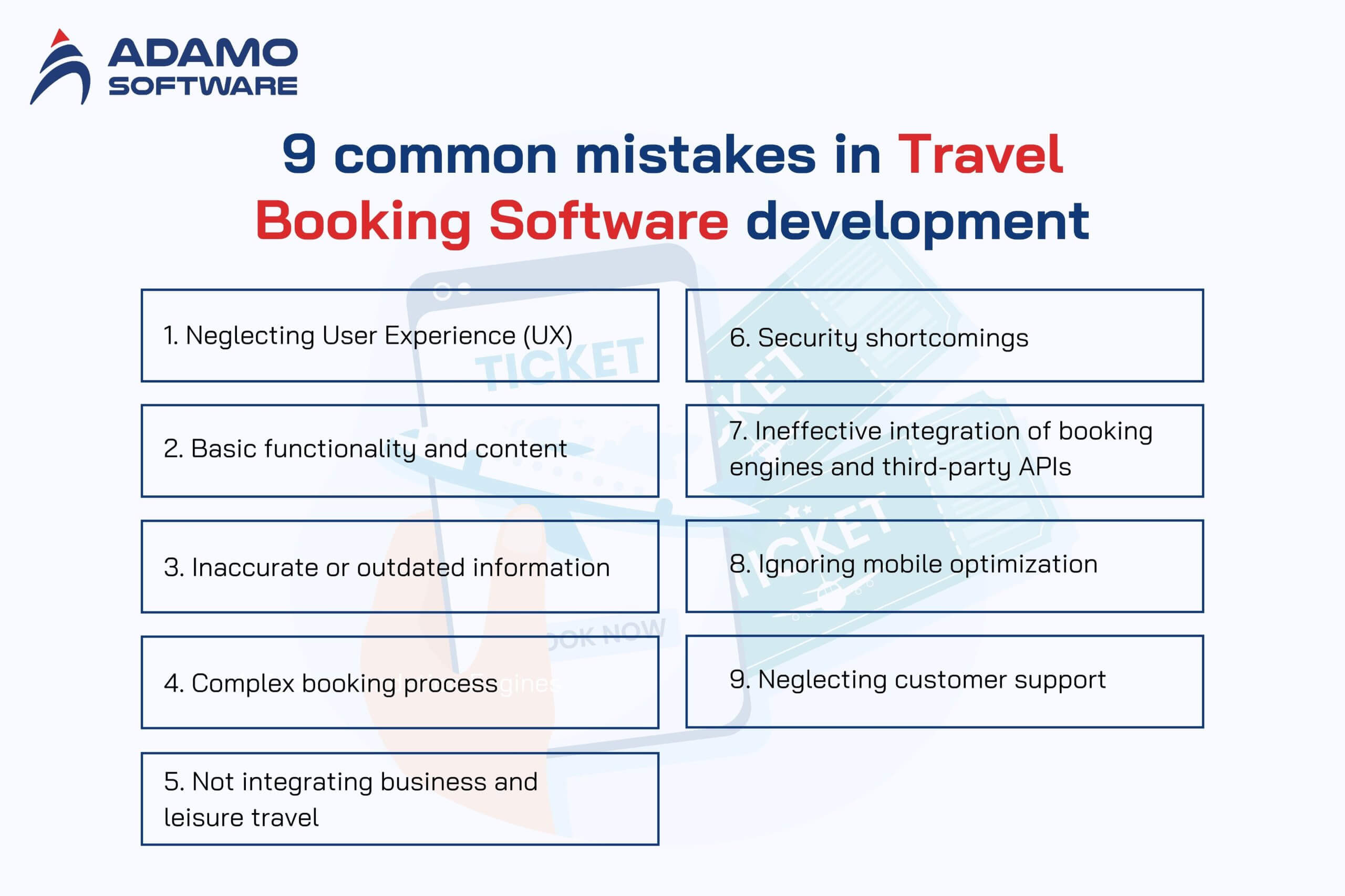
1. Neglecting user experience (UX)
If the interface is too complex or hard to search, customers leave before they see what you offer. Prioritize intuitive navigation, clear search filters, and a clean design that works on both desktop and mobile, so customers find what they need quickly. A seamless experience raises booking success rates and rebooking.
2. Thin functionality and content
Software that only shows basic information (destination, fare, time) makes it hard for customers to decide. Move beyond basic search by combining hotels, car rentals, tours, and activities into a one-stop experience, with advanced filtering, combo booking, and personalized recommendations that drive conversions and loyalty.
3. Inaccurate or outdated information
If fares, availability, departure times, or policies are not updated in real time, customers make wrong decisions and hit problems after booking, which leads to cancellations and lost trust. Connect your software to real-time supplier data, and integrate reliable GDS integration or supplier APIs to keep availability, pricing, and descriptions accurate.
4. A complex booking process
When customers must enter information repeatedly or face unnecessary steps, they get confused and abandon the booking. Make the flow shorter, ask for less, and provide more information upfront, then keep iterating to stay responsive and current.
5. Not integrating business and leisure travel
Without combined business and leisure (bleisure) support, customers juggle separate platforms for work and personal trips, which fragments the experience and loses business users who increasingly blend the two. Let customers separate business and leisure activities within one booking flow, and suggest leisure packages that fit a business itinerary.
6. Security shortcomings
Travel booking software handles sensitive data: personal details, passport information, itineraries, and payment data. If this is not properly secured, it can be exposed to breaches, cyber-attacks, or fraud. Build security in from the start and review and update the system regularly to keep data safe.
7. Ineffective booking engine and third-party API integration
When data, prices, or availability are not synced in real time, the result is inaccurate content and a poor experience, and API conflicts can cause outages. Integrating APIs without testing scalability and future compatibility leads to software that is hard to upgrade or needs a rebuild. Partner with a team experienced in booking engine and travel API integration.
8. Ignoring mobile optimization
If the mobile interface is clunky, slow, or complicated, customers switch to a competitor. This matters more than ever: 63% of online travel bookings now happen on mobile (TravelPerk, 2025). Ensure fast responsiveness across screens, a simple payment process, mobile notifications, and app integration.
9. Neglecting customer support
Without clear support channels such as live chat, hotline, email, or a help center, frustrated customers move to another provider. Build accessible support into the product so issues are resolved quickly.
III. How to avoid these mistakes: solutions that work
Each mistake has its own fix, but they share a few common practices.
Discovery workshops and MVP planning
Before any code is written, align business goals with the technical roadmap to avoid scope creep, technical debt, and delays. Research your target customers’ booking behavior, focus the MVP on essentials (real-time availability, multi-currency, dynamic pricing, OTA integrations), and validate user journeys early with wireframes and clickable prototypes.
Find a dedicated development team
Instead of a single freelancer, a dedicated development team gives you consistent support, deep domain knowledge, and focused effort. The team learns your back-end logic and the travel industry’s booking flows, and keeps improving performance over the long term, which suits startups especially well.
Partner with a specialized travel-tech firm
Outsourcing to a specialized travel booking software development company cuts cost, accelerates time to market, and improves code quality. Such firms bring expertise in GDS, PMS, OTA, and meta-search integration, handle complex booking flows, and build custom software on a scalable stack (for example React, Node.js, PHP Laravel, AWS) across desktop and mobile. Adamo Software has delivered custom travel booking platforms to clients across Australia, Europe, and Asia, with dedicated teams that adapt and scale as needed.
Follow agile development and continuous testing
Split the project into short phases to check progress and adjust, and invite stakeholders to review after each sprint. Automating functional, performance, and cross-device testing catches errors early, shortens time to market, and reduces long-term maintenance cost.
Prioritize security and compliance from day one
Integrate security standards such as HTTPS, data encryption, and secure authentication, and comply with regulations such as GDPR, PCI-DSS, and CCPA to protect customer information from the start rather than as an afterthought.
IV. Final thoughts
Building travel booking software takes serious investment in both strategy and implementation. Identifying and handling these nine mistakes early prevents costly rework later. Partnering with an experienced team like Adamo Software helps you build optimal, safe, and market-relevant software. Here is how Adamo can help:

- Analysis and solution advisory: Based on your business model, Adamo identifies core features and an effective development roadmap.
- User-friendly interface and UX: Design that increases successful bookings and retains customers.
- Secure, high-performance systems: HTTPS, data encryption, secure authentication, and compliance with GDPR and PCI-DSS.
- Flexible API connections: Integration with airline, hotel, and payment APIs to expand services quickly and accurately.
- Long-term maintenance and upgrades: Keeping your software stable and ready to adapt to market changes.
FAQs
1. How long does it take to develop a full-featured travel platform?
It depends on project complexity and requirements. Depending on scope, a customized solution can typically go live within a few months, starting with an MVP and expanding in phases.
2. Which technology stack suits a scalable travel platform?
There is no single best answer. Common choices include Node.js or Python for the backend, React or Angular for the frontend, and AWS or GCP for cloud deployment.
3. Which regulations or compliance standards matter?
To protect customer and business data, a travel platform should comply with standards such as CCPA, GDPR, PCI-DSS, and SSL.
4. Can you build a travel platform without GDS integration?
Yes, but it may restrict access to some travel content and require more effort or direct supplier connections to secure inventory.
5. What happens if the software does not update information regularly?
Outdated or inaccurate prices, schedules, or availability can lead to complaints, cancellations, and loss of customer trust.

 adamosoft.com
 (+84) 373 11 44 88