
AI-powered Itinerary Planner: How to build one that travelers actually use

AI-powered itinerary planners drive 78% conversion among AI users. Learn how to build one with constraint solvers, LLM orchestration, and real-time inventory.
The single most consequential decision a traveler makes about their trip is no longer “where will I stay” or “which airline will I fly.” It is “who plans my itinerary.” For decades that decision split between traditional travel agents and self-directed research using OTA aggregators. In 2026, AI-powered itinerary planners have become the third option, and they are taking share faster than either incumbent expected.
The AI travel planner market is projected to triple from $5.2 billion in 2025 to $16.4 billion by 2033, growing at a 13.7% CAGR (HTF Market Intelligence, 2026). For travel companies building custom software, the question is not whether to build an AI-powered itinerary planner. It is how to build one that travelers will actually use, and what separates a planner that generates real bookings from one that produces beautiful but unbookable suggestions.
Key Takeaways:
- The AI travel planner market was valued at $5.2 billion in 2025 and is projected to reach $16.4 billion by 2033, growing at 13.7% CAGR (HTF Market Intelligence, 2026).
- 53% of travel technology leaders identify “digital assistance during booking” as the top gen AI use case, with itinerary planning at the core (Amadeus, 2025).
- A production AI-powered itinerary planner requires four components: LLM reasoning layer, structured inventory database, constraint solver for logistics validation, and personalization engine.
- Itinerary planners that generate logistically feasible plans (validated against real travel times, opening hours, and budget limits) outperform pure LLM-generated suggestions by a significant margin in user acceptance.
- 62% of millennials and Gen Z travelers already use generative AI for travel planning. The behavioral shift is here. The technical bar to capture them is rising.
What an AI-powered itinerary planner actually is
The term “AI itinerary planner” is now used to describe systems that range from a one-shot ChatGPT prompt to a fully integrated booking platform. These are not the same product. Understanding the distinction matters before you write a line of code.
Tier 1: Generic LLM with travel prompts. A user types their trip parameters into ChatGPT, Claude, or Gemini and gets a 5-day Bali itinerary in response. The output looks impressive. It often contains hallucinated details: a restaurant that does not exist, a temple closed on Mondays when the suggested visit is Monday, a hotel listed at a price that has not been accurate for six months. There is no booking layer. The traveler manually verifies each suggestion before acting on any of them.
Tier 2: Branded AI travel assistant. A travel platform integrates an LLM with its own product catalog. The output is grounded in real inventory: hotels the platform actually distributes, tours actually available, prices actually current. The user can browse and ask questions, but booking still happens through traditional flows.
Tier 3: AI-powered itinerary planner with end-to-end booking. The system generates a personalized, logistically feasible itinerary from a natural language description, validates every component against real availability and pricing, and lets the traveler book the entire trip within the conversation. This is the product that captures the share Tier 1 and Tier 2 cannot.
The difference between these tiers is not LLM quality. All three can use the same foundation model. The difference is the system around the LLM: the inventory connection, the constraint solver, the booking pipeline, the personalization layer. That system is where the engineering work lives, and it is what this guide covers.
The market signal: travelers are already shifting
40% of travelers worldwide have used AI-based tools to plan a trip (Statista, 2025). Among millennials and Gen Z in key markets, that figure rises to 62%. Among travelers who have actually used AI assistants for trip planning, 78% have booked travel based primarily on an AI recommendation, and 94% trust AI-generated recommendations at least as much as traditional sources (TakeUp, 2026).
The behavioral shift is not gradual. AI usage for travel planning doubled from 11% to 24% in 9 months between October 2024 and mid-2025 (Global Rescue, 2025), then climbed to 40% by year-end. The TakeUp 2026 report describes this as “early-stage behavior change right before it scales.” Once travelers experience an AI-powered itinerary planner that produces feasible, bookable plans, they tell others. Adoption compounds.
For travel companies, the implication is sharp: AI-powered itinerary planning is becoming the default user expectation, not a differentiator. The question is whether your platform will offer one travelers prefer over generic ChatGPT, or whether it will be the platform travelers leave when they realize ChatGPT can almost do the same thing.
The four-component architecture
A production-grade AI-powered itinerary planner consists of four interconnected components. Each one solves a problem the LLM alone cannot solve.
1. LLM reasoning layer
The LLM interprets the traveler’s natural language input (“5 days in central Vietnam for a family with one wheelchair user, mix of culture and beach, $120/day budget”), decomposes it into structured parameters, and generates the narrative itinerary in human-friendly prose.
The LLM is good at:
- Understanding ambiguous language (“somewhere relaxing” → quiet beach destinations, low-density activities)
- Maintaining coherent voice and reasoning across a multi-day plan
- Adapting recommendations based on conversational feedback
The LLM is bad at:
- Verifying that a restaurant is open on the day suggested
- Calculating whether a 9 AM museum visit and an 11 AM mountain hike are physically possible given travel times
- Tracking budget consumption across a multi-item plan
- Knowing what is actually in your inventory database
This is why the LLM cannot be the entire system. It is one component of four.
2. Structured inventory database
Every recommendation in the itinerary must come from a real, queryable inventory. This is not negotiable. The inventory layer includes hotels (with current pricing, availability, amenities), tours and activities (with operator schedules, pricing, capacity), restaurants (with cuisine type, price tier, location, hours), and transport options (flights, trains, transfers, with schedules and pricing).
The inventory database is not a static list. It is connected to live sources via API: the property’s booking engine, GDS providers (Amadeus, Sabre), tour aggregators (Viator, GetYourGuide), and restaurant data sources. For deeper coverage of inventory integration, see our guide on GDS integration.
The structured fields matter. Latitude/longitude are required for travel time calculations. Open hours are required for scheduling. Cancellation policies are required for booking confirmation flows. Amenities are required for matching against traveler requirements (wheelchair accessible, dietary options, family-friendly).
3. Constraint solver for logistics validation
This is the component that separates Tier 3 itinerary planners from Tier 1. The constraint solver checks whether the LLM’s proposed itinerary is actually feasible.
For each day in the proposed plan, it validates:
- Travel time feasibility: Can the traveler physically get from Activity A to Activity B in the time available, given the travel mode (walking, taxi, transit)?
- Opening hours: Is the destination open at the suggested time on the suggested day?
- Capacity availability: Are there enough seats/rooms/tickets for the traveler’s group size?
- Budget compliance: Does the day’s total cost stay within the daily budget allocation?
- Accessibility constraints: If the traveler stated wheelchair access requirements, does every venue and transport option meet them?
If a violation is detected, the constraint solver does not silently proceed. It routes back to the LLM with structured feedback (“the museum closes at 5 PM, your suggested 4:30 PM arrival leaves only 30 minutes; consider rescheduling or replacing with a different cultural activity”). The LLM revises. The cycle repeats until all constraints pass.
Most failed AI itinerary implementations skip this component because it requires real-world data the LLM does not have. Travel time calculations need a routing API (Google Maps, Mapbox). Opening hours need restaurant and venue data sources. Capacity requires real-time supplier API calls. Building this layer is roughly 30 to 40% of total development effort. It is also what makes the difference between a planner travelers trust and one they verify manually.
4. Personalization engine
The same trip parameters can produce dozens of valid itineraries. The personalization engine ranks them based on what the specific traveler is likely to prefer.
Inputs include:
- Past booking history with the platform
- Stated preferences (cuisine types, activity intensity, accommodation styles)
- Implicit signals from the current conversation (the traveler asked about a specific museum, suggesting interest in art)
- Demographic and behavioral data (loyalty tier, average booking value, typical trip duration)
The personalization engine uses a combination of collaborative filtering (travelers similar to this one preferred X), content-based filtering (this traveler historically liked properties with these attributes), and increasingly, LLM-based reasoning over the traveler’s full profile.
Personalization is not a launch-day feature. It is a compounding asset. A planner that has been running for 6 months has data on which kinds of itineraries get accepted, modified, or rejected. That feedback loop trains better personalization over time. Platforms that capture this data early build a moat that latecomers cannot easily replicate.
Build sequence: from MVP to production
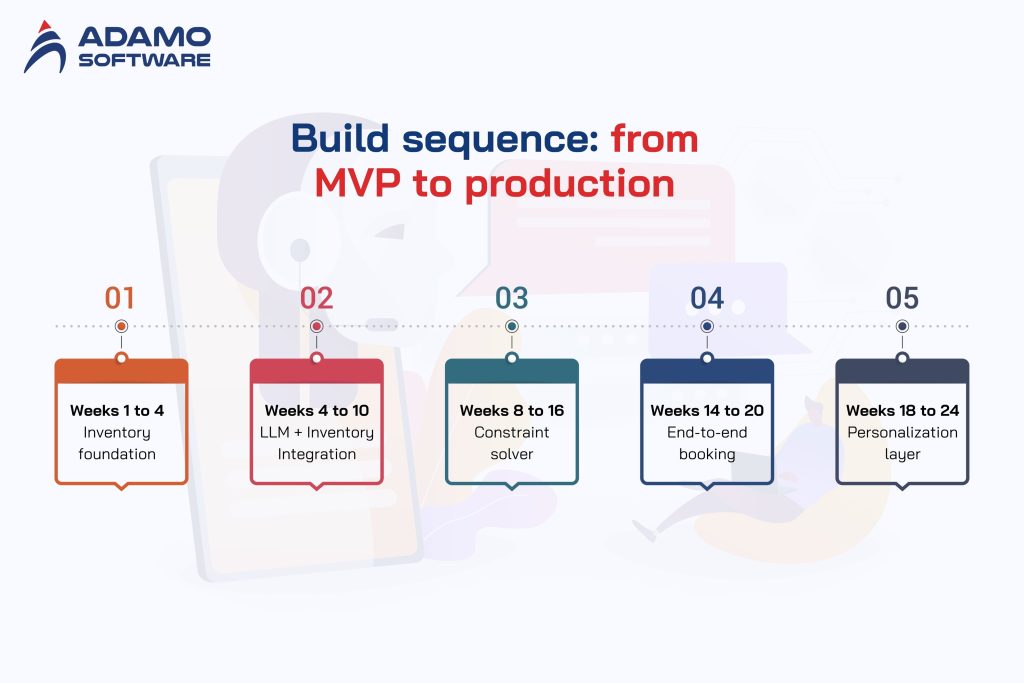
The realistic build sequence for an AI-powered itinerary planner, based on Adamo Software’s delivery experience with AI-powered travel booking platform projects:
Phase 1 (weeks 1 to 4): Inventory foundation. Connect to at least one supplier per category (one hotel API, one activity aggregator, one transport source). Normalize data into a unified schema. This is the unglamorous foundation. Skipping it means the rest of the system has nothing real to work with.
Phase 2 (weeks 4 to 10): LLM + inventory integration. Build the LLM orchestration layer with tool-use APIs that query the inventory database. Implement basic prompt engineering to constrain the LLM to recommend only items that exist in inventory. At this stage, the system can generate plausible itineraries but does not yet validate logistics.
Phase 3 (weeks 8 to 16): Constraint solver. Build the validation layer with travel time calculations (via Google Maps Distance Matrix or equivalent), opening hour checks, budget tracking, and capacity verification. Implement the LLM-revision loop when constraints fail. This is the longest phase. It is also where the planner becomes genuinely useful versus theatrically useful.
Phase 4 (weeks 14 to 20): End-to-end booking. Includes payment integration, multi-supplier booking coordination (you cannot book a hotel before checking the flight is confirmed), and confirmation/notification flows. For many travel brands, the itinerary planner ships inside a mobile app, so the booking pipeline has to account for offline states and mobile payment flows. Our guide on building a travel mobile app covers the architecture and cost tradeoffs in detail.
Phase 5 (weeks 18 to 24): Personalization layer. Build the recommendation engine with collaborative filtering and content-based filtering. Connect the feedback loop (accepted, modified, rejected itineraries) to a model retraining pipeline. This is where compounding value begins.
Total timeline: 5 to 6 months for a dedicated team of 6 to 8 engineers, depending on the number of supplier integrations and the complexity of the constraint logic. A barebones version (Phase 1 to 2 only) can ship in 6 to 8 weeks, but it falls into Tier 2, not Tier 3, and competes directly with generic ChatGPT prompts.
Common failure modes
Several patterns we see in failed or underperforming AI itinerary planner deployments:
- The LLM generates plausible-looking junk. Restaurants that do not exist. Tours from operators not in inventory. Hotels at prices not currently offered. Root cause: no inventory grounding, or grounding that the LLM is allowed to bypass when it cannot find a match. Fix: enforce strict tool-use constraints. The LLM cannot recommend an item not returned by an inventory query.
- Itineraries fail at booking time. The traveler accepts the plan, the system attempts to book, and three of seven items are unavailable. Root cause: inventory data is stale, or availability is not re-verified at the moment of booking. Fix: every recommendation includes a freshness timestamp; items older than X minutes (typically 5 to 15) trigger a re-verification call before being shown as bookable.
- Personalization feels generic. Despite collecting traveler data, the recommendations look like a default ranked list. Root cause: the personalization layer is using too few signals, or the signals are not differentiated enough. Fix: invest in feature engineering. A traveler’s third stay at a specific property type is a much stronger signal than three first-time bookings of different types.
- Multi-day plans break logistical reality. The constraint solver is not triggered, or it is triggered but its feedback is ignored by the LLM. Root cause: constraint solver implementation is incomplete (missing travel time calculations for some categories), or the LLM revision loop has no exit condition and the system silently returns the first plausible-looking output. Fix: explicit constraint coverage testing and a hard maximum on revision attempts before escalation to a fallback templated plan.
Build or integrate: a decision framework
For travel companies considering an AI-powered itinerary planner, the build-vs-integrate decision rests on three factors:
Inventory ownership and complexity. If you operate proprietary inventory (a hotel chain, a tour operator, a niche travel brand), custom build is the clear path. Generic AI itinerary tools cannot deeply represent your specific products. If you are an aggregator working with standard supplier APIs, off-the-shelf solutions may suffice for Phase 1, with custom development for Phases 3 to 5.
Personalization data strategy. Custom build is essential if first-party data is part of your competitive advantage. Off-the-shelf planners typically restrict access to raw behavioral data, blocking the feedback loop that drives long-term personalization quality.
Brand and conversion control. A planner that lives inside your platform with your brand, your booking flow, and your customer relationship has dramatically higher conversion economics than one that hands off to third-party booking pages. For mid-to-large operators, this alone justifies the custom development cost.
For more on broader gen AI use cases in travel beyond itinerary planning, see our guide on gen AI in travel.
Conclusion
AI-powered itinerary planners are moving from differentiator to default. With 40% of travelers already using AI to plan trips, 62% adoption among millennials and Gen Z, and 78% conversion among AI users on recommendations they receive, the technology has crossed from experimental to expected. The companies that will capture the next wave of travel bookings are the ones building Tier 3 planners: real inventory, validated logistics, end-to-end booking, compounding personalization. The technology stack is well-defined. The architectural patterns are proven. The build timeline is 5 to 6 months for a dedicated team. The competitive window is now. By 2027, AI-powered itinerary planning will be a baseline expectation in travel software, the same way mobile-responsive booking flows became baseline in the mid-2010s. The platforms that ship a production-grade planner in 2026 will have a 12 to 18 month lead on those that wait.
Build a Production-Grade AI-Powered Itinerary Planner With Adamo
Adamo Software builds custom AI-powered itinerary planners with live inventory integration, constraint validation, end-to-end booking, and personalization that compounds with every traveler interaction. From tour operators planning multi-day cultural trips to hotel groups building destination experiences, our engineering team delivers planners that ship in 5 to 6 months and start generating bookings from day one.
- Explore our services: https://adamosoft.com/travel-and-hospitality-software-development/
- Contact us for a free consultation: https://adamosoft.com/contact-us/

 adamosoft.com
 (+84) 373 11 44 88