
AI Development Services
in Vietnam

AI development services from Hanoi. We build custom AI, machine learning, generative AI, and multimodal systems for production.

OVERVIEW

What are AI Development Services?
- Adoption Is Easy. Scaling Is Not

AI development services cover the full lifecycle of building AI into a business: feasibility assessment, data preparation, model development, integration, and post-launch monitoring. Adoption is no longer the hard part. McKinsey’s State of AI survey found in 2025 that 88 percent of organizations already use AI, yet nearly two thirds have not scaled it beyond pilots. Adamo builds AI systems that reach production and stay accurate there.

SERVICES

Our AI and ML development services turn
your AI demands into breakthrough results

01/06

Custom AI Software Development

Custom AI software development means building around your workflows, your data, and your existing stack instead of fitting your business to a generic tool. We start with feasibility: is the data sufficient, is the problem well defined, and is a custom model actually better than an off the shelf API. When a custom build is justified, we handle prototyping, training, integration, and deployment on your infrastructure.

custom AI software development

02/06

Generative AI solution

Generative AI development covers systems that produce text, images, code, or structured output on demand. Enterprise use cases are rarely raw generation. They are grounded generation: answering from your documents, drafting inside your templates, summarizing against your policies. We build the retrieval layer, the evaluation harness, and the guardrails that keep output consistent and auditable, then run regression tests when foundation models update.

generative AI solutions development

03/06

Machine Learning development

Our machine learning development work turns historical data into forecasting, classification, recommendation, and anomaly detection systems that run in production. The work rarely starts with the model. It starts with data engineering: cleaning, labeling, feature design, and a baseline you can measure against. Every ML solution ships with drift detection and a retraining pipeline, because accuracy at launch does not survive without one.

machine learning development service

04/06

Multimodal AI Development


Multimodal AI development builds systems that reason across more than one type of input at once: text with images, documents with layout, speech with structured records. It is the difference between an AI that reads a scanned insurance claim and one that reads it, verifies the signature, cross-checks the attached photo, and returns validated fields. These systems demand careful evaluation design, because a multimodal model can be right on one input and wrong on another while sounding equally confident.

LLM development solution

05/06

Agentic AI development

Agentic AI development is about autonomy: systems that plan a sequence of steps, call tools, evaluate their own output, and adjust without a human directing each action. The engineering question is never how much autonomy is possible but how much is appropriate. We design along that spectrum, from copilots that suggest and wait, to autonomous workflows with human review at checkpoints. Observability, rollback, and audit trails are built in from the start.

agentic AI development solution

06/06

LLM Development

We build enterprise LLM systems grounded or fine-tuned on your domain data, structured and unstructured, working with models such as GPT, Claude, Llama, and Gemma. The decisions that determine success are rarely about model choice: fine-tuning versus retrieval, context strategy, cost per call at projected volume, and how to evaluate output when there is no single correct answer. You get the evaluation rubric alongside the system.

AI agent development solution

Why Choose Vietnam AI Development Services?

Vietnam gives you senior AI engineering at sustainable cost. Adamo adds the governance that usually goes missing: externally audited security and quality management, and a build team that stays on after launch.

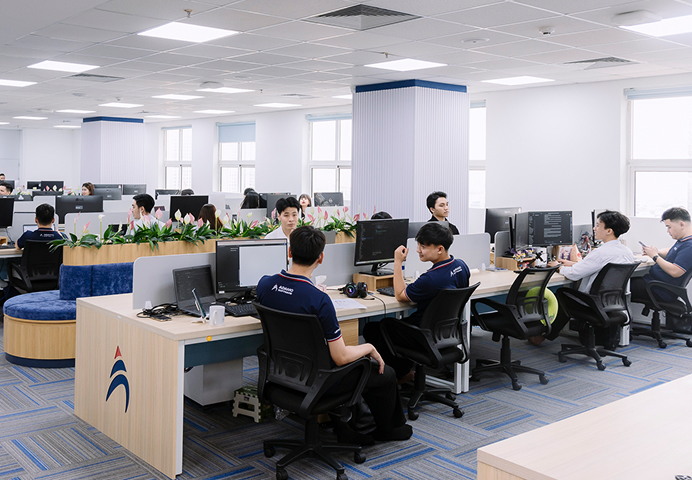
Adamo Software team

PROCESS

Our AI Development Process helps you at every stage

Problem
Identification

Our AI experts work with you to understand your goals - automation, cost reduction, or better customer experience and define the core problem.

Data Collection &
Preparation

We collect, clean, and structure relevant data, removing errors and inconsistencies to ensure high-quality input that directly impacts model accuracy and insights.

AI-Based Model
Development

Our developers select the most suitable algorithms and build the AI model. We iteratively refine and optimize it to ensure accurate predictions and strong performance.

Model
Evaluation

The model is tested using fresh data to validate performance. If necessary, we fine-tune its architecture and parameters until it consistently delivers the expected results.

Integration with Existing
Systems

Once validated, the AI model is securely integrated into your existing platform or workflows, ensuring smooth operation, scalability, and user accessibility.

Monitoring &
Maintenance

After deployment, our team continuously monitors performance, updates the model with new data, and improves it over time to maintain accuracy and reliability.

INDUSTRIES

We adopt AI solutions across different industries

Travel & Hospitality

Healthcare

Food & Beverage

Logistics

E-commerce & Retail

Finance

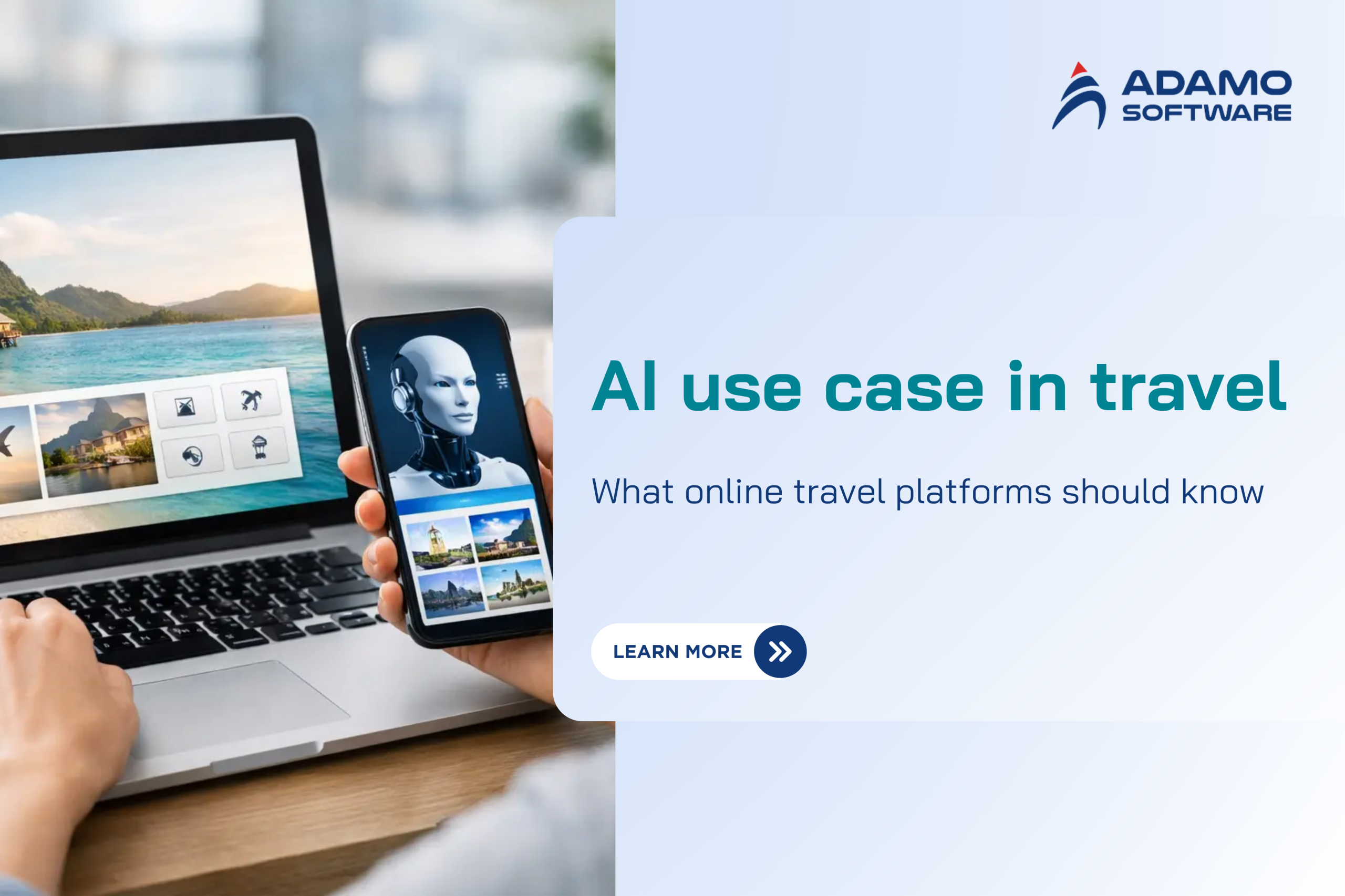
AI is redefining how travelers plan, experience, and share their journeys. From intelligent itinerary scheduling and personalized recommendations to destination management and enhanced customer support, our AI solutions empower travel companies to deliver more connected, convenient, and memorable experiences.

  • Travel personalization
  • AI recommendation engines
  • Flight ticket price forecast and dynamic pricing
  • Virtual travel assistants and AI chatbots

Learn More

AI in travel and hospitality

We develop compliant AI solutions that enhance patient experiences and operational efficiency across the entire healthcare ecosystem, from hospitals to research labs. Our solutions enable early disease detection, personalized treatment, and a more connected flow of health data.

  • Virtual medical assistants
  • Real-time alerts for high-risk cases
  • AI diagnostic and imaging solutions
  • Real-time patient data dashboards and analytics

Learn More

AI in healthcare

We design advanced AI solutions that drive transformation across the F&B value chain, from production to point of sale. Our technologies help businesses forecast demand accurately, optimize operations, control food quality and deliver exceptional customer experiences.

  • Food personalization and recommendation systems
  • Smart AI customer assistants
  • AI-powered food quality assurance and safety monitoring
  • AI-enabled inventory and supply chain optimization solutions

Learn More

AI in food and beverage

AI is transforming the logistics industry, making operations smarter, faster, and more connected. From predictive planning and intelligent routing to real-time tracking and automated warehouse management, our AI solutions help logistics providers improve efficiency, accuracy, and coordination across the supply chain.

  • Real-time monitoring of delivery routes and fleet performance
  • Predictive maintenance for warehouse equipment, vehicles, and other assets
  • Automated product inspection using computer vision
  • Automated supplier communications, including payment reminders and invoice sharing

Learn More

AI in logistics

We integrate AI into retail systems to enhance customer experiences and improve operations across online and offline channels. Our solutions deliver demand forecasting, personalized recommendations, real-time inventory management, and dynamic pricing for a smarter, more responsive shopping experience.

  • Personalized product recommendation systems
  • AI shopping assistants
  • Demand forecasting for inventory management
  • Dynamic pricing optimization for products

Learn More

AI in ecommerce and retail

We build AI solutions that transform finance and banking by enhancing decision-making, protecting assets, and delivering personalized experiences across digital platforms. Our technologies detect risks in real time, optimize investments, and turn financial insights into measurable business value.

  • Predictive analytics software
  • Real-time risk analytics
  • Automated financial reporting
  • Personalized investment & wealth recommendations

Learn More

AI in finance

OUTCOME

We know your data, your workflow and how to make AI work for you

Your problems might be

iconWhat Adamo offers

iconUnsure how to start with AI or what’s realistic?
Strategic AI consulting – We design realistic AI strategies, choose the right models, and build validation frameworks to reduce risk and ensure ROI.

iconManual processes slowing your operations?

Custom AI development – We build tailor-made AI automation to streamline operations and deliver measurable efficiency.

iconData everywhere but insights nowhere?

AI & MLOps – We create clean pipelines, automated training, and model monitoring to turn your data into actionable insights.

iconConcerned about privacy, ethics, or compliance?

Ethical & compliant AI – We embed transparency, governance, and explainability into every solution to keep your system safe and trustworthy.

TECH STACK

AI Technology Stack

Data engineering
Spark
Airflow
ClickHouse
Kafka
PostgreSQL
Deep learning frameworks
TensorFlow
Keras
Caffe
NLP
Gemma
Falcon
LLaMA 2
Cloud providers & Computer vision
AWS
Azure
Stable Diffusion XL

RELATED TECHNOLOGIES

AI-related technologies

machine learning technology

Machine Learning

We deliver machine learning solutions to analyze data, forecast trends, and improve decision-making.

big data technology

Big Data

Adamo turns big data into actionable insights to forecast demand, uncover revenue opportunities, and act in real time.


Learn More

FAQ

Frequently Asked Questions

What do AI development services actually include?

Six phases, and the model is rarely the one that fails.


  • Feasibility assessment. Is the problem well defined, is the data sufficient, and is a custom model actually better than an off the shelf API. We answer this in one to two weeks before any build commitment.
  • Data preparation. Cleaning, labeling, feature engineering, and establishing a measurable baseline. This is usually the longest phase and the most underestimated.
  • Model development. Building candidate models, evaluating against metrics agreed at discovery, iterating. We deliver a comparison report rather than a single recommendation.
  • Integration. API endpoints, load testing, edge case handling, connection to your existing platform.
  • Deployment. Production rollout on SageMaker, Vertex AI, or Azure ML.
  • Monitoring and retraining. Drift detection, output anomaly detection, and scheduled retraining, because a model that is accurate at launch will not stay accurate without it.


Total timeline for a production AI system runs three to seven months. Anything shorter is a prototype, and it is worth being clear which one you are buying.

This is one of the first decisions in any AI project. The answer depends on three factors: data sensitivity, control requirements, and cost at scale.


Use external APIs (OpenAI, Claude, Vertex AI) when: speed to market matters more than long-term cost; your use case is general (writing assistance, summarization, classification); volume is moderate (under millions of calls per month); and you’re comfortable sending data to third parties.

Build or fine-tune custom models when: data cannot leave your infrastructure (healthcare, finance, defense); you need consistent behavior at scale where API costs become prohibitive; your domain is specialized (medical imaging, legal documents, technical documentation); or you need very low latency or offline capability. For these cases, we typically use TensorFlow or Scikit-learn for training, then deploy on SageMaker, Vertex AI, or Azure ML.


A hybrid approach is often optimal: prototype quickly with API providers, then transition critical workloads to custom models once usage patterns are clear. We help clients evaluate this trade-off during discovery, including cost projections at projected scale.

Data privacy in AI projects is more complex than traditional software because data is consumed during training, not just stored. Our standard practices:


During development

  • Training data stays in your infrastructure or in isolated environments we provision. We don’t move sensitive data to developer laptops.
  • Signed NDAs with every team member and with Adamo as a company.
  • Role-based access — only assigned engineers see project data.
  • Code reviews and access logs on every commit and data access.


During deployment

  • Models can be deployed on your cloud account (AWS SageMaker, Azure ML, Google Vertex AI) or on-premises.
  • Encryption at rest and in transit as standard.
  • Audit trails for all inference requests.


For regulated industries (healthcare HIPAA, finance PCI DSS/SOC 2, EU GDPR), we layer in additional controls: BAA agreements, data residency commitments, differential privacy, and federated learning where applicable. We discuss the specific compliance regime during discovery to set the right architecture from day one.

Our AI projects follow a phased approach that differs from traditional software because results are uncertain until you see them:


Phase 1 — Discovery (1-2 weeks): Define the business problem, success metrics, and constraints. Audit your existing data — quality, volume, labels. Estimate feasibility.

Phase 2 — Data preparation (2-6 weeks): Data cleaning, labeling (if needed), feature engineering, baseline establishment. This is often the longest phase and frequently underestimated.

Phase 3 — Model development (4-12 weeks): Build candidate models using TensorFlow, Scikit-learn, or LLM-based architectures with LangChain/LlamaIndex for RAG. Evaluate against metrics defined in Phase 1, iterate. We deliver an evaluation report comparing approaches.

Phase 4 — Integration and testing (2-4 weeks): Connect the model to your application, build API endpoints, load testing, edge case handling.

Phase 5 — Deployment and monitoring (1-2 weeks initial, then ongoing): Production deployment on SageMaker, Vertex AI, or Azure ML, with monitoring for model drift, performance degradation, and unusual inputs.


Total timeline: 3 to 7 months for production AI systems. We share findings at each phase so you can pivot or stop if the technical risk is higher than expected — this is genuinely possible in AI work, unlike traditional development.

Honest answer: we don’t guarantee specific accuracy numbers upfront, and you should be skeptical of any AI vendor that does. AI model performance depends heavily on training data quality, the inherent difficulty of the problem, and ongoing data distribution stability.


What we commit to:

  • Establishing baseline metrics during discovery (target precision, recall, F1, latency, business KPIs).
  • Reporting actual measured performance at the end of model development.
  • Providing an honest assessment of whether targets are achievable with current data.
  • Recommending data collection or labeling improvements if needed.


Common metrics we report depending on the use case: classification accuracy/precision/recall/F1, regression RMSE/MAE, ranking NDCG/MRR, LLM evaluation rubrics (helpfulness, accuracy, safety), inference latency at p50/p95/p99.


If your data is insufficient for your target performance, we’ll tell you before starting, not after. This sometimes means recommending a smaller pilot first, or postponing the project until data is improved.

AI systems require more active post-launch attention than traditional software because they degrade silently. Without action, model performance drops as your data distribution shifts.


Continuous monitoring

  • Inference latency and throughput tracked through SageMaker Model Monitor, Vertex AI Model Monitoring, or Azure ML monitoring depending on your platform.
  • Input data distribution shift detection.
  • Output anomaly detection.
  • Business metric tracking — whatever the AI is supposed to improve.


Retraining (typically quarterly or trigger-based)

  • Refresh the model with recent data using TensorFlow or Scikit-learn pipelines.
  • Re-evaluate against current production traffic.
  • A/B test new model versions before full rollout.


Foundation model updates (for LLM-powered systems)

  • New model releases from providers (GPT, Claude, Gemini updates).
  • Prompt evaluation and regression testing — LangChain has built-in evaluation tooling we use.
  • Cost optimization as model pricing changes.


AI maintenance contracts typically run 12 to 36 working days per year depending on system complexity. We provide quarterly health reports and recommend retraining schedules based on observed drift. For high-stakes systems (medical, financial), we recommend more aggressive monitoring with paged on-call coverage.

The honest framing is cost against three risks: communication, governance, and continuity.


Cost. Vietnam sits well below United States, Western European, and Australian rates for equivalent AI and data engineering seniority. It is broadly comparable to India at the mid level, and often more favourable at senior level where Indian rates for AI specialists have risen sharply.


Communication. Vietnam overlaps a full working day with Singapore, Australia, and most of Asia Pacific. Overlap with Western Europe is partial, and with United States time zones it is limited to early or late hours. We schedule fixed overlap windows rather than pretending the gap does not exist. If your project needs daily synchronous collaboration with a United States team, say so at discovery so we can staff for it.


Governance. This is where vendor selection actually differs. Ask any prospective partner for their ISO 27001 certificate number and its scope, not just a claim on a website. Ask whether training data can stay inside your infrastructure. Ask who owns the model weights and the training artefacts at contract end. Adamo holds ISO 27001:2022 and ISO 9001:2015, both externally audited, and our default position is that your data does not leave environments you control.


Continuity. AI systems degrade quietly as data distributions shift, so the maintenance relationship matters more than it does for conventional software. Ask whether the engineers who built the system will still be available in eighteen months. Our AI maintenance contracts typically run 12 to 36 working days per year and are staffed by the original build team.

Vietnam is the right answer when you need senior AI engineering at a sustainable cost with audited governance, and you can work asynchronously. It is the wrong answer if your project requires a co-located team in a United States or European office.