
Gen AI in Travel: Use Cases, Challenges and Implementation Roadmoap for Custom Software
Gen AI in travel will reach $5B by 2034. Learn 7 high-ROI use cases, key challenges, and a segment-specific roadmap for hotels, tour operators, and airlines.
The global gen AI in travel market was valued at approximately $1.06 billion in 2025 and is projected to reach $5.07 billion by 2034, growing at a CAGR of 18.9% (Precedence Research, 2024). That growth is not hypothetical. According to Amadeus research conducted with 306 senior travel technology leaders across ten markets, gen AI is already in widespread use across the travel industry, and 46% of leaders cite it as their top technology priority for the coming year (Amadeus, 2025).
But there is a substantial gap between companies experimenting with gen AI tools and companies building gen AI capabilities into their core platforms. The first group sees marginal improvements. The second group sees compounding returns. This article covers the market landscape, seven high-ROI use cases, the key challenges to navigate, and a segment-specific implementation roadmap for building gen AI in travel into custom software.
Key Takeaways
- The global gen AI in travel market was valued at $1.06 billion in 2025 and is projected to reach $5.07 billion by 2034, growing at 18.9% CAGR (Precedence Research, 2024). The broader AI in tourism market will reach $13.38 billion by 2030 (MarketsandMarkets).
- 97% of travel executives believe gen AI will significantly impact their industry. 46% cite it as their top technology priority (Amadeus, 2025).
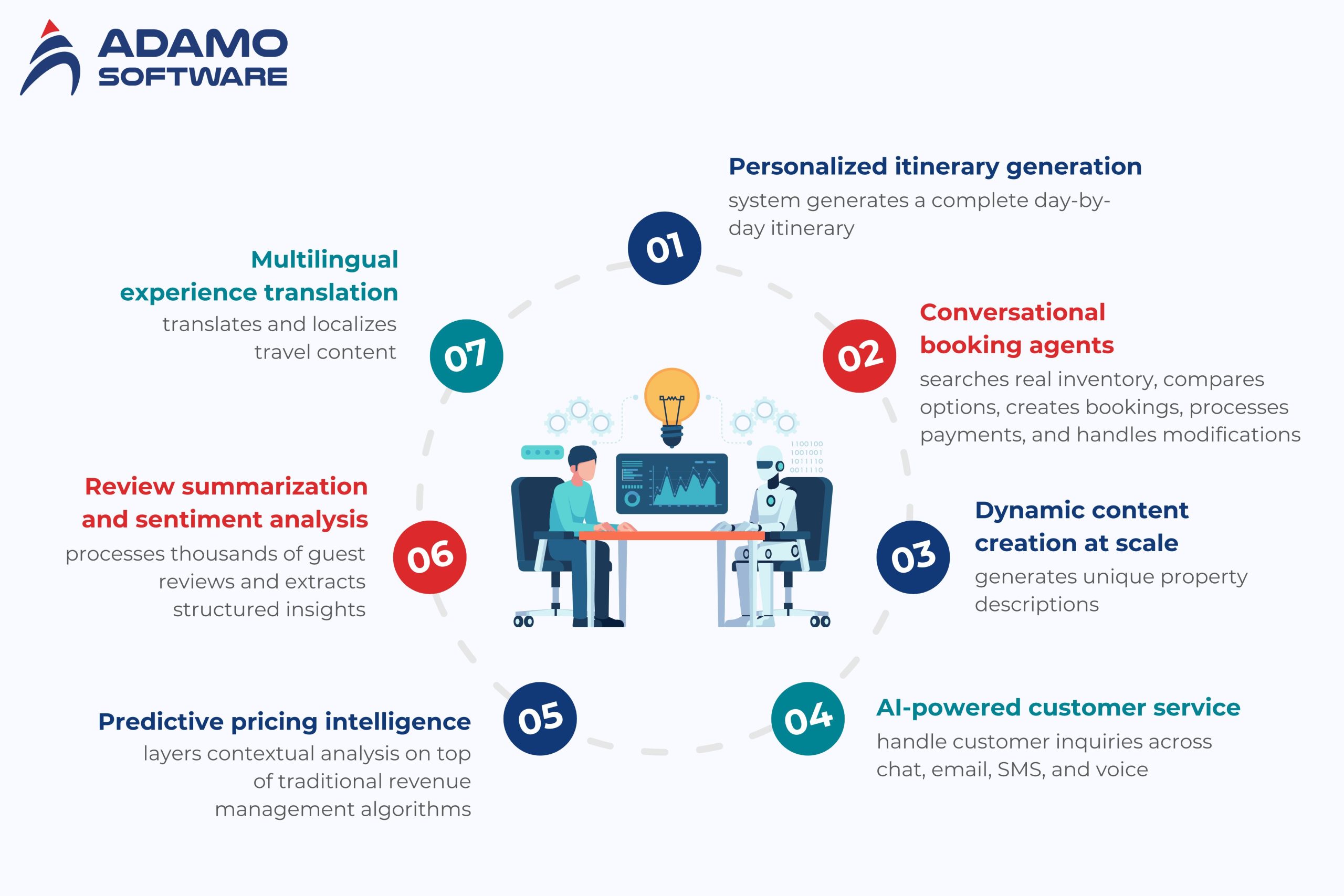
- The seven highest-ROI use cases are: personalized itinerary generation, conversational booking agents, dynamic content creation, AI-powered customer service, predictive pricing, review summarization, and multilingual translation.
- Key challenges include LLM hallucination in booking contexts, data privacy compliance (51% of travelers concerned), and integration complexity consuming 40 to 60% of implementation effort.
- Hotels should start with customer service AI and review summarization. Tour operators should prioritize itinerary generation and conversational booking. Airlines should begin with high-volume customer service automation.
- Travel companies should build gen AI into custom platforms rather than relying on third-party widgets when they need first-party data ownership, deep booking system integration, and brand-specific personalization.
The gen AI in travel market: where things stand in 2026
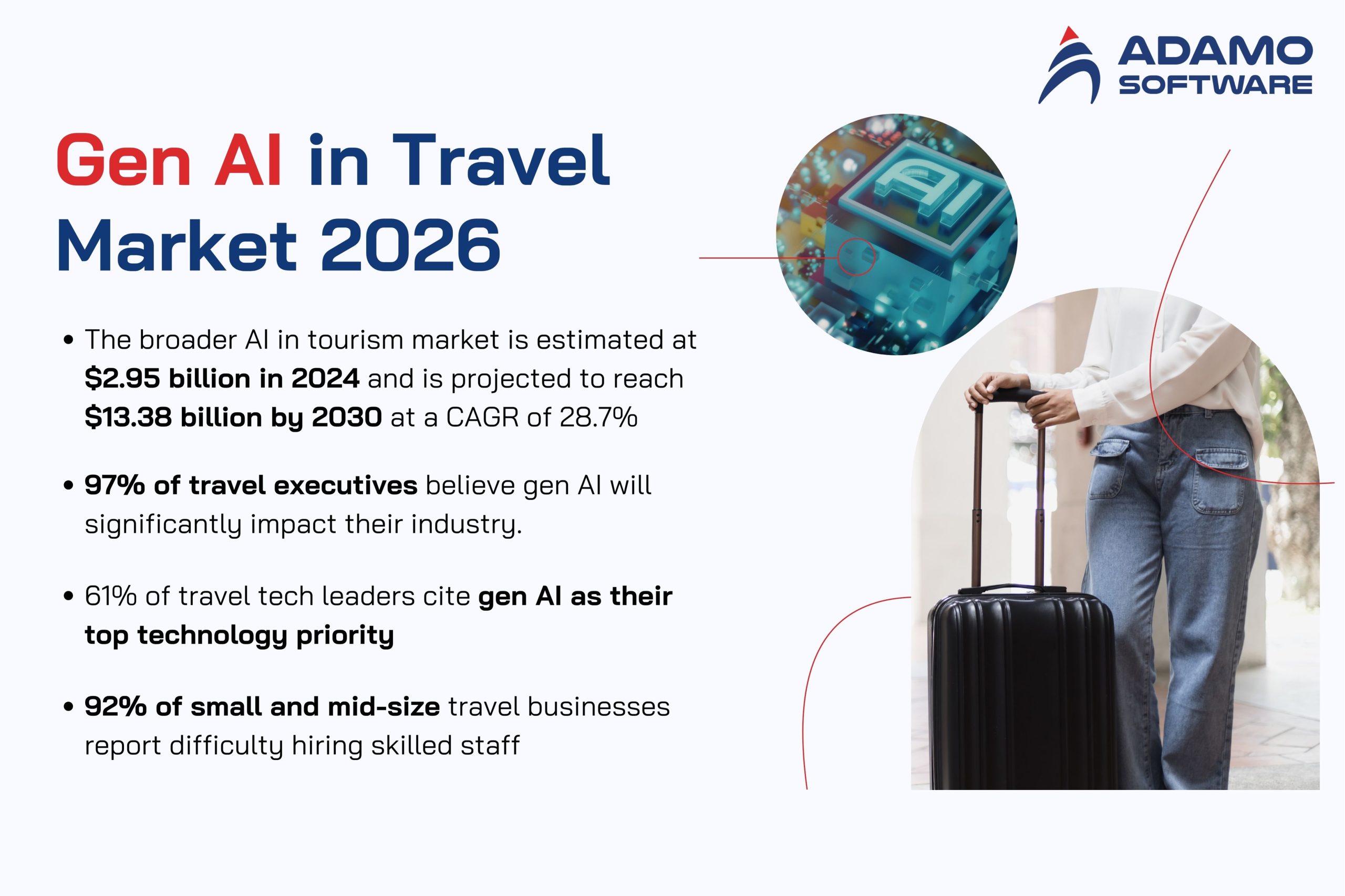
The numbers tell a clear story. The broader AI in tourism market is estimated at $2.95 billion in 2024 and is projected to reach $13.38 billion by 2030 at a CAGR of 28.7% (MarketsandMarkets, 2025). Within that, generative AI specifically is the fastest-growing segment, driven by use cases that were not technically feasible two years ago: autonomous booking agents, real-time itinerary generation, and AI-powered content creation at scale.
Adoption is no longer aspirational. According to Amadeus, 97% of travel executives believe gen AI will significantly impact their industry. The leading use cases already in production are digital assistance during booking (53%), activity and venue recommendations (48%), content generation (47%), helping staff serve customers better (45%), and collecting post-trip feedback (45%). In APAC specifically, 61% of travel tech leaders cite gen AI as their top technology priority, the highest of any region (Amadeus, 2025).
Three market-level trends are shaping how gen AI in travel evolves:
- The shift from search to conversation. Harvard Business Review published a January 2026 analysis arguing that gen AI-powered conversational tools are threatening the dominance of traditional OTA aggregators like Expedia and Booking.com (HBR, 2026). When travelers describe what they want in natural language and an AI assistant handles comparison and booking, the traditional search-browse-filter-book funnel collapses. Companies that control the conversational interface capture the traveler relationship.
- The rise of agentic AI. Gen AI is evolving from systems that generate text to systems that take autonomous action. Sabre, PayPal, and MindTrip announced a partnership in February 2026 to build the travel industry’s first end-to-end agentic booking pipeline, covering 420+ airlines and 2 million hotel properties (OAG, 2026). For a deeper dive into how agentic AI in travel works and what it requires technically, see our dedicated guide.
- The staffing multiplier. 92% of small and mid-size travel businesses report difficulty hiring skilled staff (Master of Code, 2025). Gen AI is not replacing employees. It is multiplying the output of existing teams: one content marketer producing localized descriptions for 50,000 properties, one customer service agent handling 5x the inquiry volume with AI support, one revenue manager overseeing dynamic pricing across 200 properties.
7 use cases of Gen AI in Travel that drive real ROI
1. Personalized itinerary generation
What it does. A traveler describes what they want in natural language (“5 days in central Vietnam, mix of culture and beach, $120/day budget, no guided tours”) and the system generates a complete day-by-day itinerary with specific hotels, restaurants, activities, and transport recommendations.
Why it matters. According to Amadeus research, 53% of travel tech leaders identify digital assistance during booking as the leading gen AI use case, followed by activity and venue recommendations at 48% (Amadeus, 2025). Travelers rank the inspiration and planning stages as the most complicated parts of the travel journey. Gen AI reduces hours of comparison research into a single conversation.
How to build it. The system requires three components: an LLM for natural language understanding and itinerary composition, a structured inventory database (hotels, activities, restaurants with pricing, availability, and location data), and a constraint solver that ensures the generated plan is logistically feasible (travel times between locations, opening hours, budget limits). The LLM drafts the narrative itinerary. The constraint solver validates it against real-world data. The inventory database provides the specific recommendations.
2. Conversational booking agents
What it does. An AI chatbot that does not just answer questions but searches real inventory, compares options, creates bookings, processes payments, and handles modifications, all within a natural language conversation.
Why it matters. 40% of travelers worldwide are already using AI-based tools for trip planning (Statista, 2025). Expedia Group’s AI service agent handles over 143 million conversations annually, with more than 50% of travelers self-serving without calling in (Expedia Group, 2025). Chatbots that access live inventory and complete bookings within the conversation convert at significantly higher rates than those that redirect users to a separate booking page.
How to build it. This requires an LLM with tool-use capabilities connected to live booking APIs. The agent calls search tools (flights, hotels, activities), presents results in natural language, collects traveler preferences through conversation, and executes bookings through transactional APIs. Critical components include conversation memory (tracking preferences and decisions across 5 to 15 messages), guardrails (confidence thresholds that trigger human escalation), and payment integration within the chat flow. For a detailed architecture breakdown, see our guide on building AI chatbots for travel booking.
3. Dynamic content creation at scale
What it does. Gen AI automatically generates unique property descriptions, destination guides, promotional emails, social media content, and SEO-optimized blog posts for thousands of listings.
Why it matters. A hotel aggregator with 50,000 properties cannot manually write unique descriptions for each one. According to an Epsilon report, 65% of marketing specialists believe automated copywriting will be the most transformative AI capability over the next five years. Hospitality has a 96% AI adoption rate in marketing, with 43% of companies already calling their AI usage “extremely mature” (Epsilon, 2025).
How to build it. The content pipeline has three stages. First, data ingestion: pull structured property data (amenities, location, photos, reviews, pricing) from the booking database. Second, generation: use an LLM with a carefully designed system prompt that enforces brand voice, length constraints, and SEO keyword requirements. Third, quality control: a review layer checks factual accuracy (does the property actually have the amenities mentioned?), deduplication (are two listings getting identical descriptions?), and tone consistency. The system should produce localized variants for different markets without full human translation, using the LLM’s multilingual capabilities with native-speaker QA for the top 5 to 8 markets.
ROI signal. AI-generated descriptions lift conversion rates up to 23% and save teams 75 to 88% of writing time. For travel companies managing thousands of listings, this translates directly to faster time-to-market.
4. AI-powered customer service
What it does. Gen AI agents handle customer inquiries across chat, email, SMS, and voice, resolving issues like booking modifications, cancellation requests, flight status checks, and policy questions without human intervention.
Why it matters. Spirit Airlines implemented a gen AI agent (built by Quiq) that achieved an automated resolution rate of over 40%, with conversation times 16% faster than human-handled interactions (Quiq, 2026). The system freed human agents to focus on complex issues that genuinely require human judgment. Across the industry, modern AI chatbots resolve 87% of customer inquiries without escalation (Hyperleap AI, 2025).
How to build it. The gen AI service agent requires integration with operational systems: the booking database (to look up and modify reservations), the payment system (to process refunds), the flight/room inventory (to check availability for rebooking), and the policy database (cancellation terms, baggage rules, loyalty program tiers). The LLM orchestrates these integrations through tool-use APIs, maintaining conversation context across channels. A traveler who starts a conversation on chat and switches to phone should not repeat their issue. This requires a unified conversation state that persists across channels.
ROI signal. Customer service cost reduction of 30 to 40% is the industry benchmark for AI-powered support. The deeper value is in customer satisfaction: AI chatbots deliver first responses in an average of 11 seconds versus 4+ hours for email (Hyperleap AI, 2025). Speed correlates directly with satisfaction scores.
5. Predictive pricing intelligence
What it does. Gen AI layers contextual analysis on top of traditional revenue management algorithms. It does not just adjust prices based on demand curves. It generates pricing recommendations with natural language explanations of the reasoning (competitor rate changes, local events, weather forecasts, booking velocity).
Why it matters. Amadeus research found that 37% of travelers cite personalized pricing and recommendations as a key benefit of AI (Amadeus, 2025). Properties using AI-driven dynamic pricing report revenue uplifts between 7 and 12% (Prostay, 2026). The gen AI layer adds explainability: revenue managers can see why the system recommends a specific rate, making it easier to trust and override when necessary.
How to build it. The system combines a traditional pricing algorithm (demand forecasting, competitor rate scraping, seasonal patterns) with an LLM-powered explanation layer. The algorithm outputs the recommended rate. The LLM generates a natural language brief: “Rate increased to $189 for July 12. Rationale: competitor rates up 8% this week, local music festival starts July 11, booking velocity 23% above baseline for this date range.” This explanation layer is what separates a black-box pricing tool from one that revenue teams actually adopt. Build the pricing engine in Python (scikit-learn or a custom model), and use the LLM solely for the explanation and recommendation narrative.
6. Review summarization and sentiment analysis
What it does. Gen AI processes thousands of guest reviews and extracts structured insights: recurring positive themes (location, cleanliness, staff friendliness), recurring complaints (noise, slow check-in, outdated facilities), sentiment trends over time, and comparison with competitor properties.
Why it matters. Manual review analysis is impossible at scale. A property with 2,000 reviews across TripAdvisor, Google, Booking.com, and its own platform cannot meaningfully analyze all of them. Gen AI processes feedback 10x faster than manual review (WifiTalents, 2026). The output is actionable: “Check-in speed mentioned negatively in 34% of reviews from Q1 2026, up from 18% in Q4 2025. Competitor Hotel X implemented mobile check-in and saw negative mentions drop to 8%.”
How to build it. Aggregate reviews from all platforms via APIs (TripAdvisor Content API, Google Places API, Booking.com affiliate API). Feed batches into the LLM with a structured output schema: sentiment score, topic tags, key phrases, actionable recommendations. Store results in a dashboard database. The LLM is the processing layer, not the database. Raw reviews go in, structured insights come out.
7. Multilingual experience translation
What it does. Gen AI translates and localizes travel content (property descriptions, booking flows, customer service responses) across languages while preserving cultural nuance and brand voice.
Why it matters. 74% of global businesses cite multilingual support as a critical requirement (Hyperleap AI, 2025). Gen AI delivers near-instant translation at quality approaching professional human translation. A new property listing can be available in 15 languages within minutes.
How to build it. Use the LLM’s native multilingual capabilities rather than a separate translation API. For high-stakes content (legal terms, cancellation policies), add a human review step for the top 5 languages by traffic volume. Store language preferences per user so returning travelers automatically receive content in their language.
Challenges and risks to navigate
Gen AI in travel is not a plug-and-play upgrade. Companies that rush implementation without addressing these challenges end up with expensive experiments instead of production systems.
Hallucination in high-stakes contexts. LLMs generate plausible-sounding text that may be factually wrong. In travel, this means a chatbot might quote a price the hotel does not offer, state a flight departs at 10:30 AM when it leaves at 10:30 PM, or claim a property has a pool when it does not. The solution is strict architectural separation: the LLM handles natural language understanding and response formatting, while every factual claim (prices, times, availability, policies) comes from verified API responses. Never let the LLM generate facts from its training data in a booking context.
Data privacy and guest trust. 51% of travelers are concerned about the privacy of data shared with travel AI (WifiTalents, 2026). Travel platforms process sensitive information: passport numbers, payment details, travel patterns, health requirements. Gen AI implementations must ensure that guest data is not sent to third-party model providers without explicit consent, that conversation logs are encrypted and access-controlled, and that data residency requirements are met for regulated markets (EU GDPR, Australia Privacy Act).
Content authenticity. 40% of consumers worry that AI-generated travel photos are misleading (WifiTalents, 2026). As gen AI produces more marketing content, the line between authentic and synthetic blurs. Travel companies should label AI-generated content where appropriate and ensure that property descriptions, reviews summaries, and destination guides are grounded in verified data, not generated from the LLM’s imagination.
Integration complexity. Gen AI features that operate in isolation. This integration work typically represents 40 to 60% of the total implementation effort. Companies underestimate it consistently, which is why understanding the complete travel app development process and cost before kicking off a project is critical to budget accuracy.
Lack of AI expertise. Having the vision for gen AI adoption and having the engineering team to execute it are different problems. 30% of travel companies have no formal policy on generative AI usage (WifiTalents, 2026). Building a production-grade gen AI system requires LLM orchestration experience, API design for tool-use patterns, and domain knowledge in travel distribution. To navigate these hurdles, teams should adhere to structured AI-assisted coding practices that keep data flows controlled and minimize technical debt. Companies without this expertise in-house should partner with development teams that have delivered travel AI projects rather than attempting to build from scratch.
Implementation roadmap by segment
The seven use cases above apply differently depending on the type of travel business. Here is what to prioritize and when, broken down by segment.
Hotels and hospitality groups
Hotels face two urgent priorities: direct booking conversion (reducing OTA dependency) and operational efficiency (doing more with constrained staffing).
Phase 1 (months 1 to 3). Start with AI-powered customer service (use case 4) and review summarization (use case 6). These have the fastest ROI because they reduce immediate operational costs. A chatbot that handles 80% of pre-booking inquiries (room availability, amenities, check-in times, parking) frees front desk and reservations staff for higher-value interactions. Review summarization gives management actionable insights without manual reading.
Phase 2 (months 3 to 6). Add dynamic content creation (use case 3) for property descriptions, email campaigns, and localized marketing. Implement predictive pricing intelligence (use case 5) to optimize revenue management. These compound the value from Phase 1 by increasing direct bookings and average booking value.
Phase 3 (months 6 to 9). Deploy a conversational booking agent (use case 2) on the hotel website and integrate it with the loyalty program. Add multilingual support (use case 7). Begin exposing inventory via MCP protocol for AI assistant discoverability.
Tour operators and DMCs
Tour operators have a different pain point: the discovery and planning stage is far more complex than hotel booking. Travelers need help choosing between dozens of multi-day itineraries with varying activities, difficulty levels, and price points.
Phase 1 (months 1 to 3). Prioritize personalized itinerary generation (use case 1) and conversational booking (use case 2). These directly address the core friction: helping travelers find the right tour and book it without manual back-and-forth with sales staff. Adamo Software’s AI-powered travel assistant deployment for a tours CMS platform demonstrated that combining these two use cases reduces support workload on repetitive tour questions while increasing booking conversion.
Phase 2 (months 3 to 6). Add dynamic content creation (use case 3) for tour descriptions, destination guides, and seasonal promotions. Implement multilingual translation (use case 7) to serve international source markets.
Phase 3 (months 6 to 9). Deploy review summarization (use case 6) to identify tour quality issues and guide product improvements. Add AI-powered customer service (use case 4) for post-booking support (modification requests, visa questions, packing guides).
Airlines and OTAs
Airlines and OTAs operate at a scale where even small percentage improvements translate to significant revenue. They also face the highest customer service volumes.
Phase 1 (months 1 to 3). AI-powered customer service (use case 4) is the clear starting point. Spirit Airlines achieved over 40% automated resolution with 16% faster conversation times (Quiq, 2026). At airline volumes (millions of inquiries per month), this translates to tens of millions in annual cost savings.
Phase 2 (months 3 to 6). Implement predictive pricing intelligence (use case 5) layered on existing revenue management systems. Add personalized itinerary generation (use case 1) for ancillary revenue: when a traveler books a flight, the AI suggests hotels, activities, and transport at the destination.
Phase 3 (months 6 to 12). Build a full conversational booking agent (use case 2) integrated with the airline’s inventory and MCP protocol. This is the highest-complexity, highest-reward implementation, positioning the airline for the agentic AI era where AI assistants book flights directly.
Build or integrate: a decision framework
Not every gen AI use case requires building from scratch. The decision depends on three factors:
- Data sensitivity. If the use case requires training on or processing proprietary guest data (booking history, preferences, internal reviews), building in-house or with a custom development partner is the safer choice. Third-party gen AI tools may expose sensitive data to external models.
- Integration depth. If the gen AI component needs real-time access to live booking inventory, payment systems, or operational databases, custom integration is necessary. Off-the-shelf tools rarely connect deeply enough to execute transactions.
- Brand differentiation. If the gen AI output is customer-facing (chatbot conversations, property descriptions, itinerary recommendations), it must reflect the brand’s voice and standards. Generic third-party outputs feel generic to travelers.
For use cases 1, 2, 4, and 5 (itinerary generation, booking agents, customer service, pricing intelligence), custom development delivers significantly more value because these touch live systems and proprietary data. For use cases 3 and 7 (content creation and translation), a hybrid approach works: use third-party LLM APIs (OpenAI, Anthropic, Google) wrapped in custom pipelines that enforce brand guidelines and quality checks. For use case 6 (review summarization), a lightweight custom pipeline on top of an LLM API is typically sufficient.
Adamo Software has delivered gen AI integrations for travel platforms including an AI-powered travel assistant that combines personalized tour recommendations with natural language booking, demonstrating how use cases 1 and 2 work together in a production environment.
Conclusion
Gen AI in travel is past the experimentation phase. The market is growing from $1 billion to $5 billion by 2034. 97% of travel executives acknowledge its impact. The seven use cases outlined here are already in production at leading travel companies, delivering measurable improvements in conversion, customer satisfaction, and operational efficiency. But the technology alone is not the differentiator. The companies pulling ahead are those building gen AI into the core of their platforms, connected to live inventory, trained on first-party data, and integrated with their operational systems. The challenges are real (hallucination, privacy, integration complexity), but they are engineering problems with known solutions, not fundamental barriers. Whether you are a hotel group starting with customer service automation, a tour operator deploying an AI itinerary planner, or an airline scaling autonomous support agents, the implementation roadmap starts with the same principle: build on your own data, integrate deeply with your own systems, and compound your advantage with every interaction.
Build Gen AI Capabilities Into Your Travel Platform
Adamo Software helps travel companies implement gen AI across booking, customer service, content, and pricing. From LLM integration and tool-use API design to full conversational booking agents, our engineering team builds gen AI features that connect to your live inventory, run on your data, and reflect your brand.
- Explore our services: https://adamosoft.com/ai-development-services/
- Contact us for a free consultation: https://adamosoft.com/contact-us/

 adamosoft.com
 (+84) 373 11 44 88