
Insourcing vs Outsourcing cost analysis: What is more cost-effective?
Insourcing vs outsourcing cost analysis: in-house team at $910K/year vs outsourced team at $67K (2 months). Real numbers, factors, and decision framework.
Choosing between insourcing and outsourcing is one of the most consequential cost decisions a company makes. The choice affects more than just headcount budget. It determines how fast the company can ship, how easily it can scale up or down, and how much margin gets reinvested into product versus overhead.
This guide breaks down the actual cost numbers for both approaches using 2025-2026 market data, then walks through the factors that determine which approach fits your business. By the end, you will have concrete benchmarks to take into your own budget planning and a clear framework for the build-versus-outsource decision.
Most companies underestimate the full cost of insourcing because the headline salary number hides 30-40% in benefits, infrastructure, and recruitment overhead. Most companies also underestimate outsourcing because they look only at hourly rate without accounting for communication, quality control, and transition costs. A proper cost analysis includes both sides honestly.
Below, you will see the real numbers, the factors that drive the decision either direction, and a framework for choosing between the two approaches based on your specific situation.
I. Factors affect Insourcing vs Outsourcing cost analysis
Insourcing versus outsourcing costs depend on the work type, project duration, and how tightly the work needs to integrate with internal teams. Outsourcing is generally more cost-effective and flexible for short-term projects or specialised work that does not require deep integration with core internal processes.
For core processes that require deep integration with company workflow, decision-making, and intellectual property, building an in-house team typically delivers better long-term outcomes.
Now, let’s break down the cost difference between sourcing and outsourcing.
1. In-house costs
Recruitment & onboarding
Recruiting and onboarding new employees can be time-consuming and expensive. It is a scheduled process of hiring, which involves job posting, interviews, background checks, and training. Each of these adds to the overall cost of bringing new talent to your organization. It’s crucial that this investment ensures new hires fit well within the company culture.
Salaries & benefits
In an insourcing vs outsourcing cost analysis, ongoing costs for employee compensation are substantial. It’s also about expenses like salaries, health benefits, retirement plans, and other perks. These costs are fixed and must be paid, even if the company profits or performs poorly. Hence, they constitute a key element of the in-house cost structure.
Infrastructure
Maintaining a physical workspace involves various costs, such as office space, equipment, software, and tools. This includes rent, utilities, and regular maintenance expenses. Infrastructural costs can pile up quickly, and you need to consider them when deciding whether your organization should insource or outsource.
Retention
Retention efforts are related to keeping employees engaged and reducing turnover rates. All these include professional development programs, team-building activities, and competitive packages. Your employees are your greatest asset, so investing in making them happy can pay off in higher productivity and lower turnover costs.
2. Outsourcing costs
Service fees
Service fees paid to third-party providers are key to outsourcing costs. The payments for these projects are usually based on the project’s scope or duration. The fees in outsourcing vary a lot depending on how complicated and long the project is to be outsourced.
Communication
The insourcing vs outsourcing cost analysis is impossible without effective team members’ communication. Communication-related potential costs include investment in tools and technologies to enable in-house and outsourced teams to collaborate. Having clear communication helps bridge any gaps due to being with external partners.
Quality control
Monitoring and assuring the quality of outsourced work expenses are critical for quality control expenses. Maintaining high standards requires regular audits, performance reviews, and quality-assured processes. That is to say, these activities make sure that the output matches your company’s expectations.
Transition
The costs of the initial work transition to an outsourcing partner should not be overlooked. These could be knowledge transfer, process documentation, and initial onboarding of the outsourced team. A successful collaboration with external partners depends on properly managing this transition.
A complete insourcing vs outsourcing cost analysis is useful to businesses in determining the best practice to adopt in deciding operational strategies. Understanding in-house and outsourcing costs is important to optimize resources effectively.
For a comprehensive overview of outsourcing models and types, see our guide on what is IT outsourcing.
II. Insourcing vs Outsourcing cost analysis: Detailed calculation
Many businesses need to decide whether to outsource IT services, which is a challenge. Comparing these costs is important before you decide whether to choose in-house or outsourced development. This insourcing vs outsourcing cost analysis can give you insights into your strategy.
A proper cost comparison requires concrete numbers for both approaches. The following calculation uses 2025-2026 market data for a typical software development team building a mid-size custom application over a 6-month period.
1. Costs of in-house product development (US-based team)
A typical product development team includes a front-end developer, back-end developer, UI/UX designer, QA specialist, business analyst, and project manager (six roles for a focused team; seven if you add a dedicated architect).
According to 2025 US market data, the average annual salary for a US-based software developer is USD 148,000, with senior developers averaging USD 111,456 (Second Talent 2026 data, talentjdi.com). Junior developers average around USD 86,582.
For a mid-level team of 7 people at an average loaded cost of USD 120,000 per role (mix of junior and senior), total annual salaries are USD 840,000.a
Total fully loaded costs:
- Annual salaries: USD 840,000
- Benefits and payroll taxes (25-30% of salaries): USD 210,000-252,000
- Office space, equipment, software licences (per-employee overhead): USD 80,000-120,000
- Recruitment and onboarding (one-time for new hires): USD 50,000-100,000
- Training and ongoing professional development: USD 30,000-50,000
Total annual cost of a US-based in-house team of 7: USD 1.2-1.4 million.
This figure represents the realistic cost of running an in-house team in major US tech hubs (San Francisco, New York, Seattle). Lower-cost US cities (Austin, Denver, Raleigh) typically run 15-25% lower, but still substantially above offshore alternatives.
2. Costs of outsourcing product development (offshore team in Asia)
Offshore software development rates in 2025-2026 fall into three pricing tiers based on region:
- Low-cost tier (India, Vietnam, Philippines, Bangladesh): USD 15-50/hour for standard development roles (Aalpha 2026, Second Talent 2026)
- Mid-tier (Eastern Europe, Latin America): USD 30-70/hour
- High-cost tier (Western Europe, North America): USD 80-200/hour
For a comparable team of 7 working full-time (1,600 hours per role per year, ~6 months at full capacity = 800 hours per role for a 6-month project), Vietnam-based rates would be:
- 3 mid-level developers at USD 30/hour: USD 72,000
- 1 senior developer at USD 45/hour: USD 36,000
- 1 UI/UX designer at USD 25/hour: USD 20,000
- 1 QA specialist at USD 25/hour: USD 20,000
- 1 project manager at USD 40/hour: USD 32,000
Total cost for a 6-month offshore project: USD 180,000.
Annualised (assuming continuous engagement): USD 360,000.
3. Direct cost comparison
| Metric | US-based in-house (annual) | Vietnam-based outsourced (annualised) |
|---|---|---|
| Direct salaries / fees | USD 840,000 | USD 360,000 |
| Benefits and overhead | USD 290,000-372,000 | Included (vendor handles) |
| Recruitment / setup | USD 50,000-100,000 (one-time) | USD 0 |
| Total annualised cost | USD 1.2-1.4 million | USD 360,000 |
| Cost difference | – | Savings of USD 850K-1M per year (~70-75%) |
This calculation assumes equivalent skill level and output. In practice, communication overhead, time zone coordination, and knowledge transfer costs reduce the gross savings by 10-20%, leaving net savings typically in the 55-65% range.
For smaller teams or shorter projects, the percentage savings are similar but absolute dollar figures scale down accordingly. For larger teams or multi-year engagements, the absolute savings grow significantly.
4. When outsourcing math does not work
The numbers above assume the work can be cleanly handed off to an offshore team. There are scenarios where insourcing is more economic despite higher headline cost:
- Core IP development that requires deep institutional knowledge
- Work requiring constant collaboration with non-engineering teams (sales, customer success, compliance)
- Highly regulated industries where audit trail of who built what matters legally
- Very small teams (1-3 people) where coordination overhead with vendor exceeds direct cost savings
- Projects with rapidly changing requirements that need real-time co-location
For everything else, the offshore math is compelling and the global trend toward distributed teams since 2020 has made the operational model much smoother than it was even five years ago.
III. Other reasons why you should choose outsourcing service
The global IT outsourcing market is projected to grow at 8.28% CAGR through 2029, with small businesses representing a significant share of new outsourcing relationships (multiple industry sources, 2025-2026). Cost remains the primary driver for small business outsourcing decisions. Although this is an area of growing interest, cost remains a key concern for small businesses considering outsourcing. An insourcing vs outsourcing cost analysis will tell you if outsourcing is the right choice for your organization.
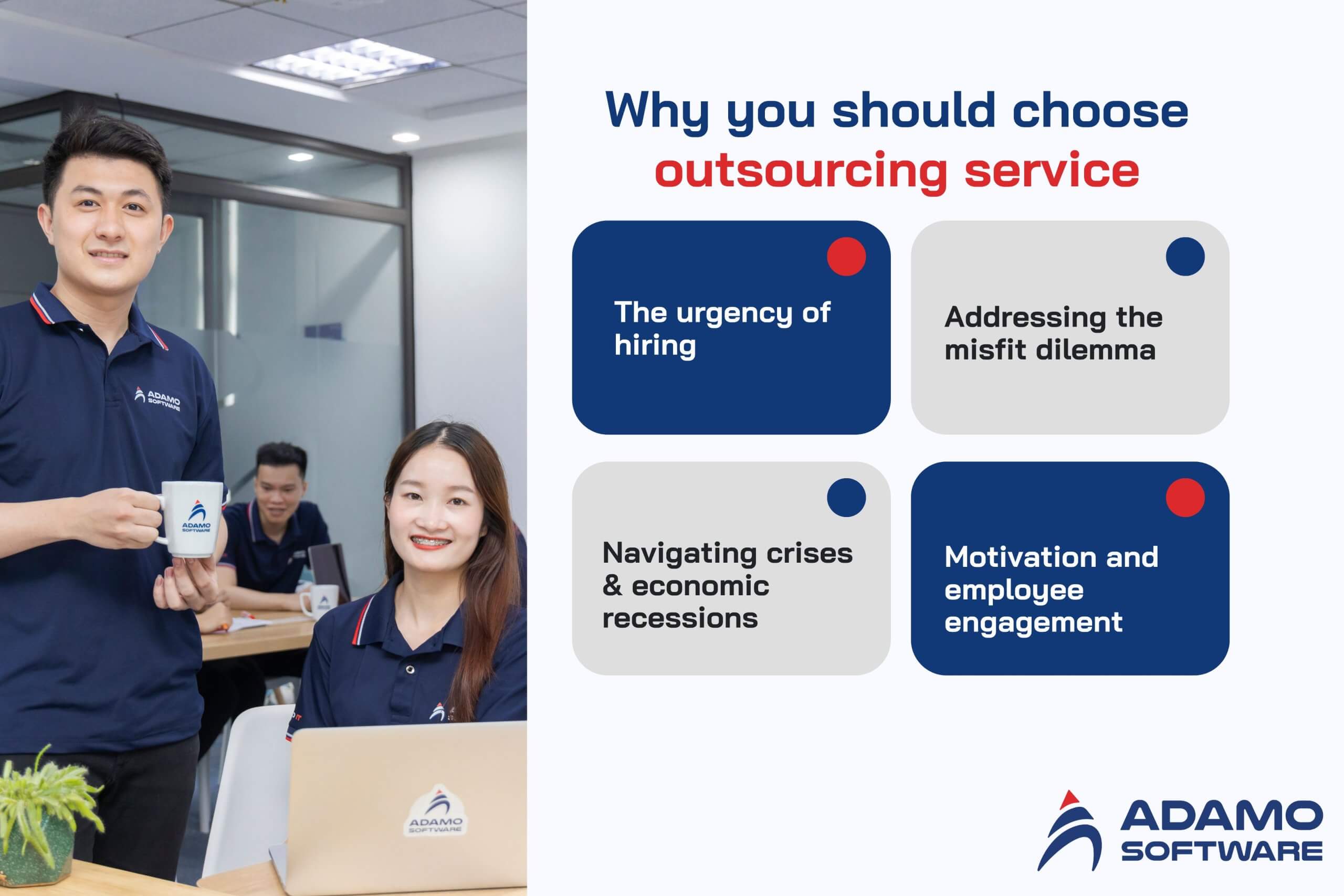
1. The urgency of hiring
Today, in the fast-moving business environment, an urgent hiring need may be necessary because of a sudden employee departure or an increased project demand. In times like these, companies should pause important business processes to fill the gap in their staffing or find an alternative solution immediately.
An alternative that works is outsourcing. By paying a slightly higher fee (typically 15-20 percent above standard outsourcing rates), companies can have qualified professionals working within days rather than weeks or months. That minimizes downtime and allows important tasks to continue uninterrupted.
Another option is using an HR agency, which will come with many fees that can strain budgets. However, through insourcing vs outsourcing cost analysis, most companies have realized that outsourcing is a faster and more affordable way to get staffed up quickly. This approach helps them get back to productivity and meet deadlines.
2. Addressing the misfit dilemma
The right candidate to hire is crucial but often is a gamble. Companies spend lots of money choosing candidates and find they’re missing certain skills or don’t work with the company culture.
This risk is mitigated by outsourcing to a service provider who can provide a substitution guarantee. If outsourced people don’t fit, businesses can replace them in a week or less and cause minimal project disruption.
On the other hand, insourcing involves long procedures for off-boarding and on-boarding that can take weeks or months. An insourcing vs outsourcing cost analysis shows how outsourcing provides agility. It also reduces the costs of mismatched hires, which helps keep teams effective and aligned with objectives.
3. Navigating crises and economic recessions
Workforce decisions come quickly under economic downturns and financial crises, such as the 2022-2024 tech industry layoffs across major companies that affected hundreds of thousands of in-house engineering staff.
Flexibility is provided by outsourcing. Ending an outsourcing arrangement is as easy as a phone call if you have to reduce staff due to financial constraints. It is very flexible, which allows businesses to change quickly without incurring the emotional and legal burden of firing in-house staff.
During turbulence, an insourcing vs outsourcing cost analysis may show how outsourcing simplifies workforce management while minimizing risk. This makes it a strategic choice for navigating a crisis.
4. Motivation and employee engagement
Sustaining productivity and maintaining high-quality output depends on employee motivation. But that requires constant attention from the management team.
Shifting this responsibility to external service providers allows internal leaders to focus on strategic initiatives instead of daily personnel management. Companies can conduct an insourcing vs outsourcing cost analysis to learn that outsourcing increases operational efficiency. Also, this allows their internal teams to focus on high-impact activities.
Many benefits are available to businesses of all sizes when they outsource. Outsourcing addresses urgent hiring needs quickly and mitigates the risks of employee misfits. It allows flexibility during economic downturns. Additionally, it frees up internal teams to focus on core strategies.
By carefully conducting an insourcing vs. outsourcing cost analysis, organizations can make educated decisions regarding insourcing and outsourcing. This will help increase efficiency, cut costs, and maintain their long-term success.
IV. Benefits of Insourcing vs Outsourcing: What to choose?
Self-performance vs outsourcing is a common consideration when managing different operations within a business. Each approach has its merits, similarities, demerits, and differences. The best category depends on the goals, resources, and priority of the organization participating in the show. The drawbacks and benefits of insourcing vs outsourcing shall be discussed further to assist you in making the right decision.
1. Insourcing Pros & Cons
Insourcing entails managing work activities, projects, or processes locally within the organization. Here are its advantages and disadvantages:
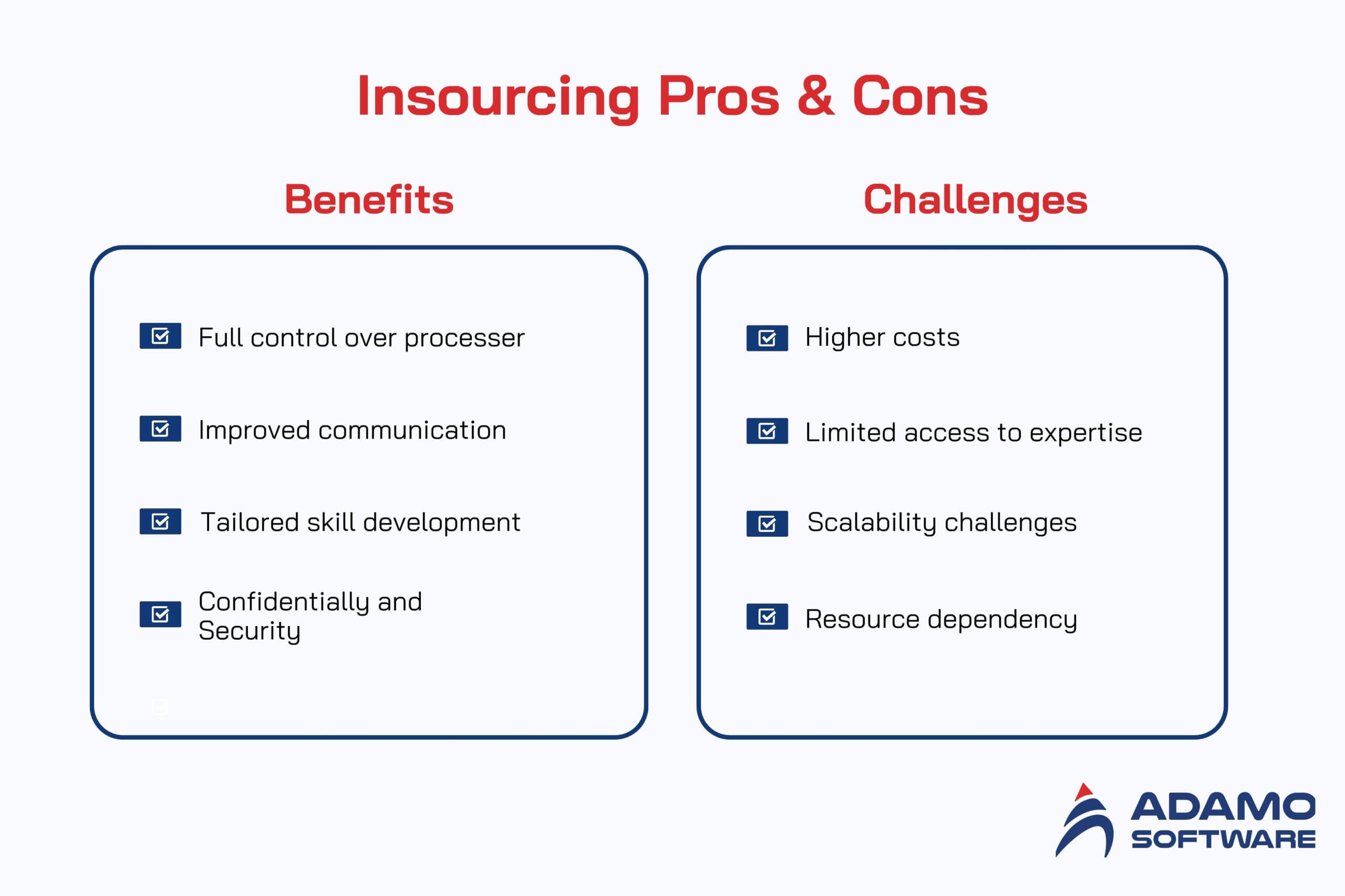
Pros of Insourcing:
- Full Control Over Processes: Insourcing gives you full authority to run an operation from within your organization. This helps make a performance more relevant to the firm’s goals and objectives.
- Improved Communication: In addition, insourcing strengthens your team’s cooperation. They are located in the same building and share the same working space. This makes communication effective.
- Tailored Skill Development: It also improves the expertise inside an organization by training employees to fit the organization’s needs.
- Confidentiality and Security: Because all the processes remain internal, there is little chance of compromising vital information.
Cons of Insourcing:
- Higher Costs: Insourcing requires salaries, infrastructure, training, and tools, which can debilitate budgets, especially for smaller businesses.
- Limited Access to Expertise: You might not always have the specialized skills needed for certain tasks. This leads to slower results or lower quality.
- Scalability Challenges: Expanding operations through insourcing takes time and resources, making scaling harder.
- Resource Dependency: Relying solely on internal resources limits your ability to scale capacity up or down in response to demand shifts.
2. Outsourcing Pros & Cons
Outsourcing is delegating certain unit operations to organizations other than the firm that needs the service. This approach is common for efficiency’s sake and broad access to certain specialized knowledge.
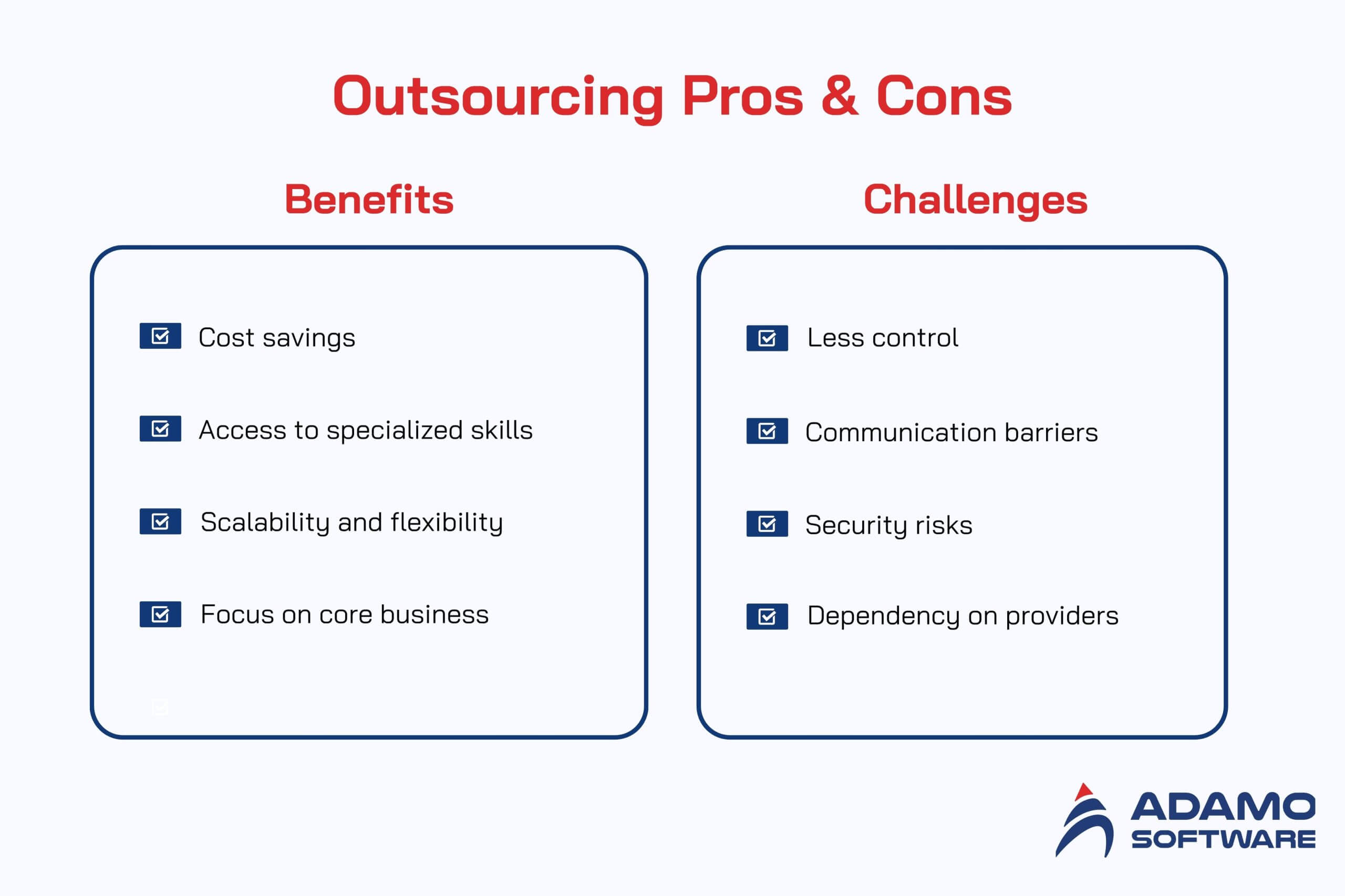
Pros of Outsourcing:
- Cost Savings: Outsourcing is less costly than in-house because it doesn’t require acquiring staff, facilities, or equipment for full-time use.
- Access to Specialized Skills: Outsourcing provides you with personnel who have worked for quite a long time in their respective fields. Hence it provides quality services.
- Scalability and Flexibility: They can easily increase or reduce the number of staff. That makes outsourcing flexible for your business.
- Focus on Core Business: Outsourcing nonbusiness activities means your internal team may focus only on business activities that would drive performance.
Cons of Outsourcing:
- Less Control: Outsourced tasks typically involve less direct management over day-to-day processes, requiring stronger upfront specifications and ongoing quality oversight.
- Communication Barriers: Co-ordination with external teams, especially in different parts of the world causes a lot of complications.
- Security Risks: The data flow to third parties comes with the likely chance of exposing that information to hackers or leakages.
- Dependency on Providers: Situations may arise when an external provider fails to provide the services or may terminate the contract with the organization.
A clear demarcation between the benefits of insourcing vs outsourcing is crucial for any organization that is keen on expanding. Insourcing gives necessary control, safety, and customized services. However, it is expensive with significant scalability problems. Meanwhile, outsourcing is affordable, versatile, and available. However, it has drawbacks such as lack of control or confidentiality. Making a comparison between the weaknesses and benefits of insourcing vs outsourcing enables you to select a strategy that would be best suited for a particular objective.
V. How to decide: Insource vs Outsource?
The decision of whether to insource or outsource a particular activity can be difficult. Both have their pros and cons. It has some contingent factors such as your company’s objectives, resource constraints, and working requirements. Below we are explaining how to approach the decision-making and determinants of insourcing and outsourcing:
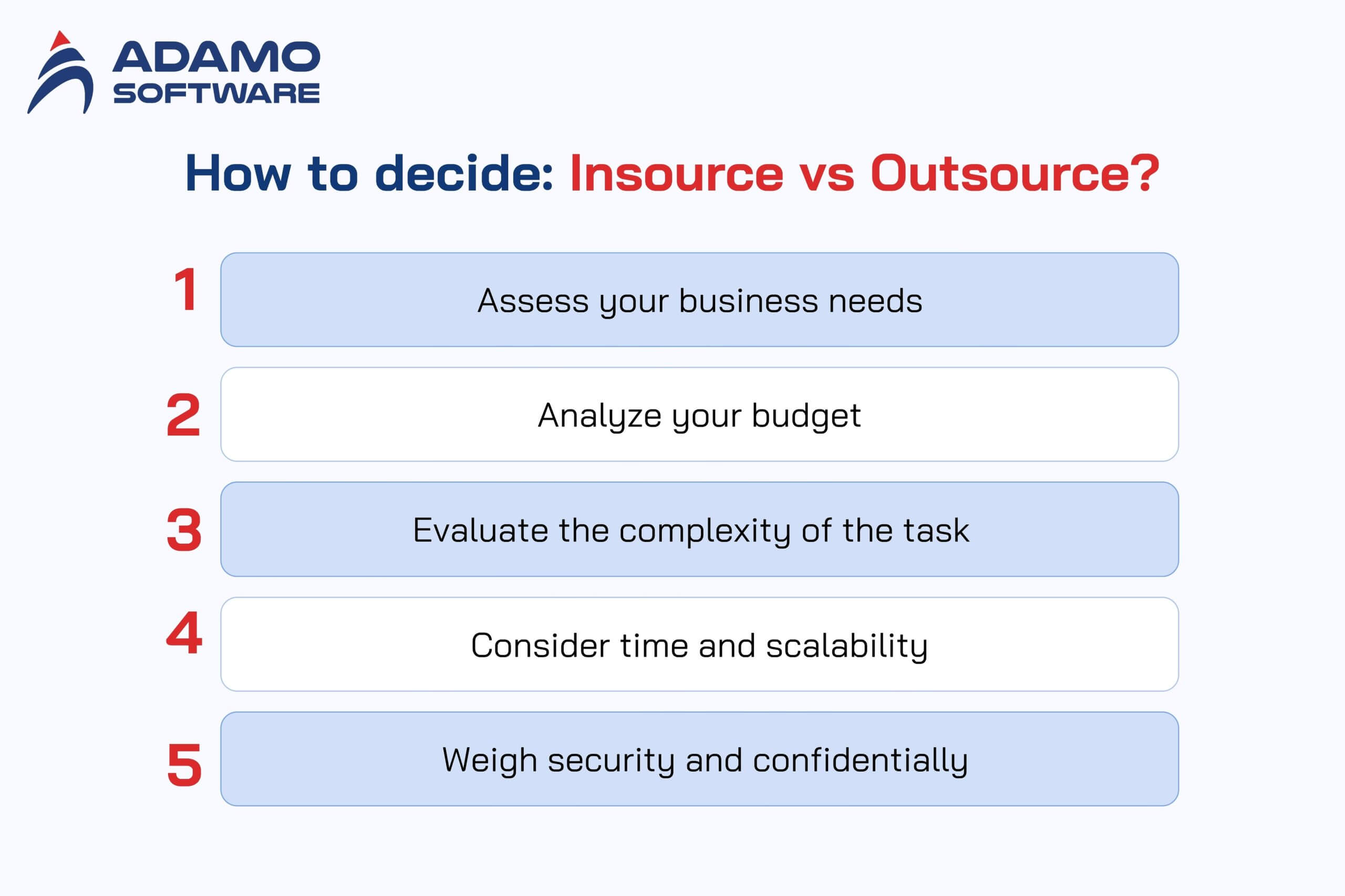
1. Assess Your Business Needs
Start with an analysis of your existing business needs and strategic targets. If a task requires unique skills or relates to a particular industry or activity, it is better to outsource it to another party. Another advantage is that outside suppliers can provide qualified people and effective equipment. On the other hand, if the task demands close supervision, frequent information exchange, or enjoys strategic importance to your enterprise, it is best to insource.
Whether the task is well aligned with the long-term vision and mission. For instance, you may want to use insourcing to strengthen competency within your organization while promoting employee teamwork. On the other hand, outsourcing enables the quick outsourcing of activities without putting much pressure on internal resources in scaling up operations on key activities.
2. Analyze Your Budget
Based on budget, business organizations can determine whether it is better to insource or outsource. Insourcing, in general, may entail greater costs in the initial stage including searching for full-time workers or trainers, and building and equipping structures. Such costs are rather prohibitive – more so when it comes to small businesses with constrained cash flows.
Contrary to this, outsourcing is usually cheaper. Because outsourcing companies have invested heavily in determining the optimum price for every service they offer. As it enables them to only pay for specific services. There will be no need for infrastructure costs such as staff and workplace. Nonetheless, whilst outsourcing can start with a seemingly lower cost price, costs such as contract management or quality assurance can quickly add up.
3. Evaluate the Complexity of the Task
The complexity of the task is another key factor in the insourcing versus outsourcing decision. If a task requires petty, mundane, and ceremonial tasks to be carried out or done frequently, outsourcing can be productive. Many organizations outsource routine processes such as call centre operations, data entry, or first-tier customer support.
Nevertheless, the source selection method such as insourcing may be necessary, if the job is intricate and delicate, or regularly innovated. In-house teams also know the organizational culture, its values, and requirements. This might sometimes be beneficial for such projects, the study noted.
4. Consider Time and Scalability
The constraints are the limited amount of time that an organization takes to decide whether to insource or outsource. When there is a need to advance a solution in record time, outsourcing offers existing know-how, equipment, and workforce. This is particularly beneficial when a company is looking to quickly grow or even diversify into new markets.
With this context in mind, insourcing is better for organizations that are interested in long-term stable solutions. Soon, one may hire people and provide all the necessary training. It will pay off, as the employees will be loyal, and the work – of high quality.
5. Weigh Security and Confidentiality
This part of the decision-making process cannot ignore matters of security regarding deciding which option is best between insourcing and outsourcing. From the perspective of protection for certain content including customer information and corporate secrets, insourcing may have the advantage. Staff in-house are not likely to leak any compromising information and this cuts risks.
Outsourcing has the disadvantage of information security since it is managed by a third party. To avoid this, select a good outsourcing partner. They should be able to honor and implement data security measures that are recommended in the market.
Outsourcing and insourcing both are strategies that completely depend on the requirements, goals, budget, and vision of the organization. When comparing the benefits of insourcing vs outsourcing, which action is proper, factors such as complexity, cost, time, and security must be considered. There is greater and direct control, and flexibility to collaborate and build long-term utility in insourcing than there is in outsourcing. Yet outsourcing has the attributes of flexibility, cost control, and quick scalability. By considering them, you get to make the correct decision when it comes to your business and realizing your objectives.
VI. Insourcing vs Outsourcing: Real-world patterns from custom software projects
Beyond the cost numbers, the decision often depends on specific situational patterns. The following are three patterns that consistently emerge in custom software development engagements across industries.
1. Pattern: Operational control insourced, specialised work outsourced
A common pattern for mid-size and enterprise companies is to insource the work that defines competitive advantage and outsource the work that supports it. A travel technology operator might insource their core booking engine team because the booking logic IS the product, but outsource mobile app development, third-party integrations, and admin dashboards.
This split pattern preserves IP control over the core while accessing offshore cost advantages for the supporting layer. The key requirement is clear interface contracts between insourced and outsourced work, typically through well-documented APIs.
When this pattern fits: Mid-size technology companies, hospitality operators, healthcare platforms, and any operator where some software is competitive differentiator and some is commodity.
2. Pattern: Outsourcing for capacity expansion without permanent headcount
A second common pattern is using outsourcing as a flexible capacity layer over a stable in-house team. The in-house team handles architecture, code review, and product ownership. Outsourced developers provide implementation capacity that can flex up or down based on roadmap demand.
In a 2-year project lifecycle, this pattern might look like: a 3-person in-house team plus 4-6 outsourced developers during build-out phases, scaling back to 3 in-house plus 1-2 outsourced during maintenance phases. The in-house team retains institutional knowledge while the outsourced capacity scales with actual workload.
When this pattern fits: Companies with variable project pipelines, startups scaling product features faster than they can hire, and enterprises with seasonal or campaign-driven development demand.
3. Pattern: Full outsourcing for non-core projects with vendor accountability
A third pattern is full outsourcing for projects clearly outside the company’s core domain. An e-commerce retailer needing a B2B distributor portal, a hospitality operator needing an HR system, or a logistics company needing a customer reporting platform might fully outsource because these systems are operationally necessary but not strategically core.
Full outsourcing in this pattern requires strong vendor selection (track record in the specific domain), clear acceptance criteria, and structured maintenance contract. The cost savings come from not having to recruit, retain, and manage developers for work that does not justify permanent in-house capacity.
When this pattern fits: Non-tech companies needing software for internal operations, companies with one-off platform needs, and companies where the project sits outside the existing development team’s expertise.
What these patterns share
In all three patterns, the decision is not “insource everything” or “outsource everything”. It is matching the work type to the engagement model. Companies that approach insourcing versus outsourcing as an either-or decision typically end up with worse outcomes than companies that segment their work and apply different models to different segments.
VII. Tips to identify excellent outsource service provider
The greatest asset in outsourcing is identifying the right partner for your business to be a success. Outside service providers that extend full support can significantly contribute to promoting the benefits of insourcing vs outsourcing. It produces higher quality work to ensure that the project is completed on or before the deadline and by the goals set. Below are some clear ways to look for the right outsourcing partner for your business:
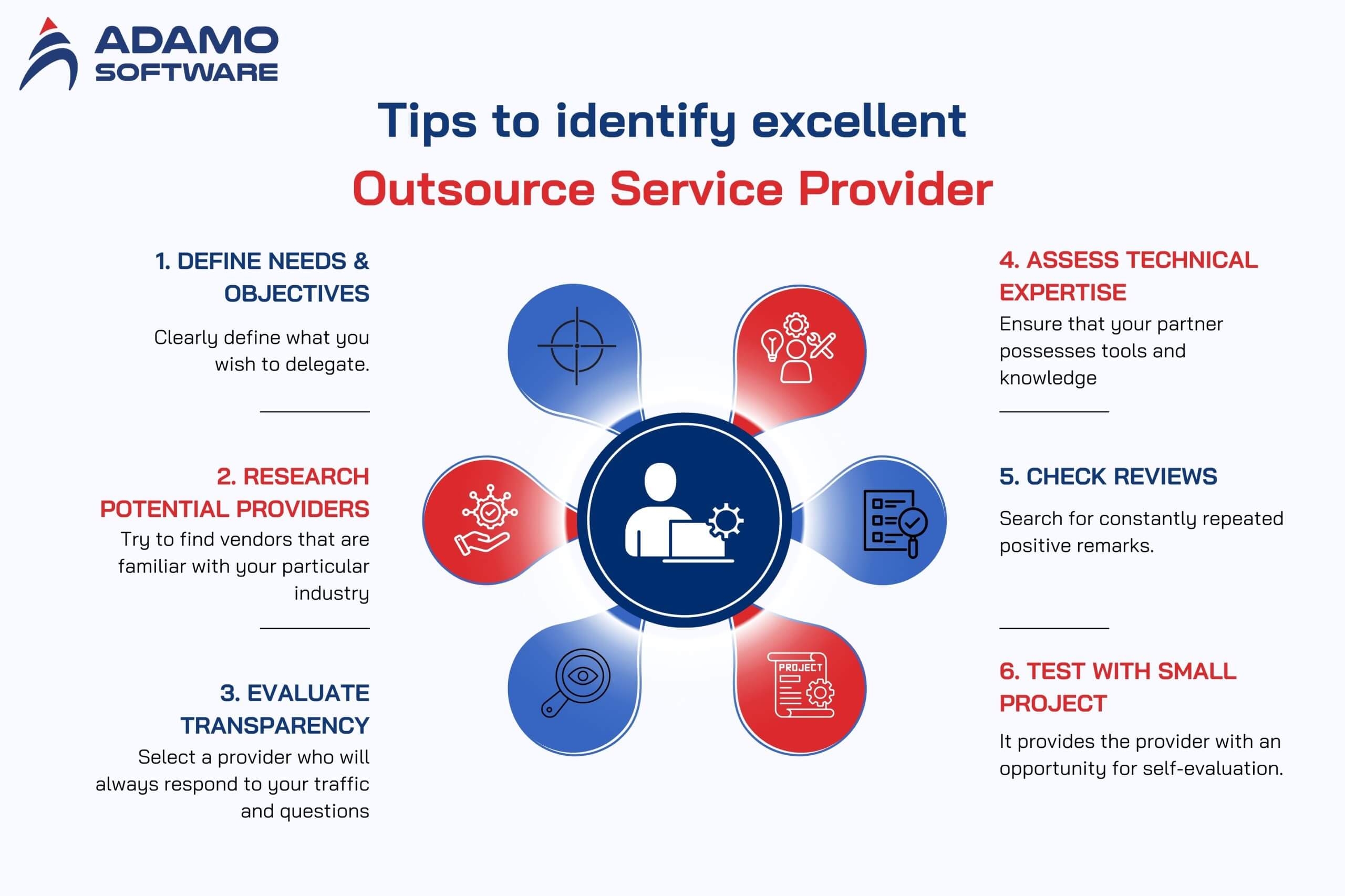
1. Define Your Needs and Objectives
This process should begin before scouting for an outsourcing partner. You need to determine your needs and wants. Clearly define what you wish to delegate, the competencies you require, and the expected results. From the above list, this clarity will enable a user to filter through the providers that can offer the service.
If your priority is cost-effective delivery, look for providers with strong portfolios in your domain and competitive pricing. If scalability is the main requirement, prioritise vendors with proven experience managing flexible workloads. However, if the scalability of the IT services is the main aspiration, it is better to pay attention to the vendors with experience in managing maneuverable workloads. Insourcing vs outsourcing requires a clear objective to derive optimal gains.
2. Research and Shortlist Potential Providers
Take time to research outsourcing providers properly. Vendor selection is the single highest-leverage decision in the outsourcing process. If possible, try to find vendors that are familiar with your particular industry because they will comprehend your problem. Our rationale for seeking out effective health providers is to focus on online referrals and reviews.
Check out their portfolio services and the cases they have handled to determine their competence and effectiveness. This is one of the factors that hold that the capability of the provider to complete such projects can be deemed as evidence of their aptness. This research guarantees the benefits of insourcing vs outsourcing by collaborating with a competent team to get the best results.
3. Evaluate Communication and Transparency
The working relationships can only be harmonious if the parties involved have effective communication during outsourcing. Select a provider who responds promptly and clearly to questions during the evaluation stage. They should provide a clear outlook on what is expected. Even in the course of a general conversation, one should determine whether the person can define your objectives and give distinct solutions.
Inquire about their communication channel and frequency, how often are they receiving updates, how are they receiving the updates, and who from. Pricing, timelines, and deliverables must be both clear to the clients and rational. A good provider should describe possible risks and obstacles encountered when investing and present reasonable solutions to tackle.
4. Assess Technical Expertise and Resources
One of the strongest advantages of outsourcing is access to specialised skills and infrastructure without the cost of building them in-house. Ensure that your partner possesses tools and knowledge.
To get a first-hand impression of the candidates’ performance, do interviews or ask for samples of work. You should get to know if their team members are competent, the preferences they have when choosing technologies, and how they ensure quality. An able provider will have adequate knowledge and instruments to provide quality service.
5. Check References and Reviews
Check references and reviews when evaluating outsourcing providers. Get phone numbers of previous clients and inquire from them if they had a pleasant encounter with your firm. This feedback will help you get information about how often you can rely on the selected provider and how qualified is the provider’s team. You will also know whether they can complete the task before the due date.
Online reviews and testimonials can also be helpful in a way to gather information. One should search for constantly repeated positive remarks more so focusing on the provider’s professionalism, communication, and knowledge. This is how checking references assists in decreasing possible risks and experiencing as many benefits of insourcing vs outsourcing as possible.
6. Test with a Small Project
Also, before agreeing to a long-term relationship, you might want to begin with a trial: a small business. It provides the provider with an opportunity for self-evaluation in terms of friendliness, performance, and communication with the business.
Find out if the results align with your expectations. If the provider shows efficiency, quality of the completed work, and reliability, then, you can move forward. This helps in minimizing the risks and benefits of insourcing vs outsourcing.
Therefore, to successfully implement the strategy of insourcing versus outsourcing, it is necessary to choose an outstanding outsourcing service provider. By identifying the needs, evaluating the probable vendors, and comparing their capabilities you can come out with a conclusion. Concentrate on the aspect of communication, openness, and customer satisfaction to look for a suitable partner. When choosing the right provider you can reach the goals of reducing costs and getting access to special skills. Therefore, you can increase business effectiveness and productivity.
VIII. How Adamo Software approaches outsourcing engagement
Adamo Software has worked with companies across the United States, Europe, Australia, and Asia on custom software development projects ranging from MVP builds to multi-year platform engagements. Our typical engagement falls into one of three categories that map to the patterns described above.
For companies needing dedicated development teams, we build offshore teams that operate as an extension of internal engineering, with direct reporting into client product owners, integration with client development workflows (Jira, GitHub, Slack), and consistent team composition over multi-year engagements. This model fits the “specialised work outsourced” and “capacity expansion” patterns from Section VI.
For companies needing project-based delivery, we handle scope definition, architecture, development, QA, and deployment as a vendor-managed project. This model fits the “full outsourcing for non-core projects” pattern, where the client wants vendor accountability for outcomes rather than direct management of developers.
For companies needing specialised skills augmentation, we provide individual developers or small teams to fill specific skill gaps in existing client teams. This typically applies for advanced technical specialisations (AI/ML, blockchain, specific framework expertise) or when client teams need temporary capacity for specific project phases.
Our travel and hospitality practice has shipped multi-supplier B2B distribution platforms aggregating live inventory from millions of providers, hotel reservation and booking engines, all-in-one travel platforms managing tours, accommodations, and rentals through unified inventory systems, and global air experience booking platforms with multi-region payment integration. Our healthcare practice has shipped DHA-compliant telehealth platforms, AI-assisted wellness analysis applications, and clinical workflow systems for hospital operators. Engagement details for specific clients are protected under NDA, but our team can walk through anonymised architecture decisions and engagement specifics in a discovery call.
Whether your decision lands on insourcing, outsourcing, or a hybrid model, the most important thing is matching the engagement model to the work type. If you are evaluating options for an upcoming software development project, our team can help you scope the work, estimate realistic costs for both in-house and outsourced approaches, and identify which model fits your specific situation. Explore our dedicated development team services or contact us for a free consultation.
FAQs
1. What are the potential risks of insourcing?
Several risks associated with insourcing businesses need to be considered carefully. The biggest cost is the high price of hiring extra staff and building the necessary infrastructure. These expenses can stretch finances, especially for smaller organizations.
A second challenge is the risk of a shortage of expertise dedicated to the field. In-house teams might not have the right specific skills to do some tasks, which can hurt project quality and innovation.
Another one is scalability. Insourcing can slow it down for businesses, and they can’t quickly adapt to changing market demands. That’s when an insourcing vs outsourcing cost analysis can be conducted. If the additional expense and resource constraints are more expensive than outsourcing options, it may be useful to consider outsourcing.
In the end, these risks can draw us less focused on the key operations of our company and lower the efficiency of the whole.
2. How does outsourcing influence a company’s internal workforce?
Outsourcing can make a huge positive change for a company’s internal workforce. Delegating routine non-core activities to external providers frees internal employees to focus on strategic initiatives.
This shift reduces internal teams’ workload so they can spare some time and resources. This allows employees to focus on what matters most to the company: long-term goals and objectives.
Moreover, outsourcing also reduces stress on the team when dealing with heavy workloads. Businesses can assess whether insourcing or outsourcing tasks increases employee engagement and productivity. This can spur innovation and improve organizational performance through an insourcing vs outsourcing cost analysis.
3. Is outsourcing a good option for small businesses?
Absolutely! Outsourcing is a wonderful means for small businesses and startups to make the most of their resources without spending much money. Small businesses can leverage outsourcing providers’ expertise to deliver high-quality services that would otherwise be expensive to implement in-house.
It provides a better way of managing operational costs and improving efficiency in all areas. Insourcing vs outsourcing cost analysis can demonstrate how outsourcing allows small businesses to spend their budgets more smartly, allowing resources for growth and development.
Ultimately, outsourcing allows small companies to concentrate on their core strategy business while remaining competitive in the current fast-paced market.
4. Can a business implement both insourcing and outsourcing strategies?
Businesses can implement a hybrid approach to insourcing and outsourcing, effectively taking advantage of both insourcing and outsourcing. This balanced strategy allows organizations to maintain control over the critical functions essential to their vital mission. At the same time, they can outsource noncrucial functions to external providers.
By doing an insourcing vs outsourcing cost analysis, companies will be able to know which tasks would suit the in-house team better, and vice versa. This eventually helps companies allocate their resources effectively to increase productivity and flexibility
The hybrid approach allows businesses to adapt quickly to changing market conditions while keeping strategic functions aligned with business goals. Having the best of both worlds with this approach will also get companies a harmonious balance between control, efficiency, and innovation.

 adamosoft.com
 (+84) 373 11 44 88