
How to build an AI-powered Travel Booking Platform in 2026
The AI in travel market is projected to reach $222.4 billion in 2026, growing at a 34% compound annual growth rate (The Business Research Company, 2026). For travel companies (OTAs, tour operators, hospitality groups), this is not an abstract trend. It is a direct signal that the booking platforms they operate today will be inadequate within 12 to 18 months if they lack AI capabilities. This guide breaks down what it takes to build an AI-powered travel booking platform from a software engineering perspective: the architecture decisions, the technology stack, the integration points, and the tradeoffs between building custom versus buying off-the-shelf.
Key Takeaways:
- The AI in travel market is projected to hit $222.4 billion in 2026, growing at 34% CAGR (The Business Research Company, 2026).
- SaaS booking engines cap personalization and integration depth. Custom platforms become necessary when companies need proprietary pricing logic, first-party data ownership, or deep GDS connections.
- A modern travel booking platform uses a microservices architecture with six core services: search, booking, AI recommendations, dynamic pricing, conversational AI, and API gateway.
- GDS integration (Amadeus, Sabre, Travelport) typically accounts for 25 to 35% of total development effort. Caching, data normalization, and NDC support are non-negotiable.
- AI-driven recommendations improve conversion rates by up to 22%. Dynamic pricing delivers 7 to 12% revenue uplift.
- Building with MCP (Model Context Protocol) compatibility from day one positions platforms for the agentic AI era, where AI assistants book travel directly.
- Realistic timeline: 6 to 9 months with a dedicated team of 8 to 12 engineers to reach production-ready status with AI capabilities.
Why SaaS Booking Engines Are No Longer Enough
Most mid-size travel companies start with SaaS booking platforms like Cloudbeds, SiteMinder, or PHPTRAVELS. These tools work well for basic operations such as room availability, rate display, and reservation processing. The problem emerges when companies try to differentiate.
- SaaS platforms offer the same feature set to every customer. When a tour operator in Southeast Asia and a boutique hotel chain in Scandinavia use the same recommendation engine, neither gains a competitive edge. Personalization becomes a shared ceiling, not a differentiator.
- Integration limitations become bottlenecks quickly. Connecting to niche GDS providers, local payment gateways, or proprietary loyalty systems often requires workarounds that SaaS vendors do not prioritize. According to a DataInsightsMarket report, integration complexity remains one of the top barriers to online booking engine adoption for independent and mid-size properties.
- AI features in SaaS tools are typically surface-level. A chatbot that answers FAQs is not the same as a recommendation engine trained on your specific customer behavior data. The difference in conversion impact is substantial: early adopters of AI-driven recommendations in hotel tech reported conversion rate improvements of 22% (DataInsightsMarket, 2024).
The tipping point for building custom typically arrives when a company needs at least two of the following: proprietary pricing logic, deep integration with third-party systems, AI-driven personalization based on first-party data, or multi-channel distribution control.
Core Architecture of an AI Travel Booking Platform
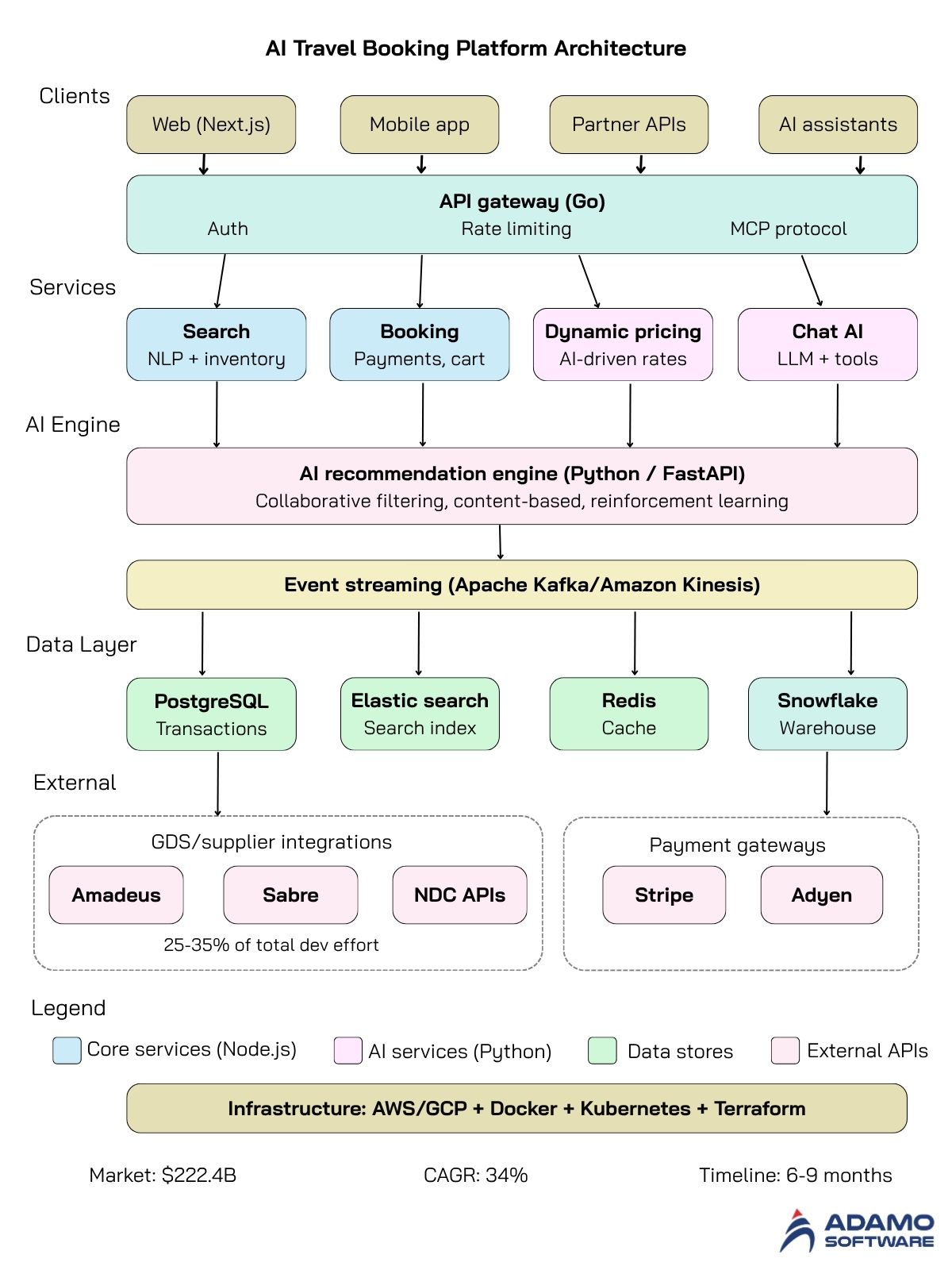
A modern AI-powered booking platform is not a monolithic application. It is a set of interconnected services, each handling a specific domain. Here is the architecture Adamo Software recommends based on delivery experience across travel projects:
Service Layer Breakdown
- Search and Discovery Service. Handles availability queries across multiple suppliers (hotels, flights, activities). This service must support natural language search, not just form-based filters. In 2026, travelers expect to type “beachfront hotel near Hoi An with pool under $80” and get accurate results. This requires an NLP layer that parses intent and maps it to structured inventory queries.
- Booking and Reservation Service. Manages the transactional core: cart management, payment processing, confirmation workflows, and cancellation policies. This service integrates with payment gateways (Stripe, Adyen, local processors) and must handle multi-currency transactions with real-time FX rates. For a deeper look at how online hotel reservation systems handle this flow, see our dedicated guide.
- AI Recommendation Engine. The differentiator. This service ingests user behavior data (search history, booking patterns, click-through data, reviews) and generates personalized suggestions. Collaborative filtering and content-based filtering are the baseline; more advanced implementations use reinforcement learning to optimize for conversion, not just relevance.
- Dynamic Pricing Service. Adjusts rates in real time based on demand signals, competitor pricing, seasonality, and inventory levels. Properties adopting AI-driven dynamic pricing report revenue uplifts between 7 and 12% (Prostay, 2026). This service requires a data pipeline that ingests market data continuously and a model that retrains on a regular cadence.
- Conversational AI Service. Handles chatbot and voice assistant interactions. This is not a basic FAQ bot. A production-grade travel chatbot needs to access live inventory, process bookings, handle multi-turn conversations, and escalate to human agents when confidence drops. Expedia Group’s AI service agent handles over 143 million conversations annually and has enabled more than 50% of travelers to self-serve without calling in (Expedia Group, 2025).
- API Gateway. Sits between the frontend and all backend services. Handles authentication, rate limiting, request routing, and response aggregation. Critical for multi-channel distribution where the same backend serves a website, mobile app, partner APIs, and potentially AI assistant integrations (via MCP or similar protocols).
Data Layer
- Primary Database. PostgreSQL for transactional data (bookings, user accounts, payment records). Relational integrity matters here because booking transactions cannot tolerate eventual consistency.
- Search Index. Elasticsearch for fast, full-text search across inventory. This is what powers the sub-second search results travelers expect.
- Cache Layer. Redis for session management, rate caching, and frequently accessed inventory data. A well-tuned cache layer reduces API calls to suppliers by 60 to 70%, which matters both for performance and for staying within GDS rate limits.
- Data Warehouse. For AI model training and business analytics. BigQuery or Snowflake are common choices. Snowflake launched a dedicated AI Data Cloud for Travel and Hospitality in 2024, signaling the importance of industry-specific data infrastructure.
- Event Streaming. Apache Kafka or Amazon Kinesis for real-time data flow between services. Every search query, click, booking, and cancellation becomes an event that feeds into the recommendation and pricing engines.
Technology Stack Recommendation
The technology choices below reflect what Adamo Software has validated across production travel platforms. These are not theoretical preferences. They are decisions based on delivery outcomes.
Backend
- Node.js (Express or Fastify) for API services that require high concurrency and low latency, particularly the search and booking services.
- Python (FastAPI) for AI and ML services. Python’s ecosystem for machine learning (scikit-learn, TensorFlow, PyTorch) and NLP (spaCy, Hugging Face Transformers) makes it the practical choice for recommendation engines and conversational AI.
- Go for the API gateway and any services where raw throughput matters. Go’s compiled nature and goroutine model handle concurrent connections efficiently.
Frontend
- React or Next.js for the web booking interface. Server-side rendering via Next.js improves SEO and initial load performance, both critical when 65% of travel bookings happen online and mobile page speed directly impacts abandonment rates.
- React Native or Flutter for cross-platform mobile apps. The choice depends on existing team expertise. React Native offers stronger ecosystem maturity for travel use cases; Flutter offers better performance for animation-heavy UIs.
Infrastructure
- AWS or GCP for cloud hosting. AWS has deeper travel-specific services (Amazon Personalize for recommendations, Amazon Connect for contact center AI). GCP has advantages in BigQuery and Vertex AI for ML workloads.
- Docker and Kubernetes for containerization and orchestration. Non-negotiable for a microservices architecture where each service scales independently based on load.
- Terraform for infrastructure as code. Ensures reproducibility across staging and production environments.
GDS and Supplier Integration: The Hardest Part
Integrating with Global Distribution Systems (Amadeus, Sabre, Travelport) is where most travel platform builds encounter their biggest friction. GDS APIs are powerful but complex. They were designed decades ago and carry legacy patterns that modern developers find unintuitive.
- Authentication and credentialing require formal agreements with each GDS provider. Lead times can be 4 to 8 weeks. Plan for this in the project timeline.
- Rate limiting is aggressive. Amadeus, for example, enforces strict quotas on search requests. Without a caching strategy, a booking platform can exhaust its daily quota during a traffic spike and return empty results to users.
- Data normalization is essential. Each GDS returns availability data in different formats, with different naming conventions, and different update frequencies. The search service must normalize this into a unified schema before presenting results.
- NDC (New Distribution Capability) is becoming the standard for airline content. Airlines like Lufthansa and American Airlines increasingly distribute through NDC rather than traditional GDS channels. A forward-looking booking platform must support both legacy GDS and NDC APIs.
Adamo Software has found that GDS integration alone typically accounts for 25 to 35% of total development effort on a travel booking platform project. Teams that underestimate this consistently miss deadlines.
The AI Components That Actually Move the Needle
Not every AI feature delivers equal business impact. Based on market data and delivery experience, here is where AI investment generates the clearest ROI in a travel booking platform:
1. Personalized Recommendations
According to MarketsandMarkets, booking management systems represent the largest market share within AI in tourism solutions. The core mechanism is straightforward: ingest user behavior data, build user profiles, and serve recommendations that match individual preferences. The implementation, however, requires careful data pipeline design.
- Start with collaborative filtering (users who booked X also booked Y) as a baseline.
- Layer in content-based filtering (match property attributes to user preference vectors).
- Graduate to contextual bandits or reinforcement learning models that optimize for conversion rather than click-through. This is where the real uplift appears.
2. Dynamic Pricing
AI-driven pricing is no longer a luxury-hotel-only tool. The model ingests demand signals (search volume, competitor rates, local events, weather forecasts, booking pace) and outputs optimal rates. The key technical challenge is latency: pricing must update in near-real-time without creating rate parity violations across distribution channels.
3. Conversational Booking
The travel industry is moving toward agentic AI, systems that do not just respond to questions but take autonomous action. RateGain Travel Technologies launched the first MCP-enabled booking engine in 2025, allowing AI assistants like Claude to transact directly with travel inventory. Booking.com and Expedia followed with their own AI ecosystem integrations. For any new platform, building with MCP (Model Context Protocol) compatibility from day one is a strategic investment.
4. Intelligent Search
Natural language search replaces rigid form-based interfaces. A traveler types a conversational query; the system parses intent, extracts parameters (location, dates, budget, preferences), and returns ranked results. This requires an NLP pipeline that handles ambiguity, synonyms, and multi-language inputs. If you are exploring how to build an AI chatbot for travel, the technical foundations start here.
Build vs. Buy: A Decision Framework
The decision to build a custom AI travel booking platform versus purchasing a SaaS solution depends on five factors:
- Data ownership. If first-party customer data is your competitive advantage, custom build is the clear choice. SaaS platforms typically restrict access to raw behavioral data.
- Integration depth. If the platform must connect to proprietary systems, niche suppliers, or custom loyalty programs, SaaS limitations will surface quickly.
- Pricing logic complexity. Revenue management strategies that go beyond standard yield management require custom pricing engines.
- Scale trajectory. The online travel booking platform market is estimated at $730 billion in 2026, growing at 8.4% CAGR to nearly $930 billion by 2035 (Global Market Statistics, 2026). Companies planning for significant growth need architecture that scales without vendor-imposed ceilings.
- Time to market. SaaS wins for MVP and proof-of-concept. Custom wins for long-term competitive differentiation. A hybrid approach (SaaS for immediate launch, custom components added iteratively) often makes the most pragmatic sense.
What a Realistic Development Timeline Looks Like
Based on Adamo Software’s delivery experience with travel platform projects:
- Discovery and architecture design: 3 to 4 weeks. Includes requirements analysis, GDS partner evaluation, and system design documentation.
- Core booking engine (search, booking, payments): 12 to 16 weeks. This is the transactional backbone without AI features.
- GDS and supplier integrations: 8 to 12 weeks, often running in parallel with core development. Includes credentialing lead times.
- AI recommendation engine (v1): 6 to 8 weeks. Initial model based on collaborative filtering with a data pipeline for continuous improvement.
- Dynamic pricing module: 4 to 6 weeks. Requires market data feeds and a model training pipeline.
- Conversational AI (chatbot with live inventory access): 6 to 8 weeks. Includes LLM integration, tool-use API design, and fallback-to-human workflows.
- Testing, optimization, launch: 4 to 6 weeks.
Total timeline for a production-ready platform with AI capabilities: approximately 6 to 9 months with a dedicated team of 8 to 12 engineers.
Conclusion
The AI travel booking platform market is not emerging. It is here. With the global AI in travel market growing at 34% CAGR and the online travel booking market approaching $730 billion in 2026, the question for travel companies is not whether to integrate AI into their booking platforms, but how fast they can build systems that leverage their own data, connect deeply with suppliers, and deliver the personalized, autonomous experiences travelers now expect. The companies that treat their booking platform as a strategic asset, not a commodity SaaS subscription, will capture disproportionate market share as the industry shifts from digital-first to AI-native.
Build Your AI-Powered Travel Platform With Adamo
Adamo Software engineers custom travel booking platforms with integrated AI capabilities, from recommendation engines and dynamic pricing to conversational booking and GDS integrations. Our team has delivered travel technology solutions for OTAs, tour operators, and hospitality groups across North America, Europe, and Southeast Asia, with architecture designed to scale from launch to millions of transactions. Contact us for a free consultation: https://adamosoft.com/contact-us/

 adamosoft.com
 (+84) 373 11 44 88