
AI Travel Assistants: Types, Features & Why Travelers Love Them
AI travel assistants understand natural language, search live inventory, complete bookings, and support travelers around the clock. Here is what they are, the types and features, how they are built, the technical architecture, build phases, and cost.
An AI travel assistant is software that does more than answer questions. It understands a request in plain language, searches real inventory across suppliers, compares options, recommends with reasoning, completes the booking with payment, and handles changes afterward. The market is moving fast. The AI-powered personal travel assistant market was valued at USD 756.76 million in 2025 and is projected to reach USD 1.13 billion by 2030, growing at 8.4 percent CAGR (360iResearch, 2025). For travel companies, the question has shifted from whether to build an AI assistant to how quickly they can ship one that actually books trips.
Key Takeaways
- An AI travel assistant acts, not just chats. It searches live inventory, books, and manages trips, unlike a chatbot that answers scripted questions and redirects.
- 40 percent of travelers already use AI tools for trip planning (Statista, 2025), and 78 percent of those who use an AI assistant have booked based primarily on its recommendation (TakeUp, 2026).
- A production-grade assistant needs five components: an LLM reasoning layer, tool-use APIs for live inventory, conversation memory, guardrails with human escalation, and multi-channel deployment.
- Typical build timeline is 4 to 7 months with a team of 6 to 10 engineers, driven mostly by GDS and booking-system integration complexity.
- Customer support is one of the highest-value uses: AI assistants resolve most routine inquiries autonomously and escalate the rest with full context.
What Is an AI Travel Assistant?
AI travel assistants are built on machine learning and natural language processing to help travel businesses serve customers with less manual work. They handle inquiries, personalize itineraries, surface options, and support travelers through the whole journey, for both the traveler and the business behind the scenes. The value is not novelty. It is a measurable shift in how travelers plan and book: AI usage for travel doubled from 11 percent to 24 percent between October 2024 and mid-2025 (Global Rescue, 2025), and 94 percent of AI users now trust AI travel recommendations at least as much as search engines and OTA reviews (TakeUp, 2026).
AI Travel Assistant vs Travel Chatbot
The terms are used interchangeably, but they describe different systems, and the distinction matters before you build.
A travel chatbot responds to predefined queries. It answers questions about amenities, flight status, or cancellation policies, operates within a fixed scope, and redirects users to a website or phone line when a request exceeds that scope. Most chatbots deployed before 2024 fall into this category.
An AI travel assistant acts. It understands a natural-language query (“find me a beachfront hotel in Da Nang for 4 nights under $100 with a pool and breakfast”), searches real inventory across suppliers, compares options, presents recommendations with reasoning, completes the booking with payment, and handles modifications and disruptions afterward. It keeps context across a conversation, remembers preferences across sessions, and improves with every interaction.
The technology gap is large. A chatbot needs scripted decision trees and FAQ databases. An assistant needs LLM orchestration, tool-use APIs connected to live booking systems, conversation memory, confidence-based escalation, and multi-channel deployment. The business gap is larger still: Expedia Group’s AI service agent handles over 143 million conversations a year, with more than half of travelers self-serving without calling in (Expedia Group, 2025).
The AI Travel Assistant Market in 2026
Three forces are driving investment in AI travel assistant development.
Traveler behavior has shifted permanently. 40 percent of travelers worldwide already use AI-based tools for trip planning (Statista, 2025). Among those who have tried AI assistants, 63 percent now rely on them for most or every trip, and 96 percent say they will use AI again for future planning (TakeUp, 2026).
Trust has crossed the threshold. 94 percent of AI users trust AI-generated travel recommendations at least as much as traditional sources, and 84 percent say a trusted AI recommendation makes them more likely to book a specific property (TakeUp, 2026). The trust gap that held back adoption for years is closing.
The competitive window is narrowing. Sabre, PayPal, and MindTrip announced a partnership in February 2026 to build the travel industry’s first end-to-end agentic booking pipeline, covering more than 420 airlines and 2 million hotel properties (OAG, 2026). Google is building agentic booking into its AI Mode, and Amadeus, Microsoft, and Accenture launched a trip-planning agent inside Microsoft Teams. Companies that do not build assistant capabilities now will compete against these platforms with a multi-year head start.
Types of AI Travel Assistant Solutions
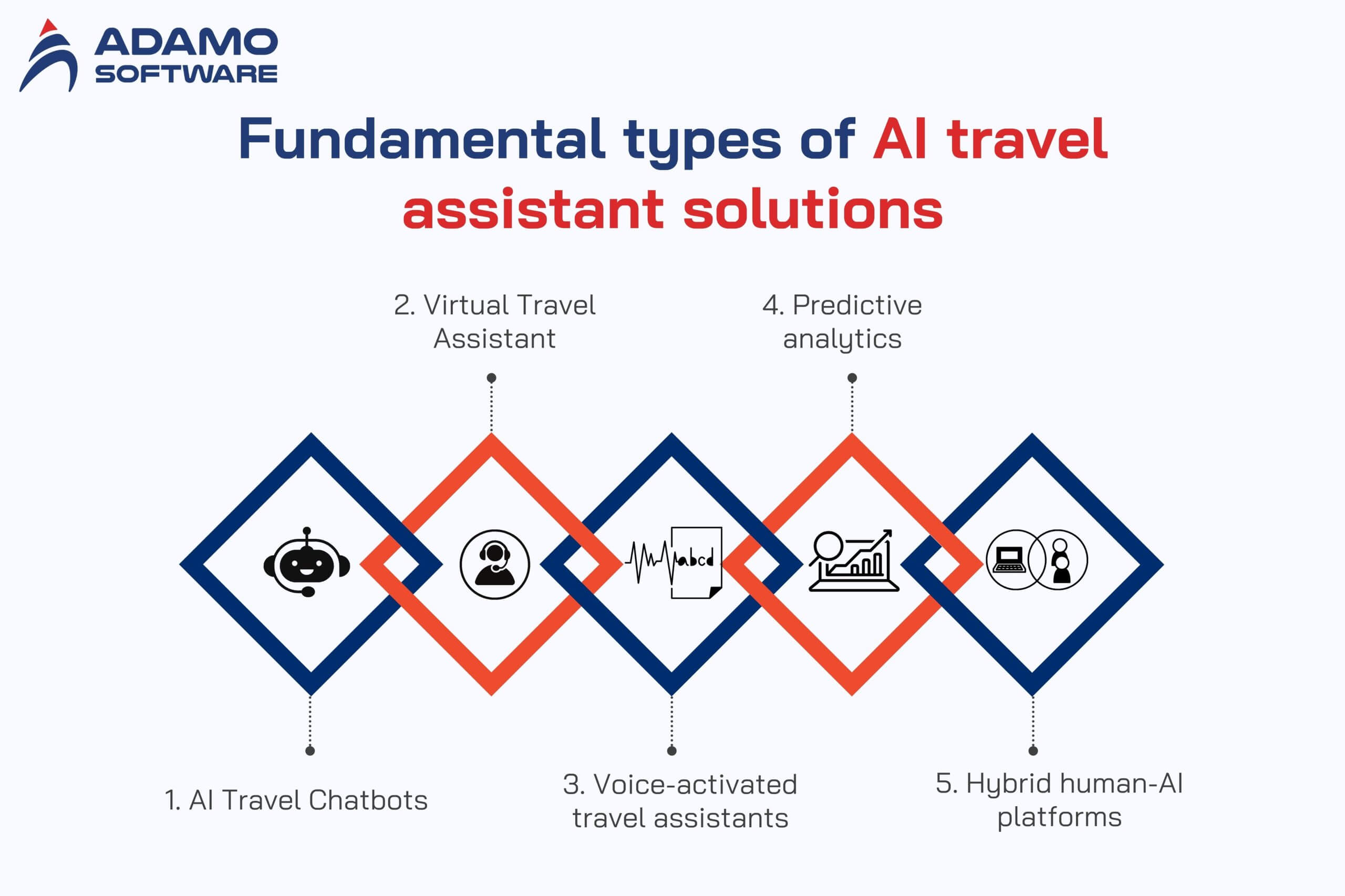
AI travel chatbots. Flexible and comparatively affordable, chatbots handle customer requests in real time: answering FAQs (baggage policies, check-in times), pushing itinerary updates and delay alerts, and supporting booking changes and cancellations. They are the entry point, best suited to high-volume, routine questions.
Virtual travel assistants. A step beyond chatbots, these handle multi-turn conversations and complex queries, book hotels, set reminders, rebook flights, and suggest tailored options rather than pre-set replies. They work across booking systems, calendars, and maps to organize a whole journey.
Voice-activated assistants. Voice interfaces (Alexa, Google Assistant, or a custom voice layer) let travelers check availability, update an itinerary, or get flight updates hands-free, which is valuable when they are on the move.
Hybrid human-AI platforms. These combine AI speed on routine tasks with human intervention for complex cases such as luxury travel or dispute resolution. Corporate platforms use this model to automate travel-policy enforcement while letting human agents personalize itineraries.
Key Features of an AI Travel Assistant
Automated reservation management. Handles hotel, flight, and transport bookings, and modifies, cancels, or rebooks as needed.
Personalized recommendations. Analyzes preferences and past bookings to tailor accommodation, transport, and activity options to each traveler.
Real-time updates and alerts. Notifies travelers of schedule changes and disruptions and enables quick adjustments.
24/7 customer support. Answers common queries, from baggage rules to entry requirements, across digital and voice channels at any hour.
Seamless platform integration. Connects with airlines, hotels, and other services so a traveler who books a flight can receive hotel suggestions, in-stay support, and dining reservations without switching tools.
Multilingual support. Communicates in a traveler’s preferred language with in-context translation, smoothing interaction abroad.
AI Travel Assistants for Customer Service and Support
Customer service is one of the highest-value applications of an AI travel assistant, because support volume is high, repetitive, and does not stop when the office closes. Instead of a queue for a human agent, an assistant resolves the routine cases instantly and escalates the rest.
In practice this covers round-the-clock answers to booking and policy questions, self-service changes and cancellations inside the conversation, proactive disruption handling (a cancelled flight triggers a rebooking offer), and multilingual support across web, app, and messaging channels. The pattern that works is intelligent escalation, not full automation: the assistant handles what it can with confidence and hands off to a human with full context when it cannot. According to Hyperleap AI (2025), only 13 percent of AI chatbot conversations require human escalation, a 60 percent reduction from traditional chat support. The goal is a high containment rate on routine inquiries, freeing human agents for the cases that genuinely need them.
How AI Travel Assistants Are Built: Technical Architecture
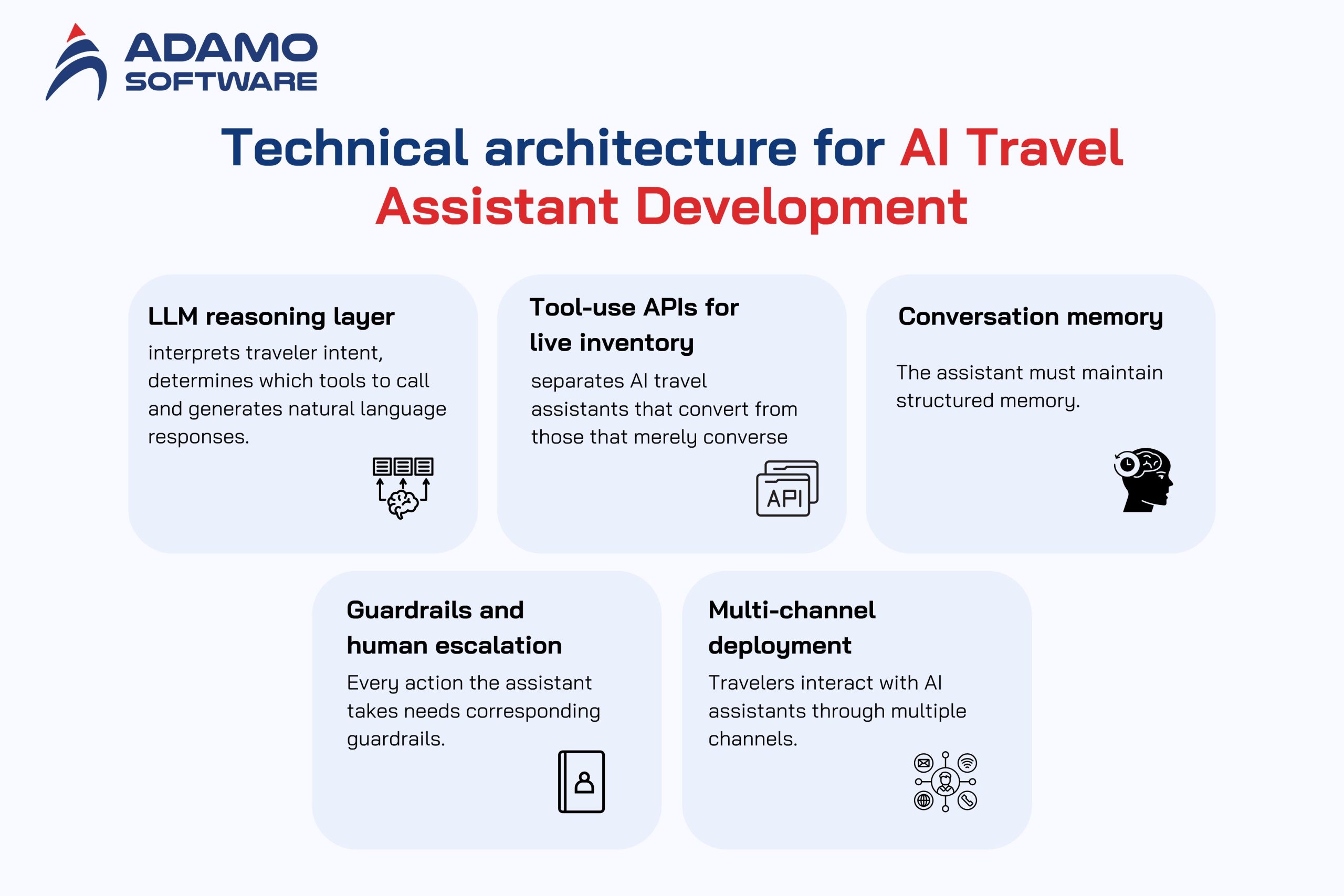
A production-grade AI travel assistant has five interconnected components. Remove any one and the system drops from a booking agent to a conversation widget.
1. LLM Reasoning Layer
The LLM is the brain. It interprets intent, decides which tools to call, sequences multi-step workflows, and generates responses. For travel it must handle multi-intent queries (flight, hotel, and activity in one message), resolve ambiguity (“somewhere warm in July under $2000” into searchable parameters), and hold context across 5 to 15 turns. A foundation model (GPT-4, Claude, or Gemini) via API with structured tool definitions is the recommended approach. Prompt engineering with clear tool schemas usually outperforms fine-tuning for travel, and is cheaper to maintain.
2. Tool-Use APIs for Live Inventory
This is what separates assistants that convert from those that only converse. The LLM calls real systems through typed tool definitions: search flights via GDS integration with Amadeus, Sabre, or airline NDC connections; search hotels via supplier APIs or the property’s own engine; check live availability and pricing; create bookings with payment; modify reservations; and send confirmations. Integrating GDS providers is the most demanding part, because their APIs enforce rate limits, return inconsistent formats, and require caching to balance freshness against quota.
3. Conversation Memory
Booking conversations span 5 to 15 messages, so the assistant must track stated preferences, results already shown, decisions made, booking state, and traveler profile. Short-term memory lives in the LLM’s context window; long-term memory needs a persistent store (Redis for session state, PostgreSQL for profiles) so a traveler can say “book the same hotel I stayed at in Bangkok last March, but for 5 nights.”
4. Guardrails and Human Escalation
Autonomous booking carries financial risk, so every action needs a guardrail: confidence thresholds that pause and escalate below roughly 75 to 80 percent, business-rule enforcement (blackout dates, minimum stays, rate parity), transaction limits, and audit logging of every action with its reasoning. The aim is intelligent escalation, not zero escalation.
5. Multi-Channel Deployment
Travelers interact through web widgets, mobile apps, messaging platforms, voice, and increasingly through third-party AI assistants via the Model Context Protocol (MCP). The core logic should be channel-agnostic, with one backend serving all channels and a presentation layer that adapts to each. MCP support is becoming critical: when a traveler asks an external assistant to “find a hotel in Shibuya,” a platform that exposes inventory via MCP can be searched and booked directly, a new distribution channel that bypasses traditional intermediaries. Our guide on agentic AI in travel covers this shift in depth.
Build Phases and Timeline
Not every feature delivers equal value at launch. A workable build sequence is:
Phase 1: Search and recommend (weeks 1 to 8). Understand natural-language queries, search real inventory, present ranked results with reasoning, and answer follow-ups. This cuts the time travelers spend browsing.
Phase 2: End-to-end booking (weeks 6 to 14). Collect details, process payment in the conversation, create confirmed bookings, and send confirmations. This is the revenue phase. Redirecting to a website to book loses a large share of engaged users, so completing the booking in-conversation is the highest-impact feature.
Phase 3: Post-booking management (weeks 10 to 18). Handle modifications, cancellations, disruption rebooking, and proactive notifications. This drives retention.
Phase 4: Personalization and autonomy (weeks 14 to 24). Use history to personalize, suggest trips proactively, manage loyalty, and operate at graduated autonomy (suggest, act-with-notification, full autonomy).
Total timeline for a production-ready assistant is 4 to 7 months with a dedicated team of 6 to 10 engineers, depending on the number of supplier integrations and the depth of custom travel solutions required.
Technology Stack Recommendations
Based on Adamo Software’s AI development services delivery experience, these are choices validated in production:
- LLM provider: OpenAI (GPT-4o) or Anthropic (Claude) via API. Both support tool-use natively; selection depends on latency and pricing at scale.
- Orchestration: LangChain or LlamaIndex for tool routing and multi-step workflows, or a custom orchestrator with direct API calls for more control and lower latency.
- Backend: Python (FastAPI) for the AI orchestration layer, Node.js for high-concurrency booking and search services, including integration with dynamic pricing engines for travel.
- Data: PostgreSQL for transactional data, Redis for session state and caching, Elasticsearch for full-text search across normalized inventory.
- Event streaming: Apache Kafka for real-time flow between the AI layer, booking services, and notifications.
- Infrastructure: Docker and Kubernetes on AWS EKS or GCP GKE, with auto-scaling tied to conversation volume.
- Monitoring: OpenTelemetry for distributed tracing across the LLM layer, tool calls, and booking services.
Metrics That Matter
- Booking conversion rate: share of conversations that end in a completed booking. The most important metric.
- Containment rate: share resolved without human escalation. Target 80 percent or more for routine inquiries.
- First response time: target under 3 seconds, against an 11-second industry average (Hyperleap AI, 2025).
- Revenue per conversation: booking revenue divided by conversations, normalizing for traffic.
- Hallucination rate: share of responses with factual errors not supported by API data. Target under 1 percent after a validation pipeline.
Benefits for Travel Businesses
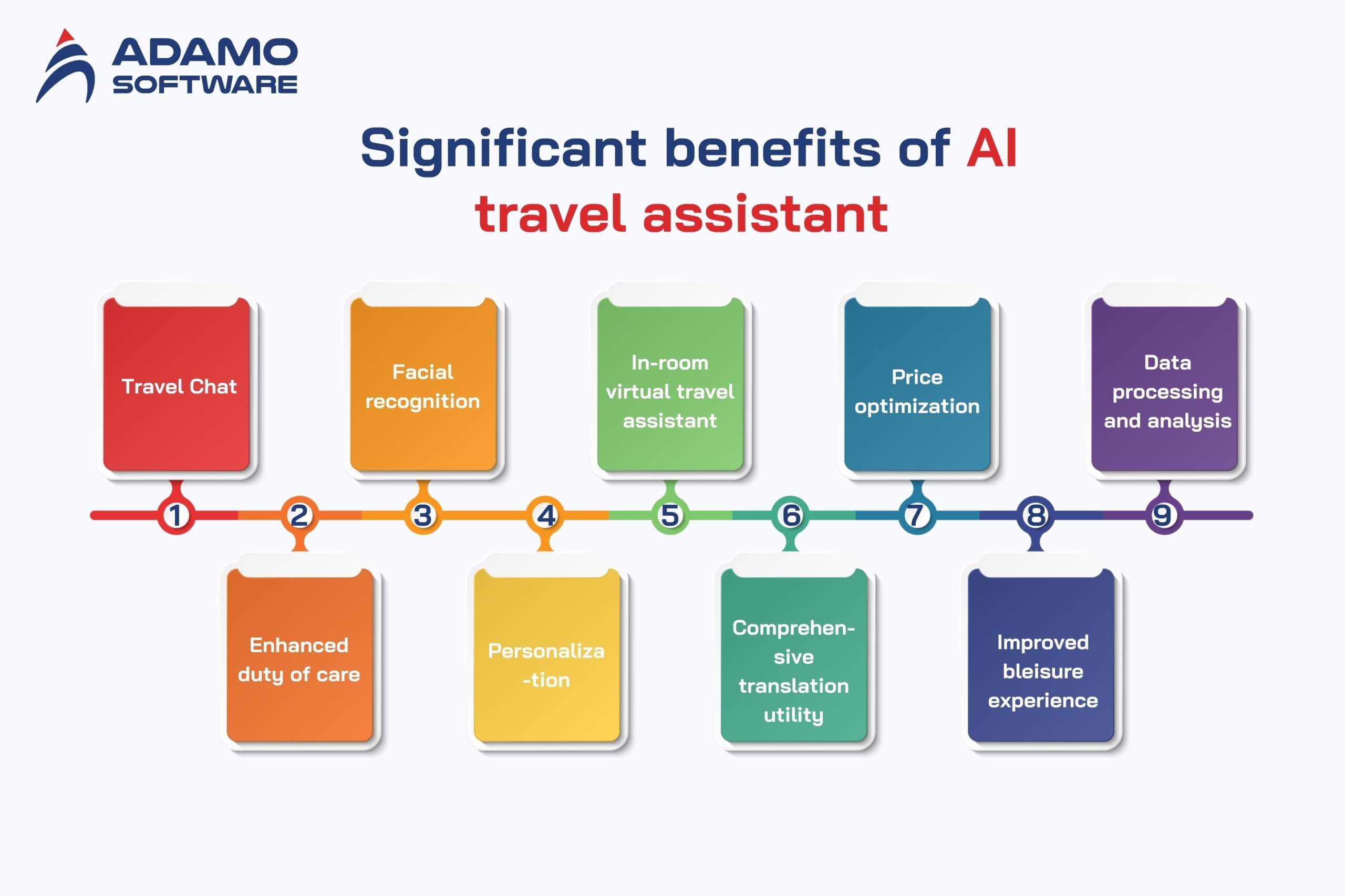
Always-on service. Travelers get instant help at any hour, including during disruptions when a human agent may be unavailable, which is exactly when support matters most.
Lower cost to serve. Automating routine inquiries and self-service changes reduces support load while keeping humans for complex cases.
Higher conversion and personalization. By searching live inventory and tailoring recommendations to stated preferences and history, the assistant shortens the path from question to booking.
First-party data and insight. Every conversation captures preference and behavior data that improves recommendations and informs pricing and product decisions, provided it is handled with clear consent and privacy controls.
Conclusion
AI travel assistant development has moved from experimental to essential. The market data is unambiguous: USD 756 million in 2025 growing toward USD 1.13 billion by 2030, 40 percent traveler adoption of AI trip-planning tools, 78 percent booking conversion among AI users, and 94 percent trust in AI recommendations. The architecture is well understood: LLM orchestration, tool-use APIs, conversation memory, guardrails, and multi-channel deployment. With Sabre, Google, Amadeus, and Booking.com all shipping production assistants, the companies that launch in the next few months will compound a data advantage with every conversation.
Adamo Software builds custom AI travel assistants with live inventory access, LLM-powered natural-language booking, and multi-supplier integration, from search and recommendation engines to autonomous booking agents connected to GDS providers and payment systems. Explore our travel and hospitality software development and AI development services to see how we deliver assistants that drive revenue across web, mobile, and AI channels.


 adamosoft.com
 (+84) 373 11 44 88