

Hotel Reservation System Development: Build, Buy, or Customize
Complete guide to hotel reservation system development: build vs buy decision, OTA commission analysis (15-30%), core features, integration, cost ranges.
Hotel reservation systems sit at the centre of hospitality revenue. The decision a guest makes about which booking channel to use determines whether the hotel captures 95% of the room revenue or 70-85% after OTA commission. Multiply that across thousands of bookings per year, and the reservation infrastructure becomes one of the most consequential operational systems a hotel or hotel group runs.
This guide is written for hospitality decision makers, OTA product leaders, and IT teams evaluating hotel reservation system options. It covers the booking channel economics, the build-versus-buy decision, the core features that determine system value, the integration architecture, the realistic cost ranges for custom development, and how to assess whether to commission a custom build or extend an existing system.
Key Takeaways:
- OTAs currently hold approximately 55% of hotel booking market share globally, with commissions ranging from 15% to 30% per booking (Booking.com 15-18%, Expedia 15-30%, Agoda 18-25%). Direct bookings cost hotels approximately 4-4.5% in payment processing and website fees, representing a significant margin difference (Skift Research, Cloudbeds, Little Hotelier, 2024-2026).
- Global OTA versus direct booking volume in 2024 was nearly even: USD 266 billion through OTAs versus USD 262 billion through hotel direct channels (Skift Research, 2024). Skift forecasts direct digital channels could overtake OTAs by 2030, generating over USD 400 billion versus USD 333 billion from OTAs.
- OTA cancellation rates average 50%, compared to 18.2% for direct bookings (Thrivin Digital, 2025). For revenue stability and inventory predictability, direct booking infrastructure delivers materially better outcomes than dependency on OTA distribution.
- The build-versus-buy decision for a hotel reservation system depends on three factors: scale of operation, integration complexity with existing systems, and degree of pricing or product differentiation. Off-the-shelf products (Cloudbeds, SiteMinder, Little Hotelier) serve standard use cases well. Custom development is justified when business logic, multi-property complexity, or specific market regulations exceed off-the-shelf capability.
- Custom hotel reservation system development costs range from USD 50,000 for a single-property direct booking engine to USD 300,000+ for multi-property, multi-currency platforms with OTA integration, channel management, and PMS synchronisation. Cost drivers are integration scope, real-time inventory management complexity, and regulatory compliance (PCI DSS for payment, GDPR for EU operations).
I. The economics of hotel booking channels
Before evaluating any reservation system, understand the booking channel landscape. The financial difference between direct and intermediary channels drives almost every downstream technology decision.
OTA versus direct: The commission gap
OTAs (Online Travel Agencies) such as Booking.com, Expedia, and Agoda charge commissions ranging from 15% to 30% per booking, depending on platform, region, and contract terms. Booking.com typically takes 15-18%. Expedia charges 15-30%, with rates often higher for independent properties. Agoda commission can reach 25% for participation in their preferred partner programmes (Cloudbeds OTA Commission Guide, Little Hotelier 2026).
Direct booking through hotel websites costs roughly 4-4.5% when accounting for payment processing, website hosting, and direct booking tool licensing (Skift Research analysis, 2024). The gap between 4.5% and 20% commission represents the core financial case for investing in direct booking infrastructure.
The market is at an inflection point
OTAs and direct hotel channels generated near-equal volumes in 2024: USD 266 billion through OTAs versus USD 262 billion through hotel direct channels (Skift Research, 2024). Skift’s forecast suggests direct digital channels could overtake OTAs by 2030, reaching USD 400+ billion versus USD 333 billion from OTAs. The shift is driven by improved hotel direct booking technology, AI-assisted personalisation, and loyalty programme effectiveness.
For hoteliers building or upgrading reservation infrastructure today, the question is not whether to invest in direct booking capability. It is how to balance OTA distribution (for visibility and customer acquisition) with direct booking optimisation (for margin and customer relationship ownership).
Cancellation rates compound the gap
OTA bookings show an average cancellation rate of 50%, compared to 18.2% for direct bookings (Thrivin Digital analysis of luxury hotel data, 2025). The reason is structural: OTA users are comparing across many properties and often hold multiple speculative bookings. Direct bookings tend to be more committed because the guest has made an active choice on the hotel’s own platform.
For revenue management and inventory predictability, the cancellation differential reinforces the case for direct booking investment beyond the commission savings alone.
II. Build, buy, or customize: The decision framework
Hotel reservation systems are available as off-the-shelf SaaS products, customisable platforms, and fully custom builds. The right choice depends on three factors.
Factor 1: Scale and operational complexity
Single-property independent hotel: Off-the-shelf SaaS (Cloudbeds, Little Hotelier, SiteMinder) typically fits well. Implementation cost USD 200-1,500 per month plus per-booking fees. Setup in weeks rather than months.
Multi-property hotel group with consistent product: Customisable platforms or mid-tier SaaS with multi-property modules. Investment higher but manageable. Examples include Cloudbeds for groups, Mews, or Oracle OPERA Cloud at the higher end.
Hotel chain, hotel group with diverse properties, or OTA-style multi-supplier platform: Custom development or heavy customisation becomes economic. Off-the-shelf products struggle with complex pricing logic across heterogeneous inventory, multi-jurisdiction compliance, and specialised channel relationships.
Factor 2: Integration complexity
Off-the-shelf products integrate well with mainstream PMS, channel managers, and payment gateways through pre-built connectors. If your operation requires integration with non-mainstream systems, including specialty PMS for boutique properties, regional payment gateways, custom loyalty platforms, or non-standard tax and pricing rules, custom development handles these scenarios more reliably than configuration of off-the-shelf platforms.
Factor 3: Differentiation through business logic
If your reservation business logic is standard (book a room for nights X to Y at the published rate), off-the-shelf works. If your business depends on specific differentiation such as dynamic packaging (room + experiences + transportation), specialised pricing models (auction, bid, time-limited), tiered loyalty integration that affects rate display, or B2B booking workflows with negotiated rates, custom development is the path that preserves the differentiation.
The honest reading is that most independent hotels do not need custom reservation systems. Most hotel groups with consistent products do not either. Custom builds are most justified for chains, OTA-style platforms, and operators whose business model carries genuine logic complexity beyond standard hotel booking.
III. How a hotel reservation system works: Architecture and data flow
Whether you build, buy, or customize, understanding the underlying architecture is essential to evaluating options and avoiding integration failures down the line.
The end-to-end booking data flow
A typical hotel reservation transaction moves through five stages, each with different actors and data dependencies.
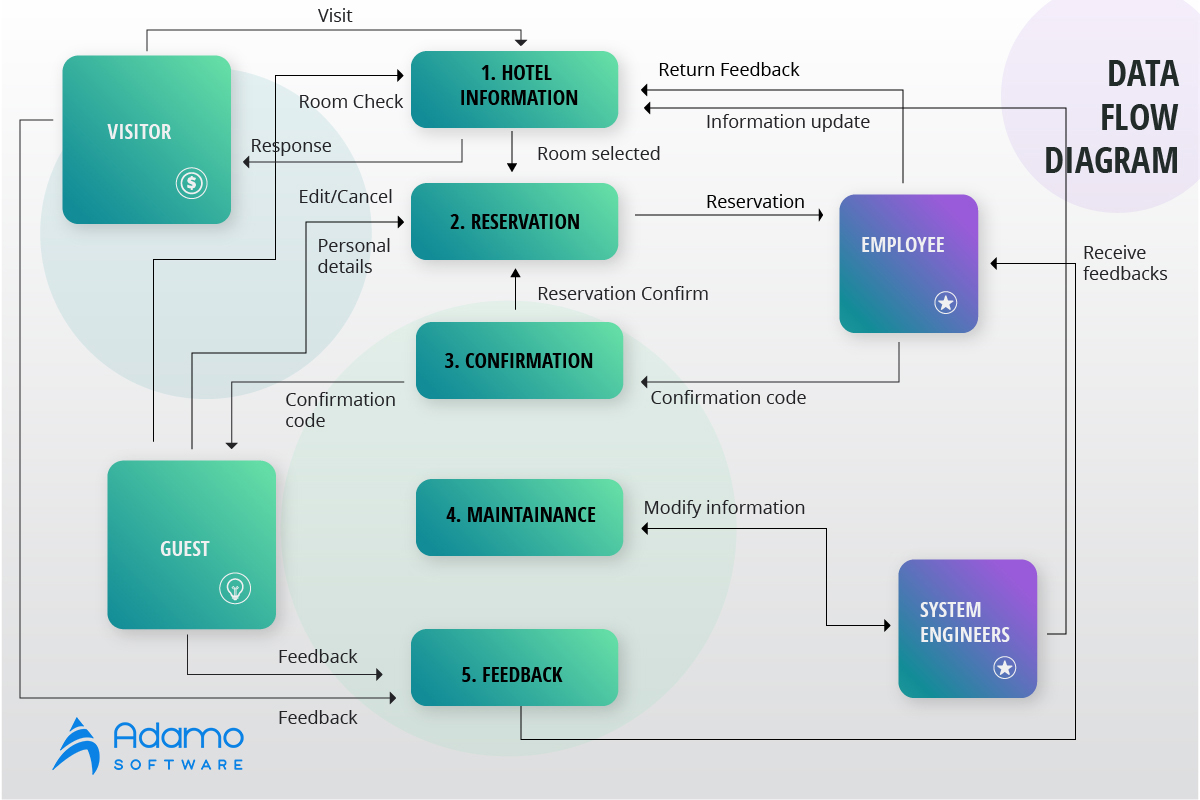
Stage 1 – Hotel Information: The visitor (potential guest) browses the hotel’s public listing, viewing rooms, rates, amenities, and availability. Data flows in two directions: information from the hotel’s content management system to the visitor, and engagement signals from the visitor (filters applied, rooms viewed) back to the system for personalisation and analytics.
Stage 2 – Reservation: After selecting a room, the visitor provides booking details and payment information. The reservation system validates availability in real time (preventing double-booking), holds the inventory, and transmits the reservation data to the hotel’s employee-facing system for review. The visitor can edit details or cancel at this stage.
Stage 3 – Confirmation: Once payment is processed and reservation is confirmed, the system generates a confirmation code and transmits it to both the guest and the hotel staff. This code serves as the booking reference for check-in and any future modifications.
Stage 4 – Maintenance: System engineers manage the underlying infrastructure, performing updates, integration adjustments, and modifications as the reservation system evolves. This stage is invisible to guests but critical for system reliability.
Stage 5 – Feedback: After the stay, guests provide feedback that flows back into both the hotel information layer (influencing future visitors’ decisions through reviews) and the operational system (informing service improvements). This creates the loop that drives long-term reservation conversion improvement.
The Central Reservation System (CRS): The architectural core
At the centre of any modern reservation infrastructure sits the Central Reservation System, the component that holds the authoritative record of inventory, pricing, and reservation state across every channel. It receives booking requests from both direct sources (website, mobile app, call centre) and indirect channels (OTAs, GDS, travel agencies), and acts as the single source of truth that downstream allocation and notification systems consume. For a full breakdown of how a CRS works, its core modules, and the leading platforms, see our guide to the central reservation system for hotels.
Marketplace hotel architecture: When the hotel becomes a platform
A different architectural pattern emerges when the reservation system itself is a marketplace, aggregating inventory from multiple hotels rather than serving a single property or chain. This is the architecture behind OTAs and B2B travel platforms.
A marketplace hotel system connects three actors: visitors (buyers) who browse and book across multiple properties, vendors (sellers) who list their inventory through the platform, and the marketplace operator who maintains the platform, sets commercial terms, and handles payment flow.
The marketplace architecture is more complex than a single-hotel reservation system because:
- Inventory aggregation: Real-time inventory must synchronise from many independent PMS systems with different APIs, update cadences, and data quality
- Pricing normalisation: Rates must be displayed in consistent format across heterogeneous suppliers with different fare structures
- Multi-supplier payment: Settlement flows to many vendors with different banking and currency setups
- Vendor management: Onboarding, performance monitoring, dispute resolution, and commission calculation across hundreds or thousands of properties
This is the architectural pattern Adamo has shipped for travel platform clients including the next-generation B2B travel platform, which aggregates live data from millions of providers.
Three integration layers every reservation system needs
A reservation system rarely operates standalone. The three integration layers that most often determine project success or failure:
Integration with PMS (Property Management System): The property management system handles on-property operations (check-in, room assignment, housekeeping, folio management). The reservation system must hand off confirmed bookings to the PMS in real time. Integration standards include direct API for modern PMS (Cloudbeds, Mews, Oracle OPERA Cloud) and proprietary integration for legacy systems.
Integration with channel manager and distribution: Channel managers (SiteMinder, Cloudbeds, RateGain) synchronise inventory and rates from the CRS out to OTAs and GDS. Without clean channel manager integration, the hotel risks rate parity violations and inventory overselling.
Integration with payment, CRM, and analytics: Payment gateway integration (Stripe, Adyen, regional providers) for booking transactions. CRM integration (Mailchimp, Klaviyo, HubSpot, custom) for guest relationship management. Analytics integration (Google Analytics, custom dashboards) for performance measurement.
IV. Core features of an effective hotel reservation system
The feature checklist matters less than how features integrate into the guest booking flow and the hotel operational flow. The following are the capabilities that determine whether the reservation system actually delivers value.
1. Real-time availability and rate management
The single most important feature. Real-time room availability and rate updates across all distribution channels prevent overbooking and rate parity issues. The architecture must support concurrent inventory updates from multiple sources without conflict.
2. Search and booking flow optimisation
The guest journey from search to confirmation should complete in 3-5 steps maximum on direct channels. Industry benchmarks suggest direct booking conversion rates above 2.5% indicate strong booking flow design; below 1.5% indicates friction that costs material revenue.
3. Dynamic pricing and revenue management integration
Modern hotels operate variable pricing based on demand, occupancy forecast, competitor rates, and channel mix. The reservation system must either include dynamic pricing capability or integrate cleanly with dedicated revenue management systems. Hotels that adopt a revenue management system report an average RevPAR increase of 7% to 20%, with some operators such as Accor recording an 18.4% RevPAR lift after replacing manual pricing (SiteMinder, 2026).
4. Multi-currency and multi-language support
For hotels serving international guests, native multi-currency pricing with real-time conversion and clear total cost display affects conversion materially. Multi-language interface support follows the same logic. Both should be designed in from the architecture stage, not retrofitted later.
5. Channel manager and OTA integration
Bi-directional synchronisation with channel managers that distribute to OTAs. Manual rate updates across channels are operationally unsustainable and risk rate parity violations.
6. Payment processing with multi-currency settlement
Multi-currency payment acceptance, secure card storage (PCI DSS Level 1 compliance), refund and cancellation workflows, and split payment for deposit-now, balance-on-arrival scenarios.
7. Guest profile and CRM integration
Capture guest data for repeat bookings, loyalty programmes, personalised offers, and direct marketing. This integration determines whether the hotel can build direct relationships that reduce future OTA dependency.
8. Promotion codes, loyalty, and package management
Configurable promotion codes, loyalty programme integration with tier-based pricing display, and package bundling (room + breakfast + experiences).
9. Mobile-first booking experience
Mobile direct booking shares have grown to over 50% in many markets. The reservation system must deliver mobile parity (not a degraded mobile experience), with mobile-optimised search, payment, and post-booking management.
10. Analytics, reporting, and revenue dashboards
Real-time dashboards covering booking velocity, channel mix, ADR (Average Daily Rate), RevPAR (Revenue per Available Room), cancellation rates, and pace reports. The reporting capability is what enables data-driven revenue management.
V. Custom development: Scope, timeline, and cost
For operators where off-the-shelf does not fit, custom development typically follows this scope.
Discovery and architecture phase (4-6 weeks)
Scope mapping covering operational workflow, channel mix strategy, integration requirements (PMS, channel manager, payment, CRM, revenue management), regulatory scope (PCI DSS for payment, GDPR for EU, country-specific tax and consumer protection rules), and core feature prioritisation against MVP budget.
MVP build (3-6 months)
Core booking flow (search, availability, reservation, payment, confirmation), basic admin dashboard, integration with one PMS and one channel manager, single-currency payment, basic email confirmation flow. Suitable for soft launch with controlled traffic.
Feature expansion (6-12 months post-MVP)
Multi-currency support, additional channel integrations, dynamic pricing module, loyalty programme integration, advanced reporting and analytics, mobile app or progressive web app, additional language support.
Realistic cost ranges
Single-property direct booking engine: USD 50,000-100,000. Scope: direct website booking, basic PMS integration, single payment gateway, single currency.
Multi-property hotel group platform: USD 100,000-200,000. Scope: multi-property inventory, multi-currency, integration with mainstream channel manager and PMS, basic dynamic pricing, loyalty programme integration.
Hotel chain or OTA-style platform: USD 200,000-500,000+. Scope: multi-supplier inventory aggregation, advanced pricing logic, multi-jurisdiction compliance, custom channel relationships, sophisticated reporting and analytics, mobile applications.
These ranges reflect development cost only. Operational costs (hosting, payment processing, licensing of third-party knowledge bases and channel manager connections, ongoing maintenance) accumulate separately and should be modelled across a 3-5 year window.
VI. Common pitfalls in hotel reservation system projects
Most custom hotel reservation system projects that fail share common pitfalls.
Underestimating integration scope: A reservation system rarely operates standalone. PMS, channel manager, payment gateway, CRM, revenue management, and increasingly AI-driven dynamic pricing tools all need clean integration. Integration scope is the most frequently underestimated cost component.
Inadequate testing under peak load: Booking flows that work fine at 10 concurrent users can fail at 500. Load testing, concurrent booking safeguards (to prevent overbooking), and peak capacity planning need to be part of the build, not afterthoughts.
Compliance designed late: PCI DSS for payment processing, GDPR for EU data, country-specific tax rules, and consumer protection requirements (especially around refund and cancellation rights in the EU) cannot be added at the end. They must be architectural decisions from the start.
Channel parity violations: OTAs enforce rate parity contractually. Reservation systems that allow rate discrepancies between direct and OTA channels can trigger penalties including OTA delisting. The rate management module must enforce parity rules or alert operators to violations.
Insufficient operational training: Even the best reservation system fails if front desk, revenue management, and marketing teams cannot operate it well. Training and change management are non-trivial parts of the launch budget.
VII. How Adamo Software approaches hotel reservation system development
Adamo Software builds custom travel and hospitality software across the booking, distribution, and operations stack. Our hospitality work draws on production deployments for travel and hospitality clients across Europe, North America, Asia, and Australia, including engagements that have shipped hotel booking infrastructure, multi-supplier travel platforms, and operational systems for tour operators and distribution partners.
Our public case studies in this space include Magpie Travel, a US-based travel operator for which we built a central, independent content management system optimising operations for travel operators and their distribution partners. We also worked on a next-generation B2B travel platform (EU-based), a scalable, data-driven solution that aggregates live data from thousands of providers to enable faster, smarter booking experiences. Hotel reservation engagements with specific operators are protected under client NDAs, but the underlying architecture patterns, including real-time availability synchronisation, multi-channel inventory management, OTA integration, and PMS coordination, draw on the same engineering capability shipped for these public projects.
The technical patterns required for a hotel reservation system, including real-time inventory across multiple distribution channels, dynamic pricing with revenue management integration, multi-currency payment processing with PCI DSS compliance, channel manager and PMS synchronisation, and analytics for direct booking optimisation, are the same patterns our travel and hospitality practice has built and operates in production. Our Online Booking Engine service covers hotel booking engine development specifically, with additional capability in flight booking, tour reservation, and vehicle rental systems for operators building multi-product travel platforms.
We work with hospitality operators on three engagement models. Full custom builds for hotel chains, multi-property groups, and OTA-style platforms whose business requirements exceed off-the-shelf product capability. Extension and customisation of existing reservation platforms, including custom merchandising modules, channel integrations, payment infrastructure upgrades, and reporting customisations. And integration projects connecting reservation systems to upstream inventory sources, downstream operations systems, and customer-facing applications.
A typical engagement begins with a four-to-six-week discovery phase covering distribution scope, integration surface, regulatory compliance requirements, and MVP feature prioritisation against realistic budget. Development follows in two-week sprints with a dedicated team that includes travel-experienced project management, business analysis, mobile and web engineering, QA with booking workflow knowledge, and DevOps with PCI DSS compliance experience. Engagement details for specific hospitality clients are protected under NDA, but our team can walk through anonymised architecture decisions, integration patterns, and feature implementation specifics in a discovery call.
Build a Hotel Reservation System That Captures Direct Bookings
The economics of hotel distribution have shifted. Direct booking infrastructure is no longer optional. It is the most consequential margin and customer ownership decision a hotel makes. Adamo Software builds custom hotel reservation systems, OTA platforms, and integration infrastructure for operators whose business model requires more than off-the-shelf product capability. If you are evaluating a custom build, significant extension of an existing system, or integration project, our team can walk you through architecture decisions and realistic scope estimates.
- Explore our Online Booking Engine services for hotel, flight, tour, and rental reservation development.

 adamosoft.com
 (+84) 373 11 44 88