
Travel Mobile App Development: Architecture, Tech Stack, and Cost Breakdown

Travel mobile app development in 2026 costs $30K-$300K+. This guide covers architecture, tech stack (React Native vs Flutter), GDS integration, AI features, and a realistic MVP timeline.
Approximately 61% of travelers now prefer mobile apps over websites for booking flights, hotels, and experiences (CMARIX, 2026). The global travel application market is projected to grow from $16.23 billion in 2026 to $63.87 billion by 2035, at a CAGR of 15.6% (Business Research Insights, 2026). For travel companies still relying on responsive websites as their primary booking channel, these numbers signal an urgent shift. Mobile is no longer a secondary channel. It is the primary revenue driver.
This guide breaks down the technical decisions behind travel mobile app development: what architecture to choose, which tech stack fits different business sizes, how to handle GDS and payment integrations on mobile, what AI features deliver measurable ROI, and what the realistic cost ranges look like in 2026.
Key Takeaways
- Cross-platform frameworks (React Native or Flutter) reduce travel mobile app development costs by 30-40% compared to building separate native apps for iOS and Android.
- GDS integration (Amadeus, Sabre, Travelport) accounts for 25-35% of total development effort on mobile. Caching strategies and offline-first architecture are critical for handling intermittent connectivity during travel.
- AI-powered personalization increases in-app bookings by up to 32%. Dynamic pricing and conversational booking assistants deliver the highest ROI among AI features for travel apps.
- A travel app MVP costs $25,000-$60,000 with a Vietnam-based team, compared to $80,000-$200,000 with US/Western Europe rates. Developer hourly rates in Vietnam are 60-75% lower than US equivalents, with strong and growing expertise in travel tech specifically.
- Only 2.8% of travel app users remain active after 30 days. Retention depends on offline functionality, smart push notifications, and genuinely useful personalization, not feature volume.
Why Mobile-First Matters for Travel Companies in 2026
The data is unambiguous. Over 80% of global travelers expect to book trips entirely through mobile apps (Vrinsoft Technology, 2026). Mobile commerce drives 70-78% of global e-commerce transactions (AppVerticals, 2026). Yet the conversion rate gap between desktop and mobile remains significant. Travelers browse on mobile but historically completed purchases on desktop.
The reason was poor mobile experience: slow load times, clunky multi-step booking forms, and unreliable payment processing. Travel companies that solve these problems capture a disproportionate share of mobile bookings. Booking Holdings generates nearly $11 billion in annual mobile revenue (Statista, 2023), demonstrating the scale of the opportunity.
For mid-size travel companies (tour operators, regional hotel groups, niche OTAs), the choice is no longer between having a mobile app or not. It is between building a custom travel mobile app with the right features of a travel app for their specific business model or settling for white-label solutions that offer the same features as every competitor.
Choosing the Right Architecture: Native, Cross-Platform, or Hybrid
The architecture decision is the most consequential technical choice in travel mobile app development. It determines cost, performance, development speed, and long-term maintenance burden.
Cross-platform (React Native or Flutter) is the right choice for most travel companies in 2026. Both frameworks allow a single codebase for iOS and Android, reducing development cost by approximately 30-40% (TeaCode, 2026). React Native holds roughly 35% of the cross-platform market, while Flutter holds 46% (Stack Overflow Developer Survey, 2024). Both are mature enough for production travel apps.
React Native works best when the travel company already has a React-based web application. Code sharing between web and mobile reduces total development effort. The JavaScript/TypeScript ecosystem provides the largest library selection. React Native apps are typically 2-4 MB smaller than Flutter equivalents, which matters in markets with expensive data plans.
Flutter excels at rendering performance and UI consistency across platforms. Travel apps with heavy animation requirements (virtual hotel tours, interactive maps, AR destination previews) benefit from Flutter’s Impeller rendering engine. Flutter also supports six platforms from a single codebase (iOS, Android, web, macOS, Windows, Linux), which matters if desktop access is part of the product roadmap.
Native development (Swift + Kotlin) is justified only when the app requires deep hardware integration (AR-based navigation, advanced camera features for travel documentation) or when performance requirements exceed what cross-platform frameworks deliver. The cost premium is significant: approximately 1.5-2x the cross-platform budget.
Adamo Software recommends React Native for travel companies with existing web products and Flutter for greenfield projects where UI polish and multi-platform reach are priorities.
Core Feature Set and Technical Architecture
A production travel mobile app requires these foundational features, organized by development priority.
MVP features (8-16 weeks development):
- User authentication with social login (Google, Apple, Facebook). Implement with Firebase Auth or Auth0.
- Search and discovery engine with filters (destination, dates, budget, traveler count). The search service connects to GDS providers and/or direct supplier APIs.
- Booking flow with real-time availability checks. This is the most complex MVP feature because it requires synchronous calls to external inventory systems (Amadeus, Sabre, or direct hotel APIs) while maintaining sub-3-second response times on mobile. The underlying online booking engine architecture must handle concurrent searches, inventory locking, and payment confirmation in a single transactional flow.
- Payment processing with PCI DSS compliance. Stripe or Adyen handle tokenization and compliance. Travel bookings are classified as physical services, so Apple and Google do not charge their 30% platform commission on booking transactions.
- Push notifications for booking confirmations, price alerts, and travel updates. Firebase Cloud Messaging for Android, APNs for iOS.
- Offline access to booking confirmations and itineraries. Critical for travelers in areas with poor connectivity.
Growth features (post-MVP, 4-12 weeks each):
- AI-powered personalization (recommendation engine based on search history, booking patterns, and stated preferences). AI-powered travel recommendations increase in-app bookings by 32% (CMARIX, 2026).
- Dynamic pricing display with price prediction (“prices are likely to rise/drop”). Requires historical pricing data and ML model training.
- Conversational booking assistant powered by LLM. Users describe trips in natural language (“family vacation, beach, Southeast Asia, under $3,000”) and the assistant returns curated options.
- Multi-currency support and localization. Essential for travel apps targeting international users.
- Loyalty and rewards program integration.
- Real-time disruption alerts (flight delays, gate changes, weather warnings).
Recommended backend tech stack:
- API layer: Node.js (Express or Fastify) for high-concurrency search services, or Python (FastAPI) for AI/ML endpoints
- Database: PostgreSQL for transactional data (bookings, payments, user profiles), Elasticsearch for search indexing, Redis for caching and session management
- Message queue: RabbitMQ or Amazon SQS for async operations (booking confirmations, notification dispatch, inventory sync)
- Cloud infrastructure: AWS or Google Cloud with auto-scaling groups configured for peak travel season traffic
- CI/CD: GitHub Actions or GitLab CI with automated testing and staged deployments
GDS Integration on Mobile: Challenges and Solutions
GDS integration (Amadeus, Sabre, Travelport) is the single most complex component of travel mobile app development. It typically accounts for 25-35% of total development effort. For a detailed comparison of GDS providers including Amadeus, Sabre, and Travelport, understanding each provider’s API architecture and NDC readiness is essential before committing. On mobile, the challenges multiply because of network latency, intermittent connectivity, and the need for fast response times on smaller screens where users expect instant results.
Challenge 1: Response time. GDS API calls often take 2-5 seconds. On mobile, users expect results within 2-3 seconds. The solution is a multi-layer caching strategy. Cache frequently searched routes and destinations in Redis with a 15-60 minute TTL (depending on how volatile the pricing is). Use background prefetching to populate the cache before the user completes their search query. For a deeper look at caching strategies for travel search, Adamo Software has documented the approach used in a production travel booking platform.
Challenge 2: Rate limiting. GDS providers impose strict rate limits on API calls. A travel app with 10,000 daily active users can easily exceed limits during peak hours. Implement request deduplication (identical searches within a 30-second window return cached results), queue-based throttling, and graceful degradation (show cached results with a “prices may have changed” disclaimer).
Challenge 3: Data normalization. Each GDS returns data in different formats. Amadeus uses JSON, Sabre uses a mix of XML and JSON, and direct hotel APIs each have their own schemas. Build an adapter layer that normalizes all supplier responses into a unified internal data model before passing data to the mobile app. This adapter pattern prevents GDS-specific logic from leaking into the mobile codebase.
Challenge 4: NDC (New Distribution Capability). Airlines are migrating to NDC for richer content and ancillary sales. Travel mobile apps built in 2026 should support both traditional GDS APIs and NDC from the outset. The adapter layer described above makes this possible without frontend changes.
AI Features That Deliver ROI in Travel Mobile Apps
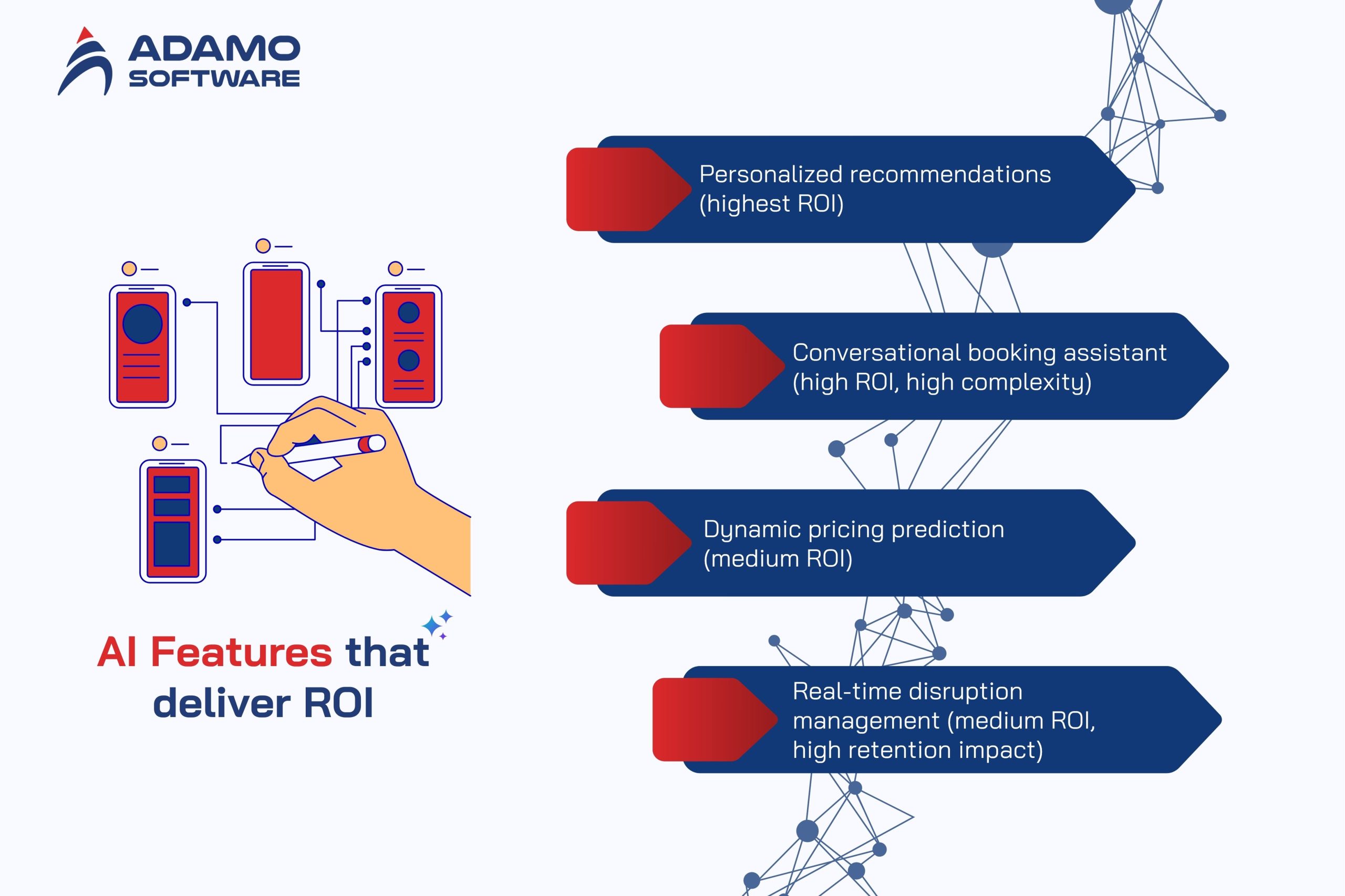
Not all AI features are worth the investment. The following deliver measurable returns based on production data from travel platforms:
Personalized recommendations (highest ROI). Analyze user search history, past bookings, saved properties, and in-app behavior to surface relevant destinations, hotels, and activities. According to CMARIX (2026), AI-powered recommendations increase in-app bookings by 32%. Implementation requires a travel recommendation engine built on collaborative filtering combined with content-based filtering, a user profile service, and an event tracking pipeline.
Conversational booking assistant (high ROI, high complexity). A natural language interface where travelers describe what they want and receive curated options. This reduces the traditional multi-step search-filter-compare flow to a single conversation. Requires LLM integration (OpenAI, Anthropic, or open-source models via Ollama), tool-use APIs for real-time inventory access, and a fallback-to-human workflow for complex requests.
Dynamic pricing prediction (medium ROI). Show users whether current prices are likely to rise or drop based on historical patterns, seasonal trends, and demand indicators. This feature builds trust and creates urgency. Requires 6-12 months of historical pricing data for accurate predictions.
Real-time disruption management (medium ROI, high retention impact). Proactively notify travelers about flight delays, cancellations, or weather events and offer rebooking options before the traveler discovers the problem. This feature does not directly increase bookings but significantly improves retention and Net Promoter Score.
Cost Breakdown: What Travel Mobile App Development Actually Costs in 2026
Cost varies dramatically based on scope, team location, and tech stack. The single biggest cost variable is where your development team is located. A mid-level full-stack developer in the US charges $100-$150/hour. The same skill level in Vietnam costs $22-$50/hour (Second Talent, 2026). That difference compounds across a 5-9 month project with a team of 4-8 engineers.
Here is a realistic breakdown by tier, comparing US/Western Europe rates with Vietnam rates.
MVP tier. Covers: user auth, search with one GDS or direct supplier integration, booking flow, payment processing, push notifications, basic offline support. Timeline: 3-5 months with a team of 4-5 engineers.
- US/Western Europe team: $80,000-$200,000
- Vietnam team: $25,000-$60,000
- Eastern Europe team: $40,000-$100,000
This tier is sufficient for validating product-market fit with a focused user segment. Most travel startups should start here.
Growth tier. Adds: AI-powered recommendations, multi-supplier GDS integration, dynamic pricing display, loyalty program, multi-language support. Timeline: 5-9 months with a team of 6-8 engineers.
- US/Western Europe team: $200,000-$500,000
- Vietnam team: $60,000-$180,000
- Eastern Europe team: $100,000-$250,000
Enterprise tier. Full-featured platform with conversational AI assistant, NDC support, white-label capabilities, advanced analytics dashboard, real-time disruption management. Timeline: 9-15 months with a team of 8-12 engineers.
- US/Western Europe team: $500,000-$1,000,000+
- Vietnam team: $150,000-$400,000
- Eastern Europe team: $250,000-$500,000
Why Vietnam specifically? Vietnam’s IT sector has grown at 9-10% annually, with over 500,000 IT graduates entering the workforce. Developer hourly rates in Vietnam are 60-75% lower than US rates (Second Talent, 2026), but the cost advantage is only part of the picture. Vietnam sits in GMT+7, providing 2-4 hours of overlap with US East Coast teams and 4-5 hours with European teams. The country has a strong track record in travel tech specifically, with multiple software companies serving OTAs, hotel groups, and tour operators across North America, Europe, and Southeast Asia. English proficiency among senior developers has improved significantly, though it remains a key differentiator in hiring. Developers with strong English skills command 50-100% premiums over those limited to local companies (Second Talent, 2026).
The important caveat: the lowest rate is not always the best value. A Vietnam-based team with specific travel domain experience (GDS integration, payment gateway compliance, booking engine architecture) will deliver faster and with fewer costly mistakes than a cheaper team learning the domain from scratch. Travel app development is integration-heavy, and domain expertise directly reduces the 25-35% of effort that GDS integration typically consumes. For a deeper look at the benefits of hiring offshore teams for travel app development, domain expertise directly reduces the 25-35% of effort that GDS integration typically consumes.
Annual maintenance cost: Budget 15-20% of initial development cost per year for updates, bug fixes, OS version compatibility, and GDS API changes (Digital4Design, 2026).
Cross-platform savings: React Native or Flutter reduces development cost by 30-40% compared to building separate native iOS and Android apps (TeaCode, 2026). Combined with a Vietnam-based team, a travel company can realistically build a Growth-tier mobile app for under $150,000, a fraction of the $300,000-$500,000 that the same project would cost with a US-based team building native apps.
Why 97% of Travel Apps Fail at Retention (and How to Fix It)
Only 2.8% of travel app users are still active after 30 days (Business of Apps, 2026). This is the harshest metric in travel mobile app development, and it explains why most travel apps never achieve meaningful traction despite good initial download numbers.
The retention problem has three root causes and three corresponding solutions.
Root cause 1: The app is only useful during active travel. Most travel apps are downloaded before a trip and deleted after. Solution: build utility outside of active travel. Price watch alerts for dream destinations, local experience discovery (restaurant recommendations, events), and travel content (destination guides, packing lists) keep users opening the app between trips.
Root cause 2: Push notifications are generic and annoying. “Check out deals to Bali!” sent to someone who just returned from Bali destroys trust. Solution: context-aware notifications powered by user behavior data. Send price drop alerts only for destinations the user has searched. Notify about gate changes for upcoming flights. Time notifications based on the user’s booking patterns (business travelers book Monday-Wednesday, leisure travelers browse Thursday-Sunday evening).
Root cause 3: The app does not work offline. Travelers are frequently in areas with poor connectivity (airports, remote destinations, international roaming). If the app cannot display boarding passes, hotel confirmations, and saved itineraries offline, it fails at its most critical moment. Solution: implement offline-first architecture with local data storage (SQLite or Realm) and background sync when connectivity returns.
Conclusion
Travel mobile app development in 2026 is defined by two realities. First, mobile is now the primary booking channel, with over 80% of travelers expecting to complete trips entirely within an app. Second, the bar for quality has risen dramatically. A basic booking form wrapped in a mobile shell no longer competes. The apps that achieve meaningful retention (above the 2.8% industry average at day 30) combine offline-first architecture, AI-powered personalization that increases bookings by up to 32%, and a caching strategy that keeps GDS-dependent search results fast despite mobile network constraints. For mid-size travel companies evaluating build versus buy, the cross-platform approach using React Native or Flutter combined with a Vietnam-based development partner offers the most practical path. This combination can cut total development costs by 70-80% compared to native development with a US team, while delivering production-grade performance.
Launch Your Travel Mobile App With Adamo
Adamo Software has built custom travel mobile apps for tour operators, OTAs, and hospitality groups across Southeast Asia, Europe, and North America. From MVP booking apps to enterprise-grade platforms with GDS integration and AI-powered personalization, our engineering team delivers production-ready mobile experiences that travelers actually keep on their phones.
- Explore our services: https://adamosoft.com/travel-and-hospitality-software-development/
- Contact us for a free consultation: https://adamosoft.com/contact-us/

 adamosoft.com
 (+84) 373 11 44 88