
How AI Dynamic Pricing helps travel companies maximize revenue
Hotels using AI dynamic pricing report up to 17% revenue gains. Learn how AI pricing engines work for hotels, OTAs, and tour operators in 2026.
Hotels that use AI-powered dynamic pricing report a 17% increase in revenue and a 10% boost in occupancy compared to those still relying on manual rate management (McKinsey). Meanwhile, RevPAR across the U.S. hotel industry grew just 0.2% year-to-date through August 2025 (STR), and ADR growth forecasts for 2026 sit between 1% and 3%. The math is straightforward: when market-wide rate growth stalls, the travel companies that price smarter capture disproportionate gains. AI-powered pricing engines are how they do it. For a broader view of how AI is reshaping the sector, see Adamo Software’s analysis of AI in the travel industry.
This article breaks down how AI dynamic pricing actually works for hotels, OTAs, and tour operators, what the technology stack looks like, and where the real ROI shows up.
Key Takeaway
- Hotels using AI dynamic pricing report up to 17% revenue increase and 10% occupancy boost (McKinsey), while the broader U.S. market sees RevPAR growth near flat at 0.2% (STR, 2025).
- Manual pricing that updates once per day cannot keep pace with real-time competitor adjustments, compressed booking windows, and sudden demand shifts from events or weather changes.
- AI pricing engines do not apply blanket rate increases. They segment pricing by channel (direct vs OTA), guest type (corporate vs leisure vs loyalty), and time sensitivity, optimizing dozens of micro-decisions per day that no human revenue manager can replicate manually.
- Hotels gain the most from micro-segmentation, instant group displacement analysis, and total revenue management across room rates plus ancillary services like dining and spa.
- Tour operators face different constraints (72-hour booking windows, thinner margins, third-party supplier costs), but AI pricing still delivers value through early-bird incentives, occupancy-based rate scaling, and automatic weather/event adjustments.
- The critical success factor is not the AI model but the data foundation underneath it. Fragmented booking data, CRM silos, and disconnected channel systems will cause any AI pricing engine to underperform.
- Start with AI-recommended rates that require human approval, then expand autonomous decision-making gradually as the system earns trust from your revenue team.
Why Manual Pricing Leaves Money on the Table Every Week
Consider a 120-room boutique hotel in a mid-size U.S. city. The revenue manager updates rates each morning based on yesterday’s pickup report and a quick scan of three competitors on Expedia. On a Tuesday in March, a regional tech conference is announced for the following week. Flight search volume to the city spikes 40% within hours. The hotel’s competitors detect this through automated monitoring and raise midweek rates by $25-$35 the same afternoon. The boutique hotel does not adjust until the next morning, by which time it has already sold 15 rooms at the old rate. At $30 per room in lost rate opportunity, that single lag costs roughly $450 in one day.
Now multiply that pattern across the year. A hotel running manual pricing faces three compounding problems:
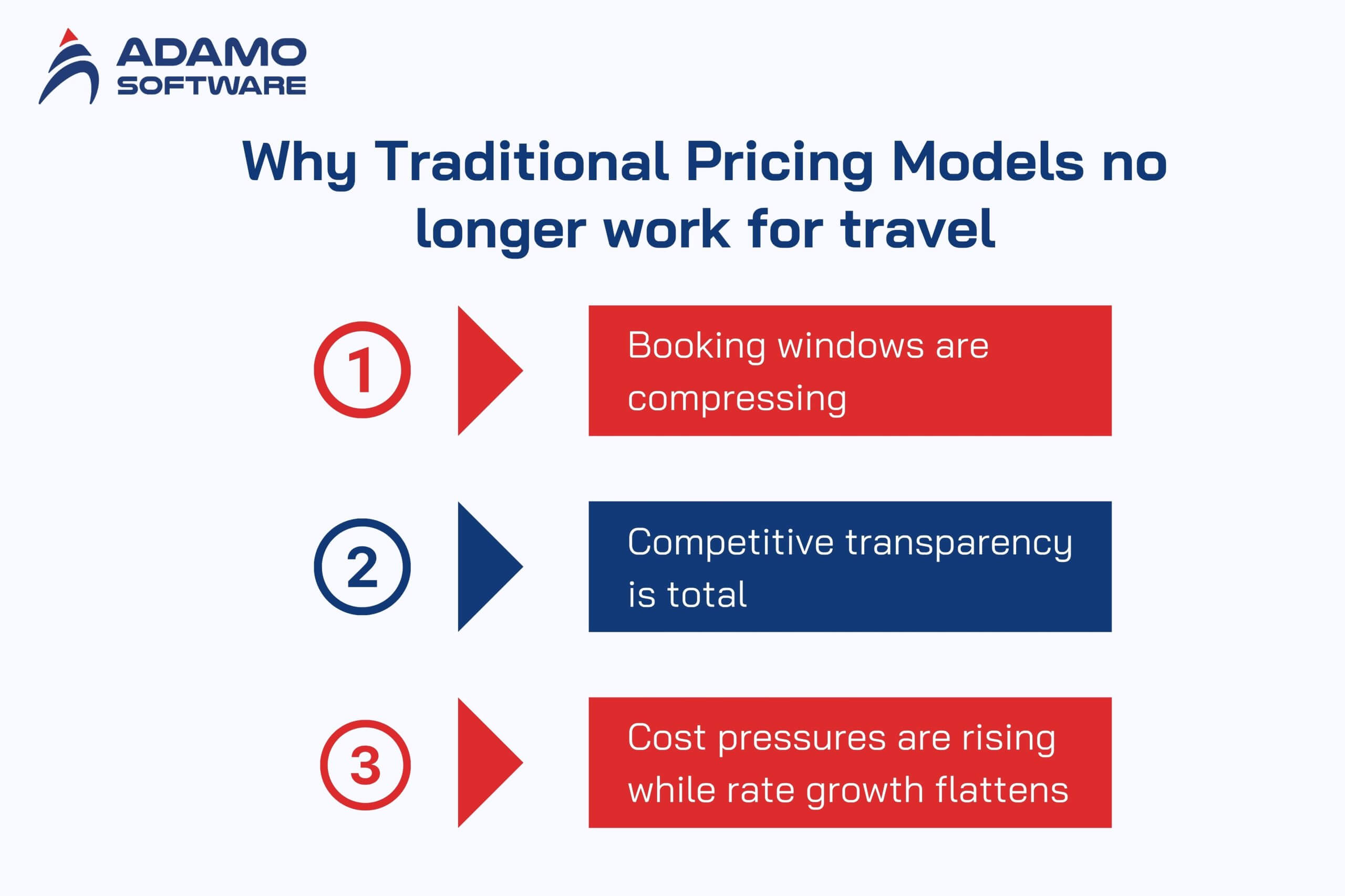
- Rate decisions happen too slowly for the current booking environment. Tour and activity bookings now occur within 72 hours of the experience date. Hotel guests comparison-shop on mobile in real time. A revenue manager updating rates once daily misses demand spikes that last only hours, and misses slow periods where a $10 rate reduction at 2 PM could fill five rooms that will otherwise stay empty tonight.
- The competitor landscape moves faster than any human can track. OTA platforms display real-time rate comparisons across hundreds of properties. The hotel across the street adjusts rates three times per day using an AI system. The manually-priced hotel responds with yesterday’s data, consistently underpricing during sudden demand surges and overpricing when events get cancelled or weather shifts.
- Margins are shrinking while the tools to protect them exist. With U.S. hotel ADR growth projected at just 1-3% for 2026 (CoStar/Tourism Economics) and operating costs rising steadily, even small pricing inefficiencies compound into significant revenue gaps. A hotel that misprices by $15 on average across 80% occupancy loses over $65,000 annually on a 120-room property. That gap is the exact territory AI pricing engines are designed to close.
What Happens Inside an AI Pricing Engine: A Real Scenario
To understand how AI dynamic pricing actually works, walk through a single pricing decision for a 200-room resort hotel on a Friday in June.
At 8:00 AM, the AI system ingests its morning data refresh: 142 rooms are booked for tonight (71% occupancy), the local competitor set averages 78% occupancy, a outdoor music festival starts at 5 PM three miles away, weather forecast shows clear skies, and flight arrivals to the nearest airport are tracking 12% above the same Friday last year. Booking pace for the last 4 hours shows 6 new reservations, compared to an average of 3 for this time window on recent Fridays.
Based on these signals, the predictive model flags tonight as a high-demand outlier. The system identifies that the remaining 58 rooms will likely sell down to 15 or fewer by 6 PM, driven by festival attendees and above-average flight volume. It recommends raising the base rate by $22 for standard rooms and $40 for suites, effective immediately.
But the AI does not apply a blanket increase. It segments the rate adjustment:
- Direct booking engine visitors see a $18 increase (lower than OTA to incentivize direct bookings and avoid commission costs).
- Expedia and Booking.com rates increase by $22, maintaining the hotel’s minimum margin threshold after commission.
- Corporate contracted rates stay unchanged because the system recognizes that 8 of tonight’s remaining corporate bookings are from a repeat client with a negotiated rate, and overriding that contract would damage a high-value relationship.
- The loyalty program tier-3 members see a $12 increase with a complimentary breakfast bundle attached, because the model has learned that this segment converts 34% better with bundled amenities than with raw rate discounts.
By 2:00 PM, occupancy hits 89%. The AI raises rates again, this time by another $15 across OTA channels only, because direct booking pace is already strong and does not need further stimulation. By 6 PM, the hotel is at 96% occupancy. The system switches strategy: it stops pushing for fills and instead optimizes the last 8 rooms for maximum rate, pricing them $55 above the morning base.
This entire sequence involves dozens of decisions that would take a revenue manager hours to evaluate manually. The AI executes them in minutes, across all channels simultaneously, without rate parity conflicts.
The five technical layers that enable this are data ingestion (pulling booking pace, competitor rates, event data, weather, and flight volume in real time), predictive modeling (forecasting tonight’s demand curve by segment), rate optimization (calculating the optimal price per room type per channel per hour), channel distribution (pushing differentiated rates to direct, OTA, and GDS channels without conflicts), and continuous learning (feeding tonight’s actual booking outcomes back into the model to improve next Friday’s predictions). The channel-differentiated pricing described above depends on a well-architected B2B booking engines layer that supports real-time rate distribution.
AI Pricing for Hotels: Where the Biggest Gains Appear
Hotels see the clearest ROI from AI dynamic pricing because they control their own inventory and can adjust rates with minimal supplier coordination. According to a recent Boston Consulting Group report, hotels implementing AI-powered pricing systems see RevPAR gains of up to 15% through real-time adjustments based on booking pace, competitor rates, and local events.
The impact shows up in several specific areas:
- Micro-segmentation replaces broad guest categories. Traditional revenue management segments guests into simple buckets like transient, corporate, OTA, and loyalty. AI uncovers micro-segments based on behavior, intent, price sensitivity, and booking patterns. A family browsing for a weekend stay sees different pricing than a returning business traveler. A price-sensitive visitor gets a different incentive than a high-value loyalty member. This granularity was previously available only to major hotel chains with dedicated data science teams. AI-powered revenue management systems now make it accessible to independent hotels.
- Group displacement analysis happens instantly. Evaluating whether to accept a group booking or hold inventory for higher-value individual bookings used to require hours of spreadsheet modeling. AI systems calculate displacement costs in real time, factoring in forecasted demand, ancillary revenue potential, and opportunity cost.
- Total revenue management extends beyond room rates. AI analyzes guest spending across dining, spa, events, and other touchpoints to maximize total revenue per guest, not just room revenue. The system identifies high-value guests who frequently use specific amenities and recommends personalized packages that bundle room rates with relevant services.
AI Pricing for Tour Operators: Different Challenges, Same Opportunity
Dynamic pricing for tour operators requires a fundamentally different approach than hotel pricing. Tours have compressed booking windows, thinner margins, fixed itineraries with third-party supplier costs baked in, and distribution through multiple OTAs that may not support frequent price changes.
Despite these constraints, AI pricing delivers measurable value for tour and activity businesses:
- Early booking incentives and last-minute optimization work together. AI systems offer modest discounts for advance bookings to improve capacity planning and cash flow predictability. As the experience date approaches, the system adjusts pricing based on remaining capacity and real-time demand signals. This dual approach encourages early commitment while capturing maximum revenue from last-minute bookers.
- Weather and event-driven adjustments happen automatically. A local festival drives unexpected demand for city tours. A weather forecast predicts rain on a peak weekend, suppressing outdoor activity bookings. AI pricing engines process these signals and adjust rates before the revenue manager even notices the change. For a deeper look at the tools driving this shift, Adamo Software’s overview of the hotel revenue management software market covers the leading platforms and selection criteria.
- Occupancy-based pricing maximizes revenue per departure. As seats fill on a specific departure, the AI gradually increases the price for remaining spots. This captures the higher willingness-to-pay from travelers who book popular time slots, while lower prices during off-peak departures improve overall capacity utilization. Tour operators evaluating their booking infrastructure can explore how a modern online booking engine supports these dynamic pricing workflows.
Tour operator TUI Group was among the first to experiment with dynamically priced packages in the UK, and the results drove significant profit improvements in 2024 and 2025. Platforms like Zaui and Aloja now offer AI dynamic pricing tools specifically designed for the operational realities of tour and activity businesses, with integrations into existing reservation systems.
The Technology Stack Behind AI Travel Pricing
Building or integrating AI dynamic pricing into a travel platform requires several core components:
- A clean, unified data layer that connects booking systems, CRM platforms, channel managers, and external data sources. Without this foundation, AI models produce unreliable output. Data unification is often the most time-consuming and highest-value part of any AI pricing implementation, and it is where custom software development expertise becomes critical.
- Machine learning models trained on travel-specific datasets, including booking patterns, seasonality cycles, price elasticity by segment, and competitive response dynamics. Generic ML models underperform in travel because the demand signals are domain-specific.
- Real-time API integrations with GDS providers, OTA channels, property management systems (PMS), and payment gateways. The pricing engine must push rate updates across all distribution channels simultaneously to maintain rate parity and prevent revenue leakage through channel conflicts.
- A human-in-the-loop interface that gives revenue managers visibility into AI decisions, the ability to set guardrails (minimum/maximum rates, blackout dates, segment restrictions), and override controls for exceptional situations. The most effective AI pricing systems are collaborative, not autonomous. They handle the computational heavy lifting while keeping human judgment in the loop for strategic decisions.
For travel companies that lack in-house data engineering and ML capabilities, partnering with a dedicated development team that understands both AI development services and travel domain requirements significantly reduces implementation risk and time-to-value.
Common Mistakes When Implementing AI Dynamic Pricing
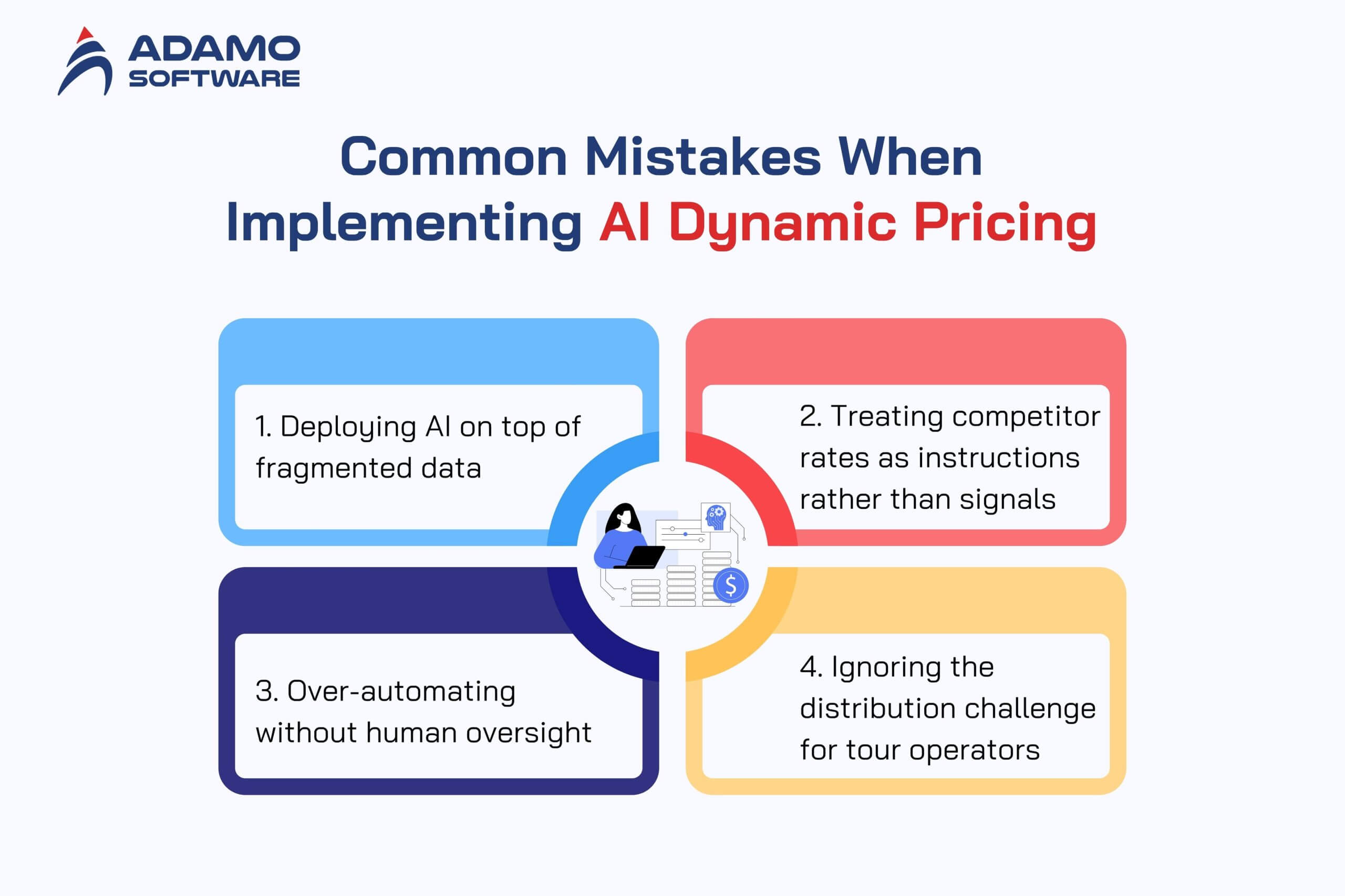
- Deploying AI on top of fragmented data. If booking data, CRM records, and channel performance metrics live in disconnected systems, the AI model operates on incomplete information. Data architecture must be unified before model deployment.
- Treating competitor rates as instructions rather than signals. AI pricing should use competitor data as one input among many, not as the primary pricing driver. Hotels that blindly follow competitor rate changes enter a race to the bottom. The AI should optimize based on your own demand, costs, and guest segments.
- Over-automating without human oversight. Only 2% of travelers currently trust AI enough to let it book autonomously (Skift, 2025). Similarly, revenue managers need to trust their AI pricing system. Start with AI-recommended rates that require human approval, then gradually expand autonomous decision-making as the system proves its accuracy.
- Ignoring the distribution challenge for tour operators. Unlike hotels, tour operators distribute through multiple OTAs and resellers that may not support real-time price updates. The AI pricing strategy must account for distribution constraints and channel-specific pricing rules from day one.
Conclusion
With U.S. hotel RevPAR growth near flat and tour operators facing compressed booking windows and rising costs, pricing precision is the clearest path to revenue growth in 2026. The data from BCG, McKinsey, and early adopters confirms that AI-powered dynamic pricing delivers measurable gains: up to 15% RevPAR improvement for hotels, significant profit increases for tour operators like TUI Group, and 20-30 hours per month saved on manual pricing analysis. The critical success factor is not the AI model itself but the data foundation underneath it and the human-AI collaboration model that keeps revenue strategy aligned with business goals.
Turns pricing into your competitive edge with Adamo

Adamo Software builds AI-integrated travel platforms that connect dynamic pricing engines with booking systems, channel managers, and revenue dashboards. Whether you need a custom pricing module for your hotel management platform or a full revenue optimization system for your OTA, our engineers deliver solutions grounded in travel domain expertise and production-ready AI infrastructure.
Explore our Travel Software Development services: https://adamosoft.com/travel-and-hospitality-software-development/ and contact us for a free consultation: https://adamosoft.com/contact-us/

 adamosoft.com
 (+84) 373 11 44 88