
P2P car sharing app development: Features, Costs and How to build
People increasingly want to rent a car and drive it themselves, and that shift is what makes peer-to-peer (P2P) car sharing a real market rather than a niche. Compared with traditional rental, where the procedures are slow and the inventory is fixed, a P2P platform lets renters pick the exact car they want from private owners. If you plan to build one, you need to understand the essential features, the cost, and the right tech stack before you start.
This article explains what P2P car sharing app development involves, how the platform works end to end, the technology behind a successful build, and what it realistically costs.
Key takeaways:
- The global car sharing market was worth USD 17.6 billion in 2025 and is projected to reach USD 35.3 billion by 2035, a 7.4% CAGR (Global Market Insights, 2026).
- Peer-to-peer is the leading business model in car sharing, holding around 25% market share in 2025, led by platforms such as Turo and Getaround (IMARC Group, 2025).
- The non-negotiable features are a clean interface, advanced search and filtering, a secure payment gateway, GPS tracking, and identity verification.
- A typical build runs USD 30,000 to USD 70,000, rising to USD 100,000 or more once advanced features (AI pricing, blockchain settlement) are added.
I. What is P2P car sharing app development?
P2P car sharing app development is the process of building a platform that connects car owners directly with renters, without a rental company in the middle. Owners list their idle vehicles to earn income, and renters get a wider, cheaper selection than a traditional fleet can offer. For the adjacent operator side of this market, see our guide to car rental management software.
The model is not a fringe one. Peer-to-peer is the leading business model in car sharing, with roughly 25% market share in 2025, driven by platforms like Turo and Getaround that turn underused private cars into revenue (IMARC Group, 2025). That is the demand signal worth designing for.
For owners, the app is a way to monetize an idle asset. They list the car with its type, year, condition, rental price, and availability. For renters, it is a marketplace: they browse, compare on price and preference, and book a car that fits their budget. The model also benefits the wider market by promoting the sharing economy, reducing the number of cars sitting unused, and supporting lower emissions.
This works best in dense urban areas where traditional rental is limited or expensive. The one thing you cannot compromise on is transparency between the two sides. Here is how the flow works in practice.
Registration
Users create an account with basic details: name, age, gender, email, and phone. The app may also require identity verification and the linking of a bank account or payment method.
Listing
After signing in, owners upload their car: photos, type, condition, number of seats, amenities, rental price, and available hours. They can also set rules such as no smoking or a cleanliness requirement.
Bookings
Once a car is listed, renters can find it, search by their preferences, and send a booking request. After the owner accepts, payment goes through the app directly, with no need to meet in person. This request-and-confirm flow is the heart of the platform, and it sits on the same logic as any booking engine handling real-time availability and reservations.
Vehicle pickup and return
The renter picks up the car at the agreed location and returns it as committed. Both parties check the car’s condition before the handover.
Feedback and ratings
After the rental, renters rate the owner’s support, the car’s quality, and the overall experience. Owners can rate renters in turn. This two-way reputation system is what keeps the marketplace honest.
In short, the product connects owners and renters into one trusted marketplace, and it is a practical entry point into smart mobility.
II. Fundamental features for P2P car sharing app development
A P2P platform has to get the essentials right, from the interface to security. These are the features you cannot skip.
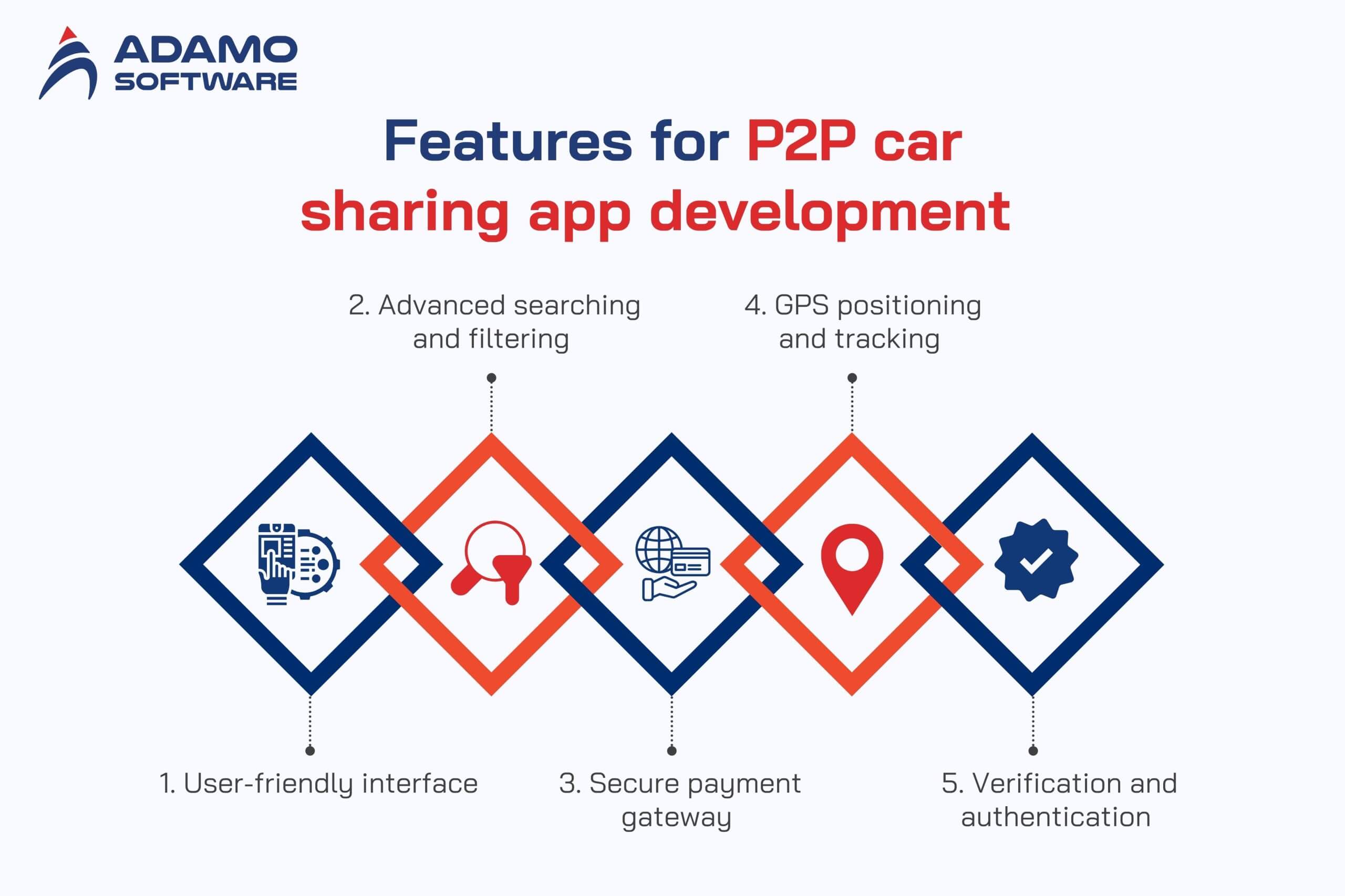
1. User-friendly interface
A clean, intuitive interface is the feature that decides whether users stay. The layout has to be easy to navigate for both owners and renters, with well-organized menus, recognizable icons, and a permanently visible menu bar for key functions.
When the interface is obvious, people understand the product faster, the experience is smoother, and transaction success rates go up. This is a retention feature as much as a usability one.
2. Advanced searching and filtering
Search and filtering let renters find the right car fast, which directly lifts the transaction completion rate and brings users back. Let renters search by keyword, by distance from their current location, or by a specific address, and let them sort by lowest, highest, or closest price.
Prioritize cars on promotion in the results, and add map-based search and smart suggestions so the most relevant options surface first.
3. Secure payment gateway
A secure payment gateway keeps every transaction fast and protected. Integrate multiple methods: credit cards, bank transfers, and e-wallets.
For security, encrypt all payment data with the SSL/TLS protocol to protect against cyber threats, and add two-factor authentication (2FA) or one-time passwords (OTP) on top.
4. GPS positioning and tracking
GPS positioning and tracking protect both sides. Owners can monitor their asset and reduce the risk of theft or misuse, while renters locate the car quickly and get optimal route suggestions. It is a safety feature and a convenience feature at once.
5. Verification and authentication
Verification and authentication establish trust. They confirm the identity of owners and renters and cut the risk of fraud. Owners can see they are renting to verified users, and renters can pick vehicles from verified owners. A robust verification system is what protects the whole process and builds the platform’s reputation.
III. Tech stacks for developing a P2P car sharing app
Choosing the right technology is what makes the platform efficient, secure, and pleasant to use. Below is a practical stack.
1. Frontend development
The frontend is the user interface layer that delivers a seamless experience. For interactive web apps, frameworks like React, Angular, or Vue.js work well. For mobile, Swift (iOS) and Kotlin (Android) are standard. UI libraries such as Material-UI, Bootstrap, or Tailwind CSS help keep the design consistent and clean.
2. Backend development
The backend handles business logic and data. For languages, Node.js, Python (Django or Flask), Ruby on Rails, or Java (Spring Boot) are all solid choices. For relational data, MySQL and PostgreSQL manage users and transactions well, while MongoDB or Firebase suit unstructured data. For account security, use OAuth 2.0, JSON Web Tokens (JWT), or Firebase Authentication.
3. Cloud infrastructure and hosting
Cloud infrastructure gives you scalability, flexibility, and cost control. AWS, GCP, or Azure provide secure storage and real-time processing. A Content Delivery Network (CDN) such as Cloudflare speeds up load times for users around the world.
4. APIs and integration
APIs let the platform plug into the services it needs. Use Stripe, PayPal, or Braintree for secure payments. Use Google Maps or Mapbox for GPS positioning and navigation. Use Firebase Cloud Messaging for real-time notifications. These integrations cut development time and keep the experience smooth.
IV. How to build a P2P car sharing software from the start
Building the platform follows a clear sequence. These are the essential steps.
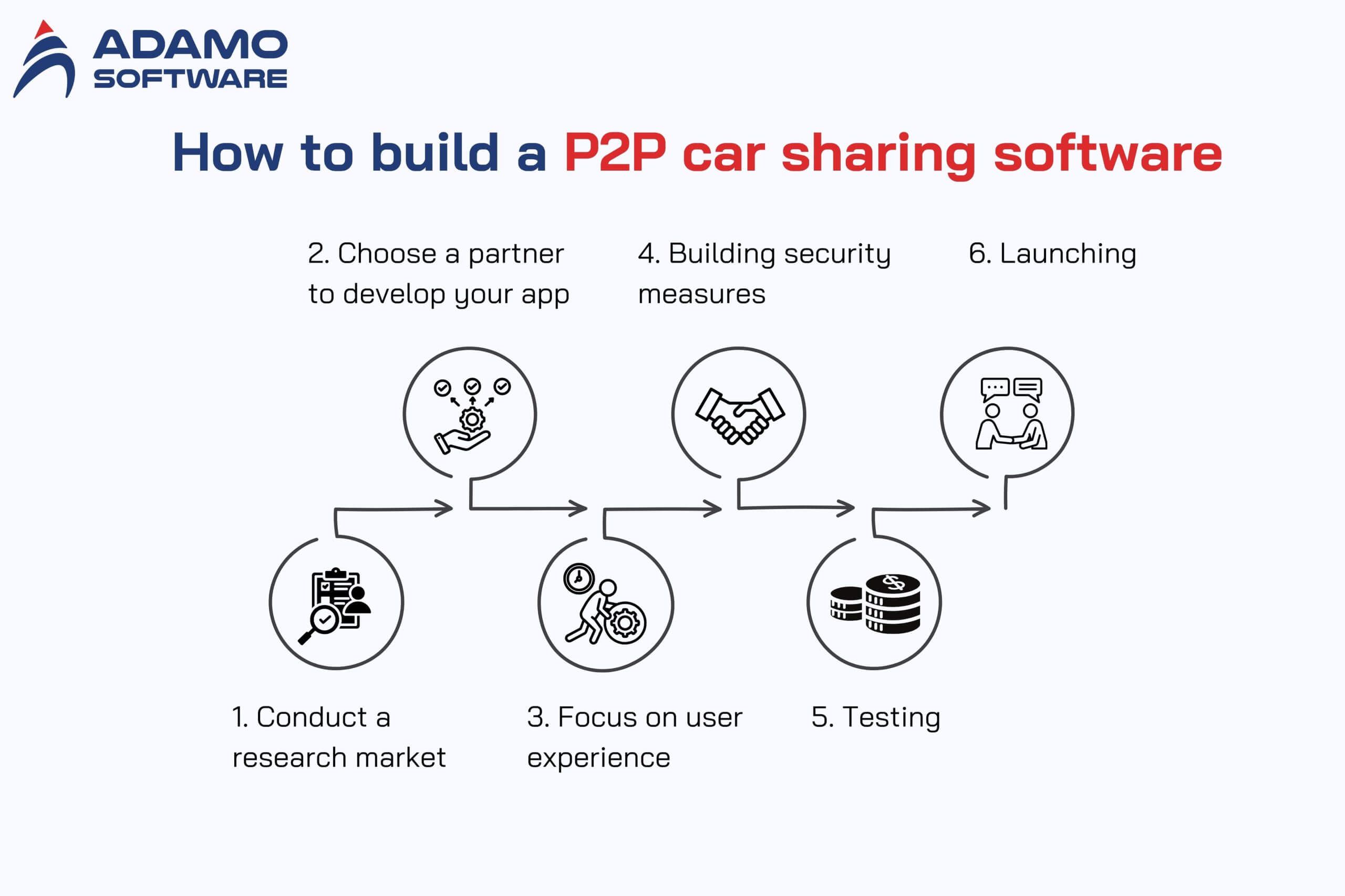
1. Conduct market research
Start by understanding the market. Split your target users into owners and renters, because each side wants different things, and define what each needs from the product. Then study your competitors’ strengths and weaknesses so you can improve on the features and the experience they offer.
2. Choose a development partner
You will need a partner to build something robust and scalable. Look for a team with real experience shipping P2P marketplace apps and the technical depth to design, build, and deliver on time. Adamo Software is one option here.
3. Focus on user experience
User experience is the core of the product. Build an intuitive interface so users can search, book, and pay without friction, and optimize hard for mobile, where most of this activity happens.
4. Build in security measures
Security is non-negotiable. Implement data encryption (SSL/TLS), two-factor authentication (2FA), and secure payment gateways to protect personal and financial data. Add fraud detection to prevent abuse and protect both owners and renters.
5. Test thoroughly
Once the build is done, run comprehensive testing to catch bugs, security gaps, and usability problems. That means functional testing, performance testing, and user acceptance testing (UAT). Real-world testing surfaces issues you cannot see on paper, before launch.
6. Launch
Finally, ship it. Make the app available on the Google Play Store and Apple App Store, then monitor user feedback and system performance to fix post-launch issues and optimize for long-term growth.
V. Technology behind a successful P2P car sharing application
Beyond the basics, a few advanced technologies separate a strong platform from an average one.
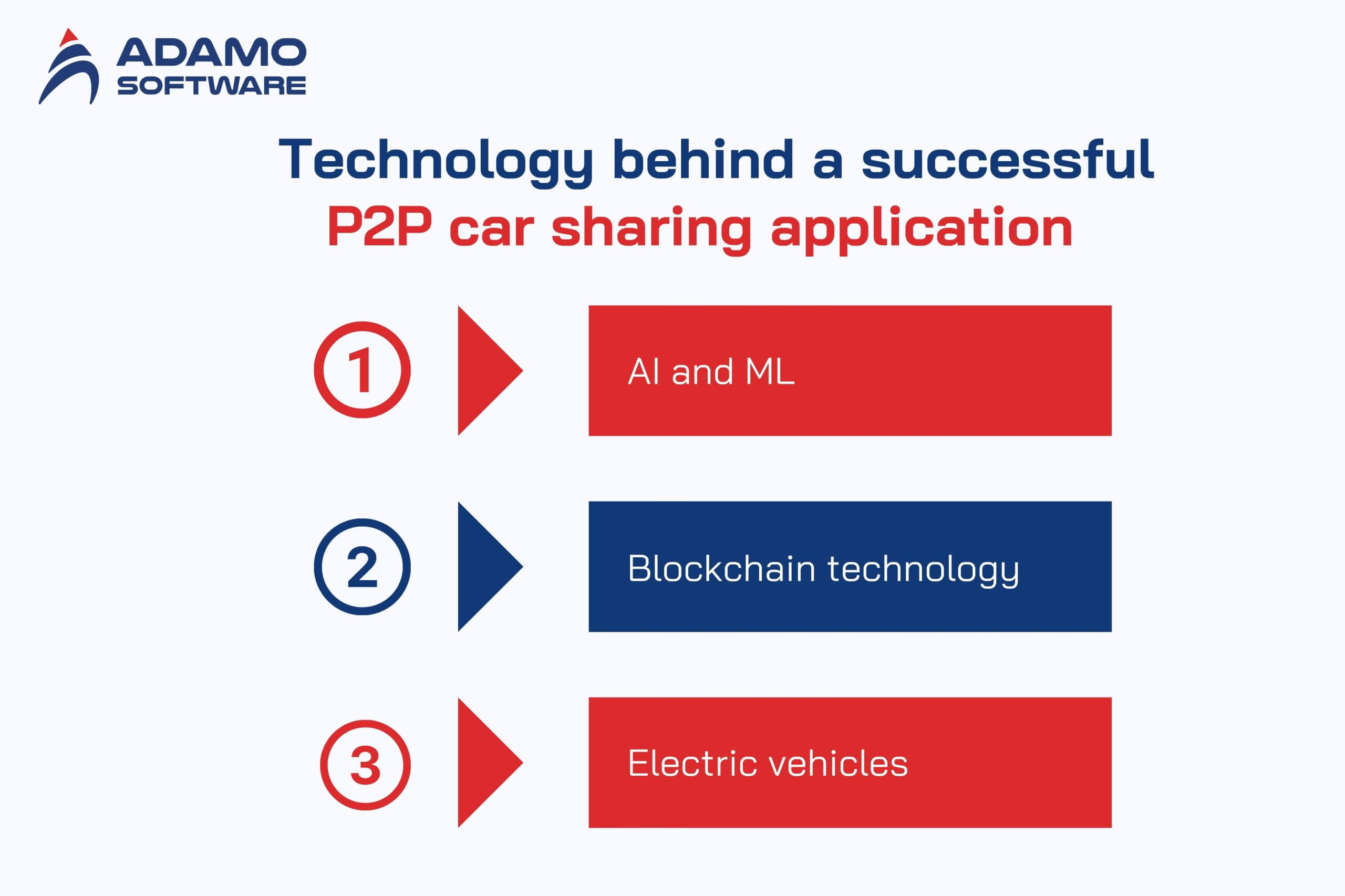
1. Artificial Intelligence (AI) and Machine Learning (ML)
AI and ML personalize the experience and optimize operations. They power dynamic pricing based on location, time, and demand, detect fraud by spotting unusual behavior and transaction patterns, and recommend the right cars to each renter.
2. Blockchain technology
Blockchain adds transparency and security to transactions. It can automate the rental flow from payment to settlement and refunds, and store records in a way that resists tampering or loss.
3. Electric vehicles
EV technology, built on electric motors, lithium-ion batteries, and charging infrastructure, is increasingly part of shared fleets. Electric motors deliver strong performance with less maintenance than combustion engines, and improving battery capacity and fast charging extend range per charge. Beyond lower emissions, EVs point the fleet toward a more sustainable future.
VI. Cost estimations for P2P car sharing app development
Cost depends on the scale of the project, the technologies used, and the team. Below are the main cost items and typical ranges.
- UX/UI design: around $3,000 to $8,000
- Frontend and backend development: $20,000 to $50,000 depending on complexity
- API and payment gateway integration: $5,000 to $10,000
- Cloud infrastructure and hosting: around $1,000 to $3,000 per year
- App testing and maintenance: around $5,000 to $10,000 per year
In total, a P2P car sharing build typically runs $30,000 to $70,000, while more complex apps with advanced features can reach $100,000 or more. Investing properly protects product quality and helps you attract and retain users over the long term.
VII. How Adamo can help

If you are looking for a reliable partner to build your P2P car sharing platform, Adamo Software can help. As a Vietnam-based software company with years of experience in travel and mobility products, here is what we bring.
- UX/UI design: An intuitive interface that makes the platform easy for both owners and renters.
- Comprehensive development: Frontend and backend built together, including a robust booking engine, with features from vehicle search and payment to GPS location fully integrated.
- Security and authentication: Advanced measures such as data encryption and two-factor authentication (2FA).
- API integration: Connections to services like Google Maps, Stripe and PayPal payment gateways, and real-time notification systems.
- App testing and maintenance: Smooth operation through comprehensive testing and ongoing maintenance.
- Cost optimization: Cost-effective delivery without sacrificing quality or performance.
Still deciding? Contact us for a detailed scope and quote.

 adamosoft.com
 (+84) 373 11 44 88