

Car rental management software: An extensive overview

NDC API integration lets airlines offer their products and services directly to travel agents and customers through a standardized interface, making the booking experience richer and more personalized. As more airlines move content to NDC, the traditional Global Distribution System (GDS) faces real pressure on its long-held dominance in airline distribution.
That said, the shift is gradual rather than sudden. NDC reached 21.2% of ARC-settled agency bookings in December 2025, up from 20.3% a year earlier (Travel Weekly/ARC, 2026), while GDS-EDIFACT messaging still handles roughly 88% of indirect sales globally (Altexsoft, 2025). NDC is becoming a mainstream channel, but most platforms run it alongside GDS rather than instead of it. NDC API is one part of the broader travel API landscape. This guide covers what NDC API integration is, its main advantages and drawbacks, and the key considerations for travel agents implementing it.
Key takeaways:
- Car rental management software is a cloud-based system that automates reservations, fleet tracking, billing, and customer data in one centralized platform.
- The car rental management software market was valued at about 2.8 billion U.S. dollars in 2025 and is projected to reach 6.2 billion by 2033, a CAGR of 10.6% (Verified Market Reports, 2026).
- The online segment already accounts for roughly 75% of all car rental bookings (Global Market Insights, 2026), so a strong digital booking layer is now essential.
- Core features include vehicle inventory, booking management, fleet tracking, billing, CRM, and reporting. Advanced features add white-label portals, dynamic pricing, GPS, and multi-language support.
- Cloud-based (SaaS) deployment typically delivers 30 to 45% lower five-year total cost of ownership for mid-sized operators than on-premises systems (Dataintelo, 2026).
I. What is NDC API Integration?
In 2012, IATA developed New Distribution Capability (NDC), an XML-based standard for airline distribution. With it, airlines can offer passengers rich content and extra services such as baggage, seat, and class selection, the kind of differentiation they need to stay competitive and build a distinct brand. Through NDC API integration, distribution channels can access real-time flight inventory, book faster, and serve customers with advanced features.
Until recently, GDS networks relied on EDIFACT, a UN data-interchange protocol in use since the 1980s. NDC modernizes this layer: instead of the basic fare-and-schedule data EDIFACT transmits, the XML-based NDC protocol carries comprehensive content and supplementary services to OTAs, GDSs, and destination management firms, which then pass it down to agents and travelers. Importantly, NDC does not fully replace EDIFACT yet. The two coexist, and the current NDC schema has evolved to version 24.1 while many airlines still run older releases. For context on the legacy side, see our guide to GDS integration.
By incorporating the NDC API into flight reservation software, travel companies gain access to a wider range of flight content, real-time availability and bookings, and a smoother customer experience. To put scale in perspective, NDC bookings reached 34 million globally in 2023, about 2.3% of global air ticket sales (IATA, 2023), and have grown steadily since. The direction of travel is clear even if the pace is measured.
II. Main Advantages of NDC API Integration
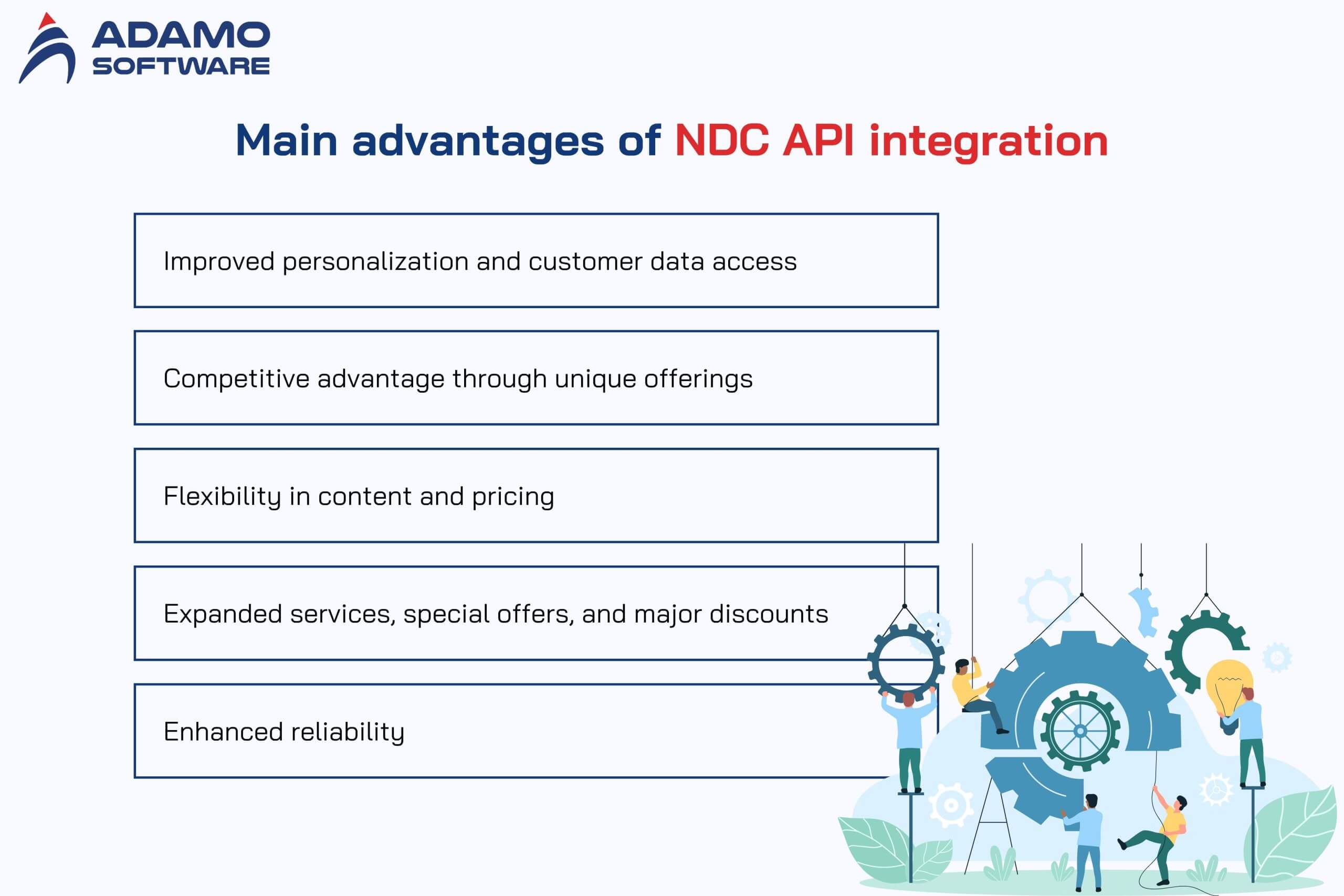
1. Improved personalization and customer data access
In today’s environment, airlines receive only limited passenger information, since OTAs, GDSs, and tour operators hold most of the relevant data. Without it, airlines struggle to understand what customers care about and miss opportunities to engage them. NDC changes this: the protocol gives airlines access to detailed consumer information, so they can analyze behavior and preferences, then serve travelers with tailored offers. The result is a better experience and stronger loyalty, because passengers feel their needs are met with personalized attention.
2. Competitive advantage through unique offerings
Traditional GDS messaging can show fares and schedules but does not easily carry value-added services, which leaves travel intermediaries in control of pricing and content presentation. NDC gives airlines flexibility and control over their product offerings, letting them build unique selling propositions distinct from competitors. They can create innovative packages that bundle flights with ancillaries such as baggage or seat selection. This is why more than 60% of airlines have adopted NDC to some degree as of 2025 (IATA, 2025), with carriers such as Lufthansa, Emirates, and American Airlines reserving exclusive fares for NDC channels.
3. Flexibility in content and pricing
NDC enables flexible, personalized pricing. Historically, airlines depended on the Airline Tariff Publishing Company (ATPCO) to file fares, and third-party involvement narrowed margins and limited tailored pricing. With NDC, airlines can build APIs on modern XML standards and adjust pricing structures to offer customized deals based on passenger data and prior interactions. The payoff is measurable: 87% of travel managers report that NDC-enabled connections save money (State of Corporate Travel and Expense, 2025).
4. Expanded services, special offers, and discounts
EDIFACT provides a consistent framework for exchanging documents across industries and borders, but it ties airlines’ hands on additional services, often limiting them to basic fare displays rather than personalized packages. NDC removes that constraint. Airlines can create and promote more services, including special deals and custom holiday packages, entice customers with bundled flights and hotel stays, and reward loyal customers with exclusive discounts, injecting their products directly into the sales process to lift sales and satisfaction.
5. Enhanced reliability
Airlines often use Passenger Service Systems (PSS) to display booking information such as pricing and schedules, but PSS can lag on real-time updates, creating discrepancies that frustrate travelers during booking. NDC API integration provides a more robust solution by updating services, fares, and schedules in real time, so passengers see the most current information. Beyond convenience, this eliminates errors from stale data, builds trust, and improves customer retention.
III. Drawbacks of NDC Integration
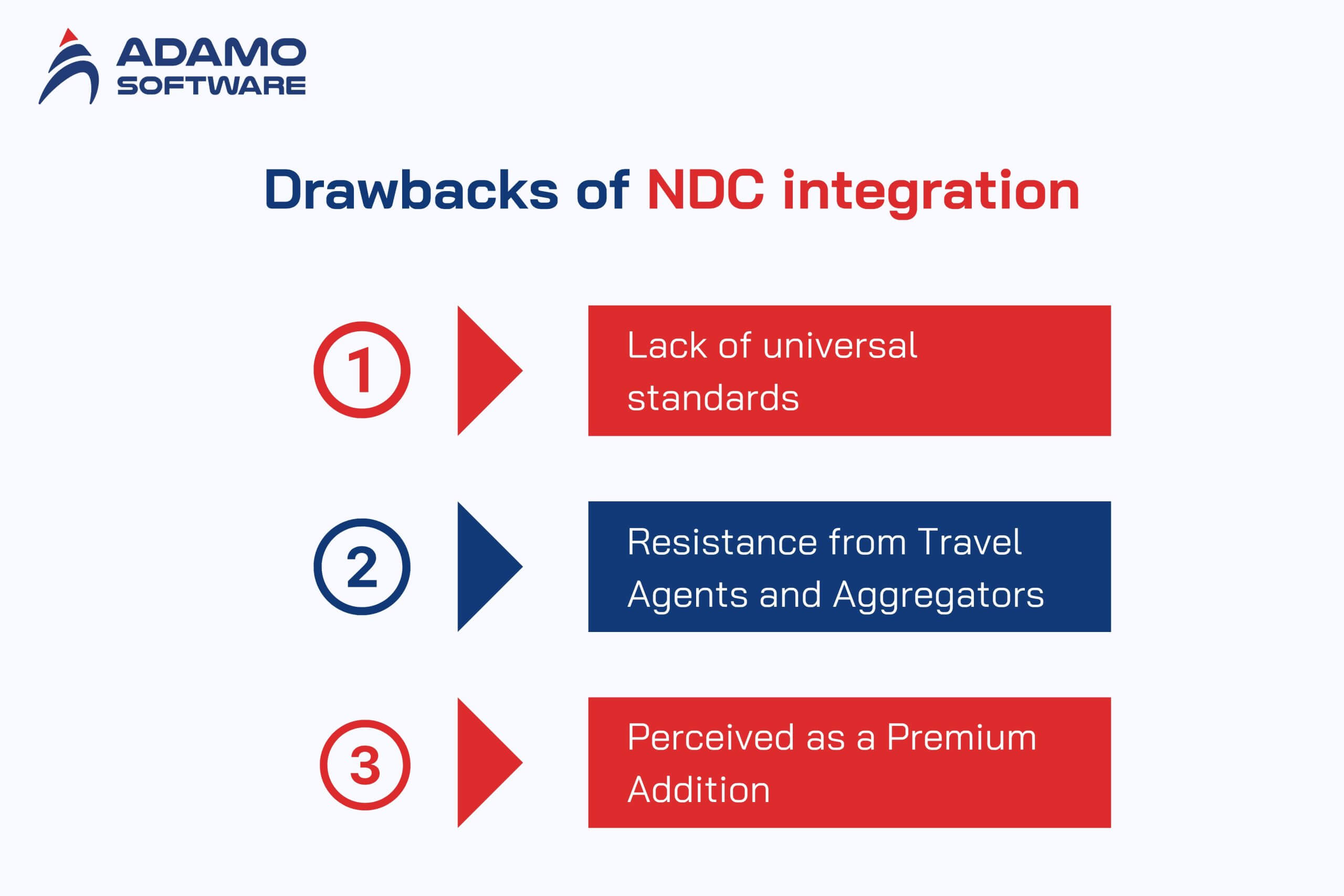
1. Lack of universal standards
NDC is meant to standardize communication between airlines, agents, and customers, but implementation varies widely. Each airline interprets and deploys the standard differently, so software providers face many connecting channels and compatibility problems with existing passenger management systems. In practice, the promised plug-and-play solution has given way to a reality where each airline must be integrated separately, which is exactly what created the market for NDC aggregators that consolidate fragmented content. For smaller and mid-sized agencies, this fragmentation is a real technical and financial burden.
2. Resistance from travel agents and aggregators
Many travel professionals are deeply embedded in existing GDS workflows, which makes them reluctant to adopt NDC. The transition often means significant investment in new software, staff training, and changed business models, which can overwhelm smaller agencies, along with feared operational disruption during the switch. The readiness gap shows in the data: a GBTA survey found that 37% of programs made zero NDC bookings and 54% of travel managers said their TMC could not adequately support NDC (GBTA, 2025). This reluctance slows industry-wide adoption and risks leaving slower agents behind.
3. Perceived as a premium addition
Many airline and agency stakeholders still see NDC as an optional enhancement rather than a must-have upgrade, largely because existing systems still meet basic operational needs with minor changes. Without a clear understanding of how NDC improves customer experience, streamlines operations, and creates competitive advantage, stakeholders feel little urgency to invest, which weakens the realized benefits and limits NDC’s growth.
IV. Key Considerations for Travel Agents Implementing NDC API Integration
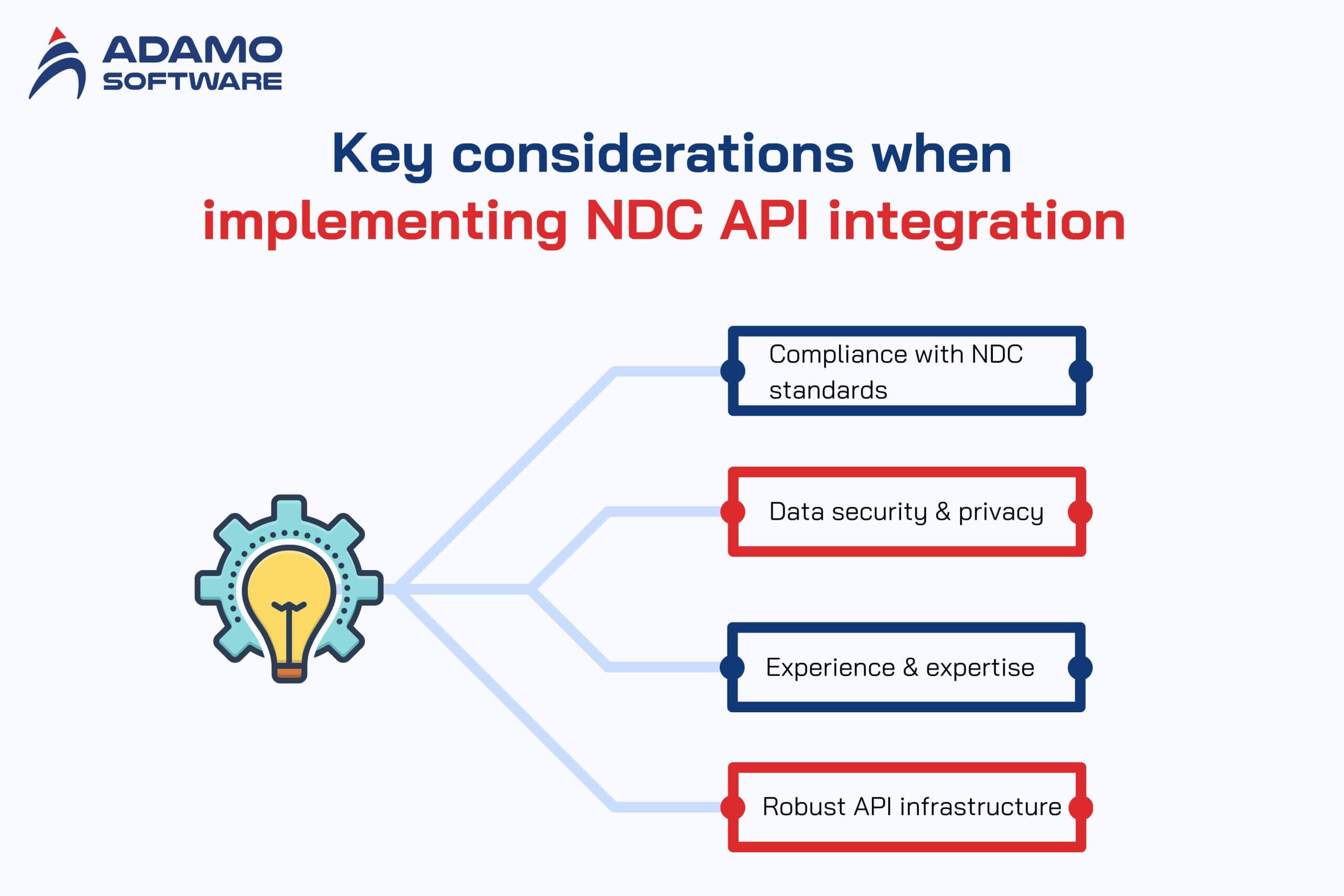
1. Compliance with NDC standards
Travel agents should confirm their technology provider meets IATA’s current NDC standards, since compliance is what lets different industry players exchange data reliably. A useful reference is IATA’s Airline Retailing Maturity (ARM) Index, on which more than 70 airlines have validated APIs conforming to published IATA schemas (IATA, 2026). Because schema versions differ (the current baseline is 24.1, while many carriers still run older releases such as 17.2), confirm the provider is certified and works with the versions your target airlines use. Without this, integration problems can delay operations and degrade the accuracy of the content you show customers.
2. Data security and privacy
Travel agents handle sensitive customer information, including personal details and payment data, so security is paramount once NDC APIs are integrated. Scrutinize the provider’s encryption protocols and compliance with regulations such as GDPR, and ask how they handle data privacy and customer consent. Strong protection against breaches and unauthorized access shields both the customer and the agency’s brand, and keeps the integration within legal obligations.
3. Experience and expertise
Choose a travel and hospitality software development provider with proven experience in NDC API integration. Look for teams that have implemented NDC for travel agencies before, understand industry standards, and know the specific challenges of the agency business. Case studies and client testimonials are a practical way to assess whether a provider can deliver a successful implementation.
4. Robust API infrastructure
The provider’s infrastructure must handle the demands of NDC, including high-volume data and transaction throughput without losing performance during peak spikes. Scalability matters so the system grows with the agency, and high availability keeps downtime and disruptions minimal. One specific cost to plan for is the look-to-book (L2B) ratio: NDC tends to generate far more search requests than bookings, and managing that traffic efficiently is often the largest ongoing operational expense (Altexsoft, 2025).
V. The Road Ahead for NDC
NDC is part of a larger shift toward modern airline retailing built on Offers and Orders (O&O), which aims to replace the legacy PNR, e-ticket, and EMD records with a single unified order. IATA’s Distribution Advisory Council has set an aspirational goal of full Offers and Orders capability by 2030, though even leading airlines are still in the setup phase and many will only begin the transition around 2028 to 2029 (IATA, 2025). For travel agents and platforms, the practical takeaway is to treat NDC as a long-term, evolving capability rather than a one-off project, and to build integration that can absorb new schema versions over time.
VI. Why Choose Adamo Software for NDC API Integration

NDC API integration delivers real advantages, richer content, personalization, and flexible pricing, but the fragmented standards and adoption challenges mean implementation needs careful planning. At Adamo Software, our travel and hospitality teams build and maintain custom online booking engines that integrate NDC, GDS, and direct airline APIs into a single, performant booking flow. We help travel businesses navigate version compatibility, aggregator choices, and infrastructure demands so the transition to NDC is as smooth as possible.
FAQs for NDC API Integration
1. What is NDC in travel?
NDC (New Distribution Capability) is an XML-based data standard developed by IATA in 2012 that lets airlines distribute fares, ancillary services, and personalized offers directly to travel agents and booking platforms, beyond the basic content carried by legacy GDS-EDIFACT messaging.
2. What is the difference between NDC and GDS?
GDS uses the legacy EDIFACT protocol to distribute standardized fares and schedules across many suppliers, while NDC is a newer XML standard that lets airlines distribute rich content, ancillaries, and dynamic pricing directly. Most platforms now combine both. For the GDS side, see our GDS integration guide.
3. Is NDC replacing GDS?
Not yet, and not entirely. NDC adoption is growing, reaching 21.2% of ARC-settled agency bookings in December 2025 (Travel Weekly/ARC, 2026), but GDS-EDIFACT still handles around 88% of indirect sales globally (Altexsoft, 2025). The realistic model today is a hybrid that pairs GDS breadth with NDC depth.
4. What is an NDC API?
An NDC API is the interface a travel platform uses to connect to an airline’s NDC-enabled system. The platform sends a real-time query, and the airline’s NDC API returns a personalized offer with fare options, seat choices, and ancillary services tailored to the traveler.
5. What should travel agents check before NDC integration?
Travel agents should verify the provider’s compliance with current IATA NDC schema versions, its data security and GDPR posture, its track record on NDC projects, and the scalability of its API infrastructure, including how it manages the high look-to-book traffic NDC generates.
Conclusion
NDC API integration gives airlines and travel agencies a powerful alternative to conventional GDS distribution, with richer content, personalization, and flexible pricing. The honest picture is that adoption is rising but still a minority of bookings, fragmentation remains a real obstacle, and the smart approach is a hybrid that runs NDC alongside GDS. For travel agents, success depends less on rushing to NDC and more on choosing a compliant, secure, and scalable integration partner that can evolve with the standard.

 adamosoft.com
 (+84) 373 11 44 88