
Healthcare Chatbot: Benefits, Use Cases, Guide to Build
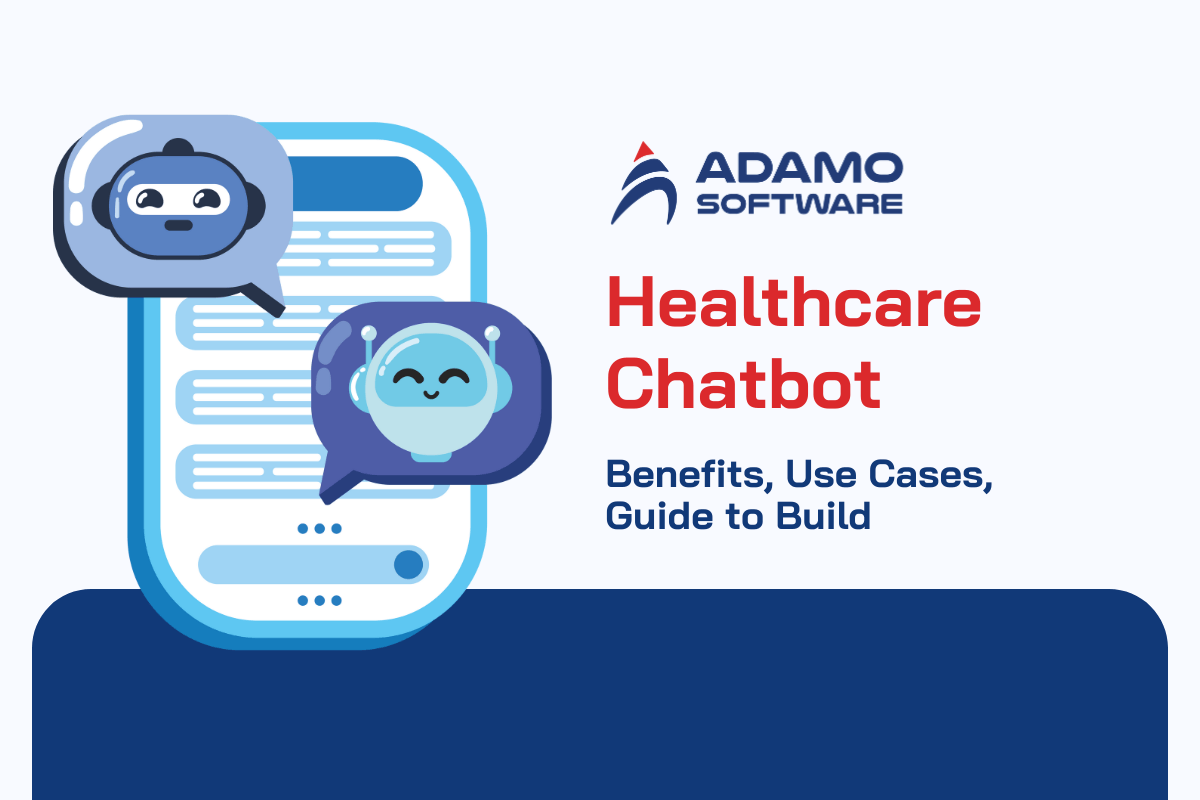
Staff shortages, rising patient volumes, and a post-pandemic expectation for digital-first access have pushed healthcare providers to automate the front door of patient communication. A healthcare chatbot is one of the most direct ways to do that. It handles the high-volume, repetitive questions that consume clinical and administrative hours, and it does so around the clock.
For a CTO or product owner evaluating one, the question is rarely whether chatbots work. It is which architecture fits the workflow, how it integrates with existing systems, and how to keep patient data compliant. This article covers the benefits, the real use cases, examples of chatbots already in the market, and a build process you can plan against.
Key Takeaways:
- A healthcare chatbot automates routine patient interactions such as scheduling, reminders, FAQs, and basic triage, freeing clinical and administrative staff for higher-value work.
- Market-size estimates vary by scope, but research firms agree the segment is growing fast. Fortune Business Insights valued the 2025 market at USD 1.98 billion and projects USD 2.41 billion in 2026 at a 23% CAGR through 2034.
- Reported operational gains are significant. Accenture has found chatbots can resolve up to 80% of repetitive, low-complexity inquiries, and a 2025 Accenture analysis reported administrative cost reductions of around 30% for organizations adopting AI patient-engagement tools.
- The hard part is not the conversation. It is HIPAA and GDPR compliance, EHR and CRM integration, and safe escalation to a human clinician.
- Build decisions hinge on architecture (rule-based versus AI and NLP versus generative), platform integration, and a tested escalation path, not on the chatbot interface alone.
What Is a Healthcare Chatbot?
A healthcare chatbot is software that conducts a conversation with patients or staff through text or voice to perform a defined task, such as booking an appointment, answering an FAQ, collecting intake data, or guiding a symptom check. It sits at the point of contact: a website, a mobile app, or a messaging channel like WhatsApp.
Not all chatbots are the same, and the type you choose determines cost, capability, and risk:
- Rule-based chatbots: They follow predefined decision trees. They are predictable, easier to keep compliant, and well suited to scheduling, FAQs, and form collection where answers are bounded.
- AI and NLP chatbots: They use natural language processing and machine learning in healthcare to interpret free-text questions and respond in context. They handle messier patient language but require more data governance.
- Generative chatbots: Built on large language models, they produce fluent, open-ended responses. They are powerful for information delivery but demand strict guardrails in a clinical setting to prevent unsafe or fabricated answers.
A chatbot is also distinct from a fuller medical AI assistant. A chatbot answers and routes. An AI assistant integrates deeper into hospital systems to act on data, support clinicians, and automate multi-step workflows. Many organizations start with a chatbot and expand toward an assistant as the use case matures.
Benefits of Healthcare Chatbots
The value of a healthcare chatbot is measured in staff hours recovered, patient access improved, and cost removed. The reported figures are substantial.
- Reduced administrative burden: Appointment booking, insurance form submission, and basic queries can be automated. Accenture has reported that chatbots can resolve up to 80% of repetitive, low-complexity inquiries without human involvement, which directly offloads front-desk and call-center work.
- Lower operating cost: A 2025 Accenture analysis found that healthcare organizations adopting AI-powered patient-engagement tools reduced administrative costs by around 30%. Independent industry analyses report similar customer-service savings of up to 30%.
- 24/7 patient access: Patients can get answers, reminders, and self-service outside clinic hours, which reduces missed appointments and eases pressure on phone lines. The use of AI automation in healthcare for reminders has a measurable effect on no-show rates.
- Stronger patient engagement: Chatbots keep patients informed from admission through post-discharge follow-up. They pair naturally with broader patient engagement software to maintain contact across the care journey.
- Reduced readmission and better adherence: Automated follow-up and medication reminders help patients stick to treatment plans after discharge, lowering avoidable readmissions.
- Privacy for sensitive topics: For mental health or sexual health questions, a chatbot lowers the social barrier to asking, which can surface concerns earlier than a phone call would.
Demand for these outcomes is reflected in adoption. An Accenture consumer survey reported that roughly 77% of patients would use a healthcare chatbot for routine tasks such as booking appointments and prescription refills, signaling that patient acceptance is no longer the main barrier.
Healthcare Chatbot Use Cases
The strongest healthcare chatbot use cases share one trait: high volume, low clinical complexity, clear rules. These are the workflows where automation pays back fastest.
- Appointment management: Patients schedule, reschedule, or cancel by message instead of calling. This is consistently the fastest-growing use case because it removes a major source of inbound calls.
- Symptom triage and self-assessment: A guided symptom checker helps patients decide whether to self-care, book a visit, or seek urgent care, and routes them accordingly.
- Patient onboarding and intake: The chatbot collects registration details and pre-visit information, then guides new patients through forms and instructions.
- Appointment preparation: Automated reminders deliver pre-visit instructions, such as fasting requirements or documents to bring, at the right time before an appointment.
- Insurance and claims support: The chatbot explains coverage, answers policy questions, and walks patients through claim steps, reducing a common source of confusion and calls.
- Medical records access: Patients request records or results through the chatbot rather than waiting on a call center, which keeps phone lines open for urgent matters.
- Feedback collection: A short post-visit conversation gathers experience data with higher completion rates than email surveys.
- Connecting patients to clinicians: The chatbot triages and hands off to a human through voice or video when a case exceeds its scope, which is essential for any telemedicine workflow.
- Medication and vaccination reminders: Scheduled prompts improve adherence and let patients ask follow-up questions about dosage or side effects.
- Health awareness campaigns: Targeted educational messages support seasonal or preventive-care outreach at scale.
Examples of Healthcare Chatbots
Several consumer-facing chatbots illustrate what mature products look like and where their limits sit. They are useful reference points when scoping your own build.
- Buoy Health: A symptom checker that assesses severity and recommends a level of care. Its limitation is the boundary every clinical chatbot shares: it cannot replace clinician judgment for complex or atypical cases.
- Ada Health: A multilingual symptom assessment tool that references medical history and integrates with wearables. Its accuracy depends heavily on the quality of the information the user provides.
- Woebot Health: A mental-health support chatbot offering anonymous, low-cost coping tools. It is designed for support and engagement rather than clinical treatment.
- Your.MD: A wellness companion focused on preventive guidance and self-care for minor conditions, with the trade-off that advice can be general rather than highly individualized.
The common thread across these examples is scope discipline. Each succeeds by doing a narrow job well and escalating beyond it, which is the single most important design decision in healthcare.
Challenges and Limitations of Healthcare Chatbots
A healthcare chatbot fails in predictable ways. Knowing them before you build is what separates a deployment that sticks from one quietly abandoned after launch.
- Patient reluctance and digital literacy: Not every patient trusts or navigates a conversational interface, and older populations in particular may find it unintuitive. If the experience is not simple and accessible, engagement drops regardless of how capable the chatbot is.
- Integration friction with clinical systems: Many platforms claim EHR integration, but real-world interoperability is harder. Weak connections lead to duplicated work, outdated records, and clinician frustration, which is the most common reason healthcare chatbot projects stall.
- Clinical safety with generative models: Large language models can produce fluent but incorrect answers. In a clinical context, an unguarded generative chatbot is a liability, which is why guardrails and a conservative escalation policy are not optional.
- Data privacy and bias: Chatbots handle sensitive health data, so any weakness in storage, access, or sharing is both a compliance and a trust risk. Models trained on skewed data can also produce biased guidance, which requires ongoing monitoring and governance.
- Scope creep: The temptation to make the chatbot do everything dilutes quality. The products that work keep a narrow remit and escalate beyond it.
How to Build a Healthcare Chatbot
Building a healthcare chatbot is less about the conversation and more about integration, compliance, and a safe escalation path. The following process reflects how production healthcare chatbots are scoped and delivered.
1. Define the problem and success metric
Pick one or two high-volume workflows to start, such as appointment scheduling or symptom triage. Define what success looks like in numbers before you build: reduced wait times, fewer inbound calls, higher engagement, or lower no-show rates. A narrow, measurable first scope outperforms a broad one.
2. Choose the architecture
Decide between a rule-based system, an AI and NLP system, or a generative model. The choice is a trade-off between control and flexibility. Rule-based is cheaper and easier to keep compliant; AI and generative handle natural language but need stronger governance. Many healthcare builds use a hybrid: rules for sensitive flows, AI for open-ended queries.
3. Plan the integrations first
A chatbot that cannot read or write to your core systems delivers little value. Confirm how it will connect to the electronic health record (EHR), the practice management or CRM system, and any scheduling or payment tools. Interoperability gaps are the most common reason healthcare chatbot projects underperform, so they belong at the start of the plan, not the end.
4. Design the conversation flow and escalation
Map how the chatbot greets users, the paths a conversation can take, and, critically, when it stops. Define the exact triggers that hand a patient to a human clinician or representative. In healthcare, a well-designed escalation path matters more than conversational polish.
5. Develop and train
Build the chatbot on your chosen platform and, for AI models, train it on accurate, governed medical content. Data handling must be designed for privacy from the first line of code, not retrofitted later. This is where partnering with an experienced AI development services team reduces risk.
6. Build in compliance and security
The chatbot must meet HIPAA in the United States, GDPR in Europe, and any local health-data regulation in your market. That means encryption in transit and at rest, access controls, audit logging, and a clear data-retention policy. Compliance is a build requirement, not a final review step.
7. Test with real users, then launch
Run internal testing for logic and flow, then a controlled pilot with a small group of real patients before full release. Use their feedback to fix dead ends and unclear responses. Launch on the channels your patients already use, whether that is your website, app, or a messaging platform.
8. Monitor and improve continuously
Track which queries the chatbot handles well and where it fails or escalates often. Those failure points are your roadmap. Update content and flows on a regular cadence, and treat the chatbot as a product that improves over time rather than a one-time deployment.
Technologies and Integrations Behind a Healthcare Chatbot
The capability of a healthcare chatbot comes from the stack underneath it. Three layers decide what it can do: language understanding, the build framework, and clinical integration.
- Natural language processing: NLP and natural language understanding let the chatbot interpret free-text patient questions rather than only menu choices. This is the difference between a rigid bot and one that handles how patients actually write.
- Build frameworks and models: Conversational frameworks such as Rasa, Microsoft Bot Framework, and Google Dialogflow handle rule-based and AI flows, while large language models from providers like OpenAI or Google power generative responses where appropriate. The right mix depends on how much open-ended language the use case demands.
- Clinical data integration: Interoperability standards such as HL7 and FHIR are what let a chatbot read from and write to the EHR safely. Without them, the chatbot is isolated from the records that make its answers useful, and this integration layer is usually the hardest and most valuable part of the build.
- Channels and delivery: The chatbot reaches patients through a website, a mobile app, or messaging platforms like WhatsApp. Channel choice should follow where your patients already are.
- Security infrastructure: Encryption, role-based access, and audit logging sit across the whole stack to satisfy HIPAA and GDPR. They are a design constraint, not an add-on.
Healthcare Chatbots in Practice
The patterns above are not theoretical. Across our healthcare and AI projects, conversational features are now a common part of the build rather than a standalone product.
- For an Australian aged-care and NDIS management platform, we built an in-app assistant chatbot that guides users through their care plans and spending in plain language, delivered in a React Native app aimed at elderly users and their families.
- For a UK workplace-psychology platform, we implemented an AI chat feature on Google Vertex AI, embedded inside an assessment-to-therapy journey rather than bolted on as a separate tool.
- For an end-to-end virtual care platform, we integrated OpenAI-powered conversational support alongside video consultation, e-prescription, and multi-role workflows for clinics, labs, and pharmacies.
The consistent lesson across these builds is the one this guide keeps returning to: the chatbot itself is the easy part. The value, and the difficulty, both live in integrating it safely into the clinical and care systems around it.
How Much Does a Healthcare Chatbot Cost?
Cost depends almost entirely on architecture and integration depth, not on the chatbot itself. A rule-based FAQ bot on a single channel is modest. An AI-driven chatbot with EHR and CRM integration, multilingual support, and clinical escalation is a larger build. The cost drivers to budget for are integration complexity, the level of NLP or generative capability, compliance work, and ongoing maintenance and model updates. The most reliable way to size a build is a scoping session that maps your specific workflows and systems before any estimate.
Frequently Asked Questions
1. What is a chatbot in healthcare?
A healthcare chatbot is conversational software that interacts with patients or staff through text or voice to automate tasks such as scheduling, reminders, FAQs, and symptom triage. It can be rule-based, AI-driven, or generative.
2. How do chatbots improve healthcare?
They reduce administrative workload, give patients 24/7 access, lower operating costs by automating routine queries, and improve adherence through reminders and follow-up. Accenture has reported chatbots can handle up to 80% of repetitive inquiries.
3. What are the main types of healthcare chatbots?
The three main types are rule-based chatbots that follow set decision trees, AI and NLP chatbots that interpret natural language, and generative chatbots built on large language models. Each trades control against flexibility.
4. Are healthcare chatbots HIPAA compliant?
They can be, but compliance is not automatic. It depends on how the chatbot encrypts data, controls access, logs activity, and handles data retention. Compliance with HIPAA or GDPR must be engineered into the build.
Conclusion
A healthcare chatbot is one of the highest-return automations a provider can deploy, with reported cuts of up to 80% in repetitive inquiries and roughly 30% in administrative costs. The technology is proven and patient acceptance is high. What separates a successful build from a stalled one is architecture choice, deep integration with your EHR and CRM, airtight HIPAA and GDPR compliance, and a clear path to escalate to a human clinician. Get those four right and the chatbot pays for itself in recovered staff hours.
Build a Compliant Healthcare Chatbot With Adamo Software
If you are planning a healthcare chatbot, the hardest decisions are architecture, integration, and compliance, not the conversation. Adamo Software is a Vietnam-based software development company that builds AI-driven and rule-based healthcare solutions, with experience integrating conversational tools into EHR, scheduling, and telehealth workflows under HIPAA and GDPR constraints. Our team can scope your use case, recommend the right architecture, and deliver a chatbot designed to be safe and maintainable from day one.

 adamosoft.com
 (+84) 373 11 44 88