
AI Automation in Healthcare: Benefits, Challenges, and How to Get Started
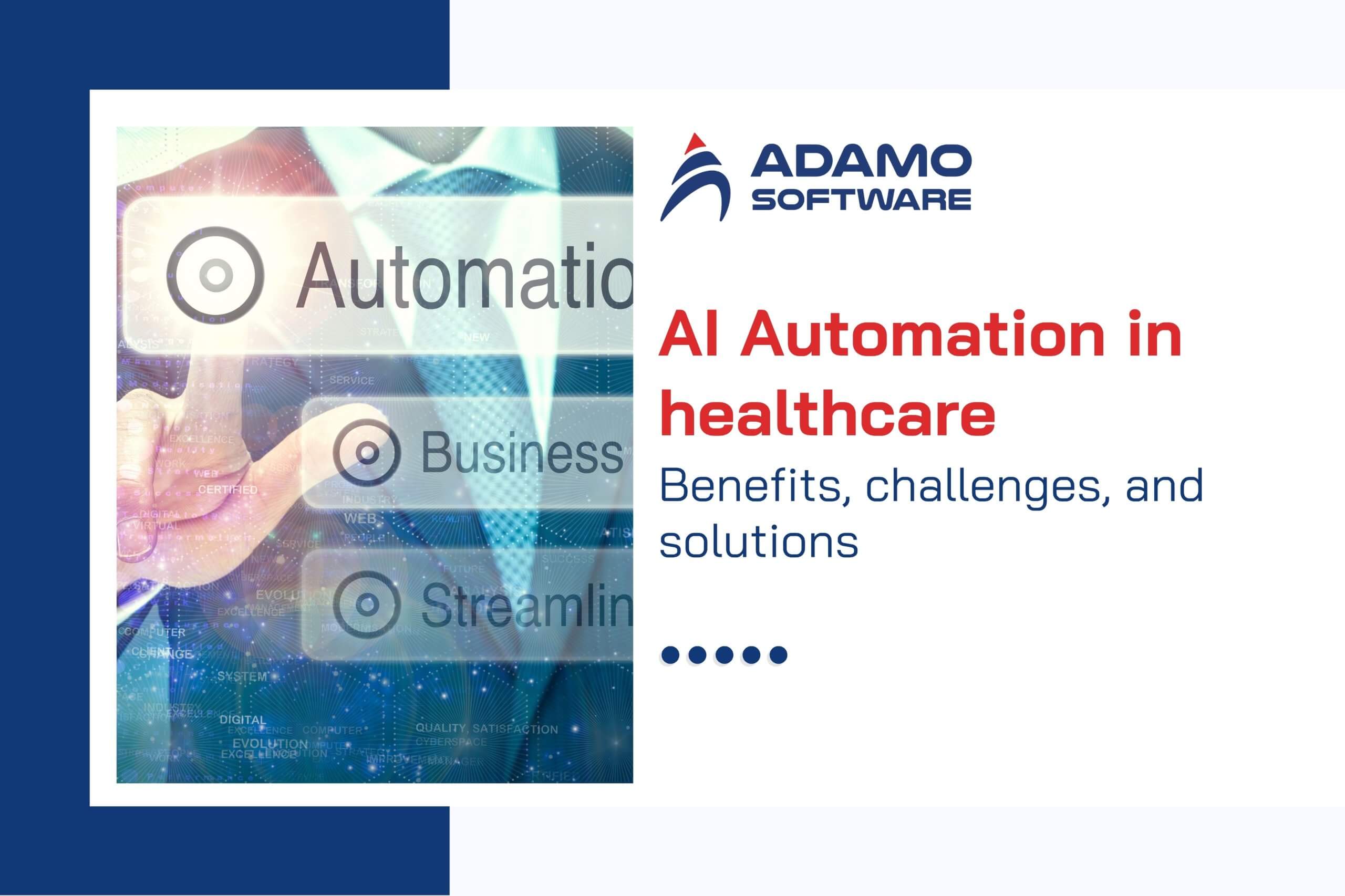
What AI workflow automation in healthcare really covers: the administrative and operational workflows it streamlines, the measurable benefits, the challenges that stall it, and how to adopt AI without overreaching.
AI automation in healthcare means using artificial intelligence to run repetitive, high-volume work such as scheduling, documentation, coding, billing, claims, intake, and the operational decisions behind them. It goes beyond old rule-based automation because Machine Learning (ML) and Natural Language Processing (NLP) let the system read unstructured text, spot patterns, and handle exceptions instead of following a fixed script. The prize is large.
Researchers at McKinsey and the National Bureau of Economic Research (2023) estimated that wider AI adoption could cut US healthcare spending by 5 to 10 percent, roughly USD 200 billion to USD 360 billion a year, using modern technologies and without sacrificing quality or access. However, adopting AI to automate workflow in healthcare is a real challenge due to the unique characteristics of this sector. This guide will provide you with a practical overview of AI automation in healthcare, including benefits, common challenges, real-world applications, and steps to implement AI automation successfully in your healthcare organization.
Key Takeaways
- AI automation in healthcare is mostly about administrative and operational workflows, not autonomous clinical decisions. That is where the near-term, measurable value sits.
- McKinsey and the NBER (2023) put the potential savings at USD 200 billion to USD 360 billion a year in the US, with the single largest lever being payer claims automation and prior authorization.
- The bottleneck is adoption, not technology. The NBER (2023) found fewer than 10 percent of healthcare organizations fully integrate AI, and McKinsey (2025) found only about a third are scaling it across the business.
- Privacy, bias, legacy integration, explainability, and change management are the recurring obstacles. Each has a practical mitigation, and keeping a human in the loop is the common thread.
Healthcare systems worldwide are under pressure from rising costs, staff burnout, and growing volumes of data. AI automation is one of the few levers that addresses all three at once, by taking administrative load off clinical staff. This article explains what the term actually covers, where it delivers value today, the challenges that hold it back, and where it is already changing hospital operations.
What AI Automation in Healthcare Actually Means
The phrase “AI Automation” covers a spectrum, and it helps to see the whole of it. At the simplest end is rule-based automation, which follows a fixed script and breaks when a case does not match the rule. AI automation adds a layer of intelligence on top: machine learning to find patterns in data, and natural language processing to work with clinical notes, messages, and forms that a rule engine cannot read.
In practice, the automation toolkit has a few distinct parts. Robotic process automation (RPA) handles structured, repetitive tasks such as moving data between systems. Machine learning predicts and classifies, for example, forecasting demand or flagging anomalies. Natural language processing reads and drafts unstructured text such as clinical notes and patient messages. Computer vision structures visual inputs. Most real deployments combine several of these rather than relying on just one, which is why a clear view of the whole toolkit matters before choosing where to start.
At the far end of the spectrum sit autonomous agents that plan and act across multiple steps toward a goal, which we cover separately in our guide on agentic AI in healthcare. This article focuses on the broader automation layer that most providers deploy first, because it carries less risk and returns value faster. For the wider context of what the technology can do across the sector, our overview of AI applications in healthcare is a good companion read.
The important distinction for a health system is not the technology label but the task. Automating a scheduling queue or a claims submission is low-risk and high-volume. Automating anything that touches a diagnosis or a treatment decision is a different matter, and the safe pattern there is decision support with a clinician in control, not automation of the decision itself.
Where AI Automation in Healthcare Delivers Value
The clearest returns are operational and administrative, because they are high-volume, measurable, and do not require the system to make a clinical call.
Administrative workflows
Claims processing, prior authorization, coding, billing, and intake are rule-heavy but full of exceptions, which is exactly what AI automation handles well. McKinsey and NBER reported that the single largest savings opportunity sat with payers, through claims automation, prior authorization, and fraud detection. A separate McKinsey study (Sahni and colleagues, 2021) put the prize from administrative simplification alone at around a quarter of a trillion dollars in US healthcare.
Clinical documentation
Documentation is one of the highest hidden costs in care. Physicians spend hours on EHR and desk work for every hour of direct patient care. Automating note-taking and record retrieval returns time to clinicians without touching a clinical decision.
Operations
AI automation in healthcare sector forecasts patient demand to plan staffing, beds, and equipment, keeps supply chains stocked without overstocking, and flags equipment likely to fail before it does. A demand forecast that is even modestly more accurate translates into fewer idle beds and fewer last-minute agency-staffing costs, which is why operations is often where a first project pays for itself. These are the workflows behind shorter waits and less waste.
Patient experience
Automated reminders, intake, and plain-language explanations of results reduce friction for patients and free front-desk staff, without the system giving medical advice.
Challenges of AI Automation in Healthcare
The upside is real, and so are the obstacles. Like any new technology, AI workflow automation comes with certain challenges that healthcare providers need to consider carefully before putting it into practice. Understanding these challenges early on can help providers set realistic expectations and make better decisions.
Data privacy and security
Health data is sensitive and a prime target. The US Department of Health and Human Services (2024) reported that data breaches involving unsecured protected health information have affected approximately 249.9 million individuals. Therefore, having strict practices to ensure data protection is essential. Typically, encrypt data in storage and transit, enforce role-based access, keep audit logs, and test defences regularly. Automation must not widen the attack surface.
Bias and equity
A model trained on skewed data produces skewed results, and in healthcare that can mean worse outcomes for under-represented groups. Without regular checks and monitoring, biases within the system can be repeated on a large scale, exacerbating healthcare inequality instead of improving the quality of treatment. To reduce bias and improve equity, the AI development team can use diverse training data, measure performance across subgroups, and keep human review on flagged cases.
Integration with legacy systems
Most hospitals run older software across many legacy systems (such as EHR/ EMR), and a poorly fitted tool creates friction or gets rejected. Also, older systems may use many different data formats, making it difficult for data to be exchanged seamlessly. To make the integration easier, businesses can start with narrow pilots, integrate through APIs and middleware to minimise disruption, and design with the clinicians and admin staff who will use it.
Explainability and trust
Staff will not rely on a black box for anything that matters. If AI produces inaccurate or inconsistent results that cannot be clearly explained, identifying the cause and troubleshooting becomes more difficult. So how to avoid it? Use explainable techniques, show the factors behind a suggestion, and route uncertain cases to a person.
Regulation and liability
Healthcare is a sector subject to strict data protection regulations. Therefore, when implementing AI automation, businesses need to ensure they comply with relevant regulations. For example, in the US, HIPAA (Health Insurance Portability and Accountability Act) sets requirements for protecting health data, along with appropriate access controls and safeguards in place.
Accountability for an AI-influenced decision is still unsettled in many jurisdictions. The safe stance is to treat AI as a support tool rather than an autonomous decision-maker, keep clinicians responsible, log every recommendation and override, and engage regulators early where software may qualify as a medical device.
Cost and change management
Tools, talent, and maintenance cost money, and staff may resist what they fear will replace them. Begin with modular tools and clear ROI cases, and position automation as removing drudgery so people can do higher-value work.
The scale of the adoption gap is worth stating plainly. McKinsey’s State of AI survey (2025) found only about a third of organizations scaling it across the business. The technology is ready; the operating discipline to deploy it is the harder part.
Where AI Automation Is Already Transforming Operations
AI workflow automation is already making its way into multiple aspects of the healthcare sector. Here are five operational areas which show the clearest, most repeatable gains.
Resource allocation
AI Automation in healthcare supports facilities in allocating resources more efficiently by analyzing operational data and predicting future needs. This allows healthcare facilities to identify staffing and equipment requirements at any given time. Specifically:
- Staff scheduling: Analyze the projected patient volume, appointment schedules, and workload to propose on-call schedules and shifts, minimizing resource shortages or surpluses.
- Capacity management: Predict bed demand based on admission, discharge, and patient flow data.
- Medical equipment allocation: Monitor equipment usage and needs in each department to support the transfer of machinery to where it is needed.
- Inventory and supply management: Forecast demand for medicines and medical equipment based on usage history, patient trends, and inventory data.
Supply chain
AI automation helps healthcare providers manage medical supplies more efficiently by predicting demand, monitoring inventory, and automating reordering. It can track stock levels, flag items that are running low or nearing expiration, and identify potential delivery delays. For example, AI can predict an increased demand for medicines during flu season and alert staff when supplies need replenishing. This helps hospitals avoid shortages, reduce waste, and keep essential supplies available when needed.
Predictive maintenance
AI automation helps healthcare providers monitor medical equipment and identify potential problems before they cause breakdowns. By analyzing equipment data and usage patterns, AI can predict when maintenance is needed and alert staff in advance. This helps reduce downtime, avoid unexpected repair costs, and keep essential equipment running smoothly.
Patient flow and scheduling
AI automation helps hospitals manage patient flow by predicting patient volumes, optimizing appointment schedules, and reducing waiting times. For example, AI can forecast busy periods and help staff adjust schedules or allocate resources accordingly. This makes daily operations more efficient and helps patients receive care with fewer delays.
Administrative task automation
AI automation can handle repetitive administrative tasks such as appointment reminders, data entry, medical document processing, and insurance claim management. Instead of spending hours on paperwork, healthcare staff can let AI take care of routine work and focus more on patients. It also helps reduce manual errors and speed up everyday processes.
How to Adopt AI Automation Without Overreaching
Given that adoption, not technology, is the bottleneck, the sequence of a rollout matters as much as the tools chosen. A pattern that works is to start where the risk is lowest, and the volume is highest.
- Start with administrative workflows. Claims, scheduling, and documentation are high-volume and low-clinical-risk, so they build confidence and return value while the organisation learns.
- Pilot narrow, measure hard. Define a specific workflow and a measurable target before building, so success or failure is unambiguous. Vague, do-everything automation is the most common way a project stalls.
- Integrate, do not bolt on. Connect to existing systems through APIs and middleware so staff keep their workflow, rather than adding a parallel tool nobody adopts.
- Keep a human in the loop. Automate the preparation and leave consequential decisions to people, with logging and override throughout. This is both the safe posture and the one that earns staff trust.
- Scale on evidence. Expand to the next workflow once the first shows measured results, rather than committing to a broad program before anything is proven.
Conclusion
AI workflow automation in healthcare is no longer theoretical, but the value that is real today is operational and administrative, not autonomous and clinical. The workflows worth automating first are the high-volume, rule-heavy ones behind the roughly two hours of In this day and age, AI adoption is no longer the hard part. McKinsey (2025) reported that 88% of organizations already use AI, yet nearly two-thirds have not scaled it beyond pilots. EHR work per patient hour and the payer claims processes that McKinsey and the NBER identified as the largest savings opportunity. Health systems that treat automation as a way to remove drudgery and support clinicians, with privacy, explainability, and a human in the loop built in, capture the benefit without taking on the risk of automating decisions that should stay with people.
Streamline your workflow with Adamo Software
Adamo Software is an AI and software development partner in Vietnam, delivering high-quality software solutions for businesses. We have built custom AI, machine learning, generative AI, and multimodal. Our AI development services cover the full lifecycle of building AI into a business workflow, model development, integration, and post-launch monitoring. Our AI experts will work with you to understand your goals and requirements, then define the core problems that need to be solved.
Adamo Software focuses on healthcare software development – a vertical that many businesses treat as a sideline. We have merged AI expertise with healthtech know-how to elevate clinical efficiency. More importantly, we maintain full compliance with regulations such as GDPR, HIPAA, and other relevant standards.

 adamosoft.com
 (+84) 373 11 44 88