
Agentic AI in Healthcare: Transforming Patient Care with Smarter Decisions
Learn what sets agentic AI in healthcare apart from generative AI and automation, where it delivers value today, the benefits health systems can measure, and how to adopt it safely.
Agentic AI in healthcare refers to AI systems that do more than answer a question. They hold a goal, break it into steps, decide the next action, and carry out multi-step work by calling connected tools, all within defined permissions and human oversight. This is a different class of software from a chatbot that replies when prompted. According to Grand View Research (2024), the agentic AI in healthcare market was worth about USD 538.51 million in 2024 and is projected to reach USD 4.96 billion by 2030, a compound annual growth rate of 45.56 percent. Most of that value is not about replacing clinicians. It is about removing the administrative load that surrounds care.
Key Takeaways
- Agentic AI in healthcare plans and executes multi-step workflows autonomously under guardrails, unlike generative AI, which only responds when prompted.
- The clearest near-term value is operational: clinical documentation, prior authorization, scheduling, and in-basket triage, not autonomous diagnosis or treatment.
- According to a study by Sinsky and colleagues in Annals of Internal Medicine (2016), physicians spend nearly two additional hours on EHR and desk work for every hour of direct patient care, which is the burden agents target first.
- Safe adoption depends on EHR and FHIR integration, graduated autonomy, human sign-off on consequential actions, and audit logging, not on the model alone.
The healthcare sector has spent a decade digitizing records and workflows. Agentic AI is the layer that finally acts on that data instead of just presenting it. But the term is used loosely, and the gap between a demo and a system that is safe to run inside a hospital is wide. This article separates what agentic AI in healthcare actually is from adjacent technologies, shows where it earns its place today, and sets out what it takes to build and integrate it responsibly.
What Makes Agentic AI in Healthcare Different From Generative AI and Automation
Three technologies get grouped together and should not be. Generative AI is reactive. It produces text, a summary, or a recommendation when a person prompts it, then stops. Rule-based automation, often called RPA, follows a fixed script and breaks the moment a case does not match the rule it was written for.
Agentic AI sits beyond both. It is given an outcome to reach, plans the steps to get there, chooses which tool to use at each step (an EHR query, a scheduling API, a claims system), checks the result, and adjusts. A human approves the actions that carry clinical or financial consequences. Fortune Business Insights (2025) framed the shift as a move from chatbots to action-oriented agents, and valued the agentic AI in healthcare market at USD 1.45 billion in 2025, projected to reach USD 19.71 billion by 2034. Analyst estimates differ on the exact figures, but every major firm puts the growth rate above 34 percent through the early 2030s.
The distinction matters for buyers because it changes what the software can finish. A chatbot drafts a message. An agent can pull the patient record, draft the prior authorization, submit it, track the response, and escalate to a human when it stalls. For a broader view of the technologies involved, see our guide on how AI is used in healthcare, and for the wider automation picture, our overview of AI automation in healthcare.
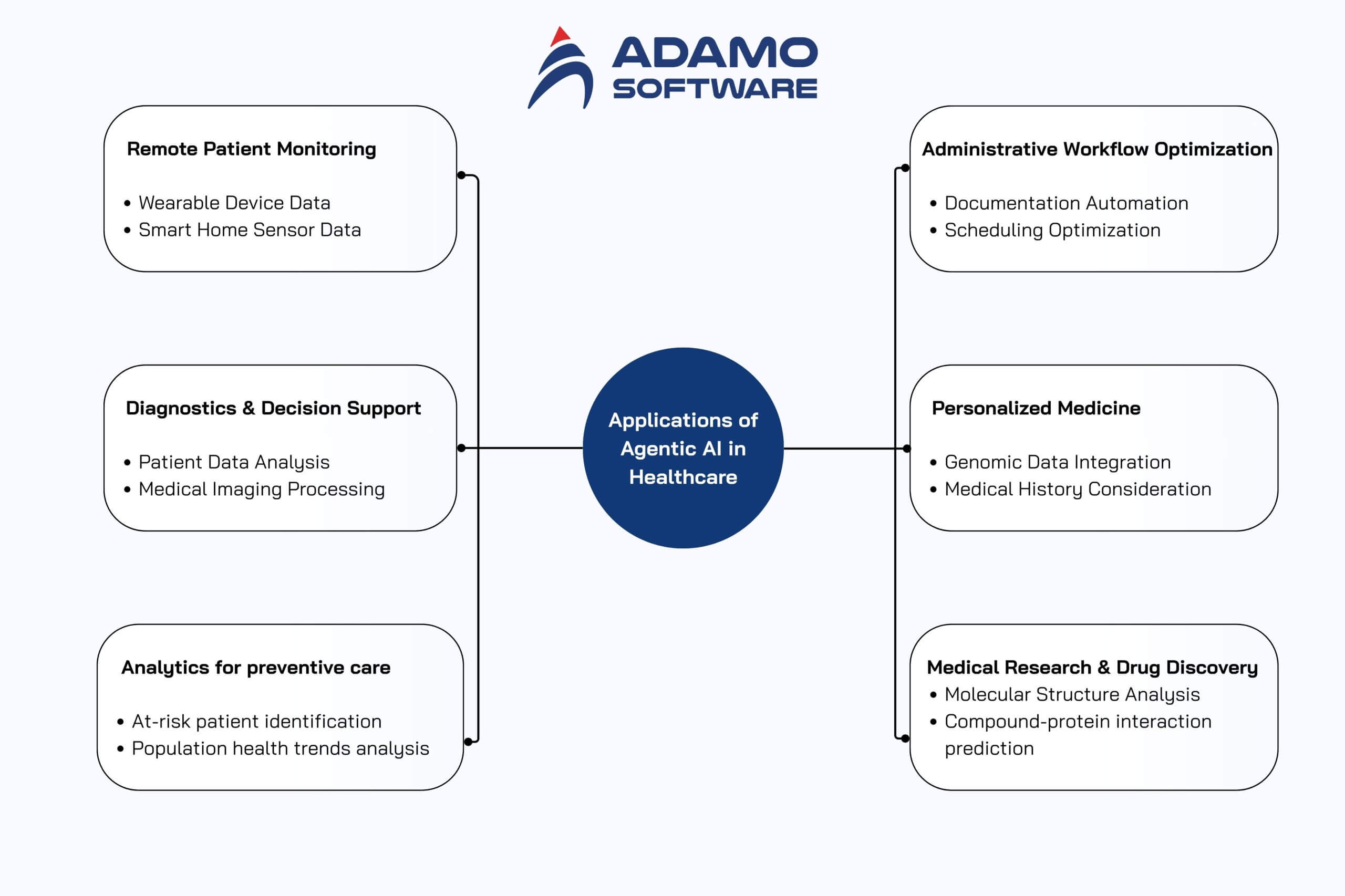
Where Agentic AI Delivers Value in Healthcare Operations Today
The first workflows agents reach are the high-volume, language-heavy ones. Fortune Business Insights (2025) noted that natural language processing leads the market because the largest workloads are clinical notes, patient messages, and in-basket traffic. These are also the workflows that do not require an agent to make a medical decision, which is why they are being deployed first.
Clinical documentation. According to a study by Sinsky and colleagues in Annals of Internal Medicine (2016), physicians spend close to two hours on EHR and desk work for every hour of direct patient care. Ambient documentation agents listen to a visit, draft the note, and file it to the record for the clinician to review and sign. A 2025 study published in a JAMA Network journal found that a 30-day ambient AI scribe deployment was associated with reduced clinician burnout. Microsoft’s Dragon Copilot (2025) is a live commercial example of this pattern.
Prior authorization and revenue cycle. An agent can gather the required clinical evidence, assemble the authorization request, submit it, and track the payer response, tasks that are rule-heavy but full of exceptions. This became more pressing after the U.S. Centers for Medicare and Medicaid Services tightened prior authorization timelines for 2026, which raises the cost of slow manual processing.
Patient intake, scheduling, and triage routing. Agents handle appointment scheduling, reminders, intake data collection, and routing of inbox messages to the correct team. Innovaccer’s Agents of Care (2025) is a named example of AI agents built to automate routine administrative tasks and reduce staff burnout.
Care-gap follow-up and clinical decision support. Agents can identify patients who are overdue for follow-up and initiate outreach under defined rules. In a clinical setting, the safe pattern is decision support, not decision-making: the agent surfaces relevant data and flags patterns, and the clinician decides. This boundary is deliberate and should be enforced in the system design, not left to policy alone.
The Benefits Health Systems Can Actually Measure
The benefits worth committing to in a business case are the operational ones, because they can be measured within a quarter. Documentation time per visit, after-hours EHR work (the “pajama time” the American Medical Association tracks in its annual burden reporting), inbox turnaround, prior authorization cycle time, and clinician retention are all quantifiable before and after a deployment.
Clinical-outcome claims are a different matter. Improvements in diagnosis or survival are hard to attribute cleanly to a single software layer, and overstating them is both a credibility risk and, in many markets, a regulatory one. The honest position is that agentic AI in healthcare returns measurable operational value first, and that operational value (time returned to clinicians, fewer manual handoffs, faster administrative cycles) is itself substantial given the burden numbers above.
The broader market reflects this. MarketsandMarkets (2026) projects the wider AI in healthcare market to grow from USD 36.67 billion in 2026 to USD 194.79 billion by 2031, and named the AI scribe segment as the fastest-growing function, which is precisely the documentation workflow described earlier.
What It Takes to Build and Integrate Agentic AI Safely
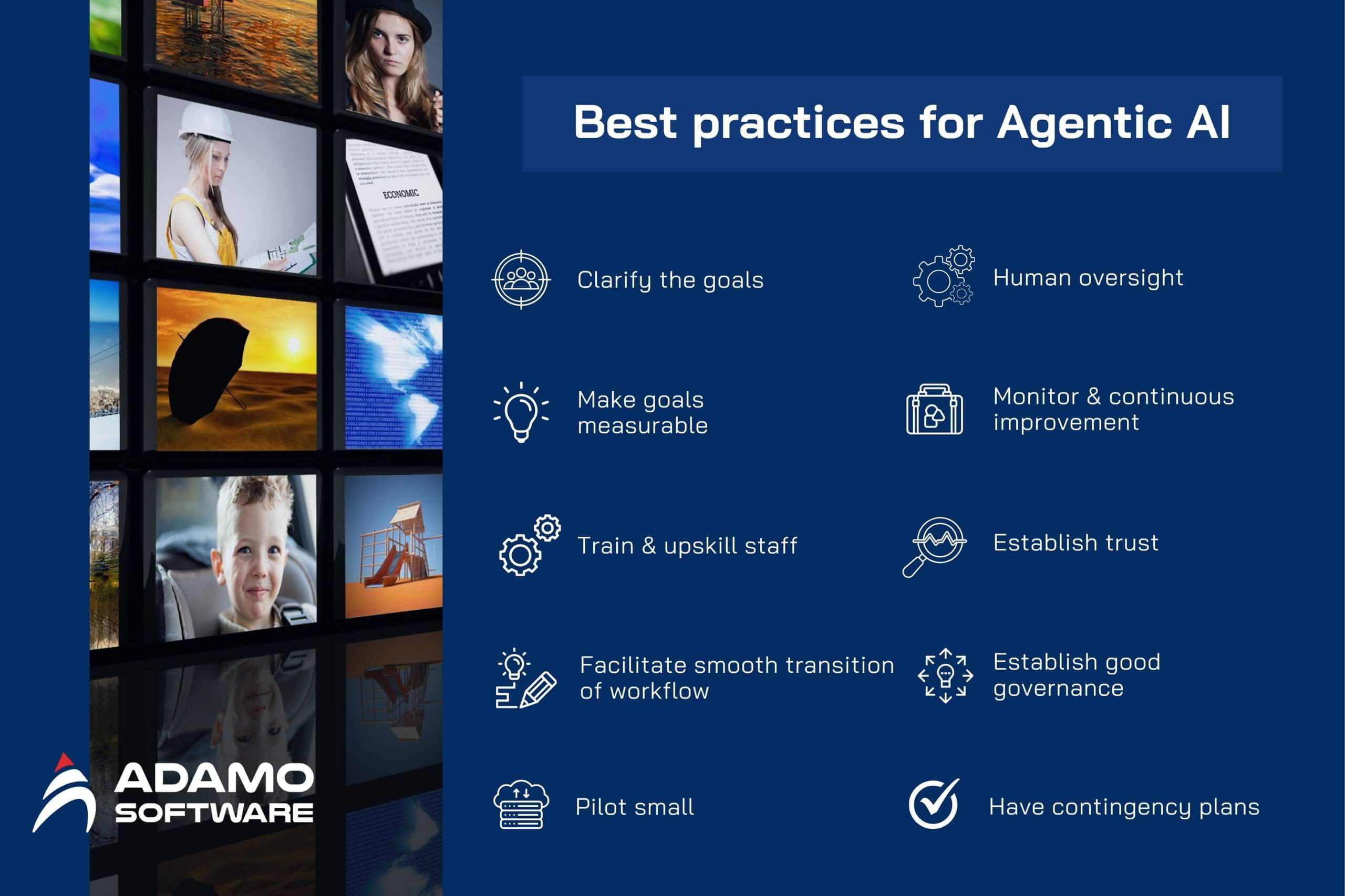
Most failed healthcare AI projects fail at integration and governance, not at the model. An agent is only useful if it can read and write to the systems of record safely, and only trustworthy if every action it takes can be reviewed. These healthcare-specific requirements sit on top of the general agent architecture, so it is worth pairing them with the AI agent architecture and build steps in our full guide. The following are the practical requirements.
- EHR and FHIR interoperability. Agents need clean, permissioned read and write access to the EHR. Standards such as FHIR are what let an agent act across systems instead of inside one screen. Our guide on AI in the EHR covers this integration layer in more depth.
- Graduated autonomy. Start read-only, then allow low-risk actions, then expand scope. Permissions should be narrow by default and widened deliberately, not granted all at once.
- Human-in-the-loop for consequential actions. Any action with clinical or financial impact should require a person to approve it. The agent prepares the work; the human owns the decision.
- Auditability. Every step an agent takes should be logged and reconstructable. Without an audit trail, an agent cannot be trusted in a regulated environment.
- Privacy and compliance. Handling of protected health information must meet HIPAA in the United States and the equivalent regime in each target market. Compliance has to be designed into the data flow, not bolted on.
- Monitoring and contingency. Track performance against defined metrics, and define fallback behavior for when the agent fails or produces a low-confidence result.
The National Academy of Medicine convened a meeting in December 2024 on using AI to improve health worker well-being, a signal that governance of this technology is now a mainstream institutional concern rather than a research topic.
This is the layer where implementation experience matters more than model choice. Adamo Software builds and integrates healthcare systems, including EHR and FHIR integration, telehealth, and remote patient monitoring, and applies the same interoperability and compliance discipline when embedding agentic workflows into systems a provider already runs. The goal is not a standalone AI product bolted beside the EHR, but agents that operate inside existing clinical and administrative workflows with the guardrails above in place.
Conclusion
Agentic AI in healthcare is growing fast, at above 45 percent CAGR by Grand View Research’s 2024 estimate, but the value that is real today is operational, not clinical. The workflows that justify a first deployment are the ones behind the roughly two hours of EHR work per patient hour that Sinsky and colleagues documented in 2016: documentation, prior authorization, scheduling, and triage. The practical path is to scope agents to those high-volume administrative workflows, enforce human sign-off and audit logging from day one, and expand autonomy only as the system earns trust.
Agentic AI in healthcare only pays off when it integrates safely with your EHR and workflows. Adamo Software builds that integration layer with FHIR interoperability, graduated autonomy, and audit-ready governance. Explore our Healthcare Software Development services to see how we embed agents into existing clinical operations, or start a project today.


 adamosoft.com
 (+84) 373 11 44 88