

App to track fitness with friends: Top features, benefits and examples
Explore 6 social fitness apps with friend tracking, plus the 6 features that drive retention. Learn what it takes to build a peer-to-peer fitness app in 2026.
The social fitness apps market reached $3.5 billion in 2024 and is projected to grow to $10.8 billion by 2033 at a CAGR of 13.5% (Source: Verified Market Reports, 2025). The reason for this growth is straightforward: people who work out with friends stick with their fitness routines longer. An app to track fitness with friends transforms exercise from a solo discipline problem into a shared experience where accountability, competition, and community drive engagement. This article reviews 6 social fitness apps, identifies the 6 features that make them work, and covers what goes into building one from scratch.
Key Takeaways:
- The global fitness app market was estimated at $12.12 billion in 2025 and is projected to reach $33.58 billion by 2033 (Source: Grand View Research, 2025). Social and community-driven features are among the fastest-growing segments as users seek motivation through peer accountability.
- Strava leads in outdoor activity tracking with GPS route mapping and segment-based competition. StepBet adds a financial accountability layer with real-money betting on step goals. Squaddy is purpose-built for group workout coordination.
- The 6 features that drive retention in social fitness apps are community groups and forums, activity feeds, achievement badges and leaderboards, personalized user profiles, streaming video content, and live chat. Apps that incorporate gamification see up to 50% higher retention rates compared to tracking-only apps (Source: FitBudd, 2025).
- Building a competitive app to track fitness with friends requires real-time activity sync, social feed architecture, push notification systems, and wearable device integration. Adamo Software has built an AI-powered fitness tracker app with GPT-4 personalization across 500+ exercises, and a calories tracker app platform that reached 10,000 users within two months through personalized content delivery.
Why Peer-to-Peer Fitness Apps Are Growing
Fitness enthusiasts do not just want personal progress tracking. They want connection with a community that shares their goals. Cyclists want riding partners to push each other on new trails. Gym regulars want to exchange tips with others using the same equipment. Runners want pace comparisons with friends on the same route.
Fitness app revenue grew by 24.5% in 2025 to reach $3.4 billion (Source: Business of Apps, 2026). A significant portion of this growth comes from social features. Apps that incorporate AI-driven personalization have 50% higher retention rates than those without (Source: FitBudd, 2025), and community-driven features like challenges, leaderboards, and group workouts are becoming the primary differentiator between apps that retain users and apps that get deleted after a week.
The business case is clear: social features reduce churn. When users have friends, teams, and competitions inside an app, they return more frequently and maintain subscriptions longer. For developers and businesses, this means the path to sustainable fitness app revenue runs directly through peer-to-peer functionality.
Benefits of using app to track fitness with friends
Here are some of the benefits of peer-to-peer fitness apps:
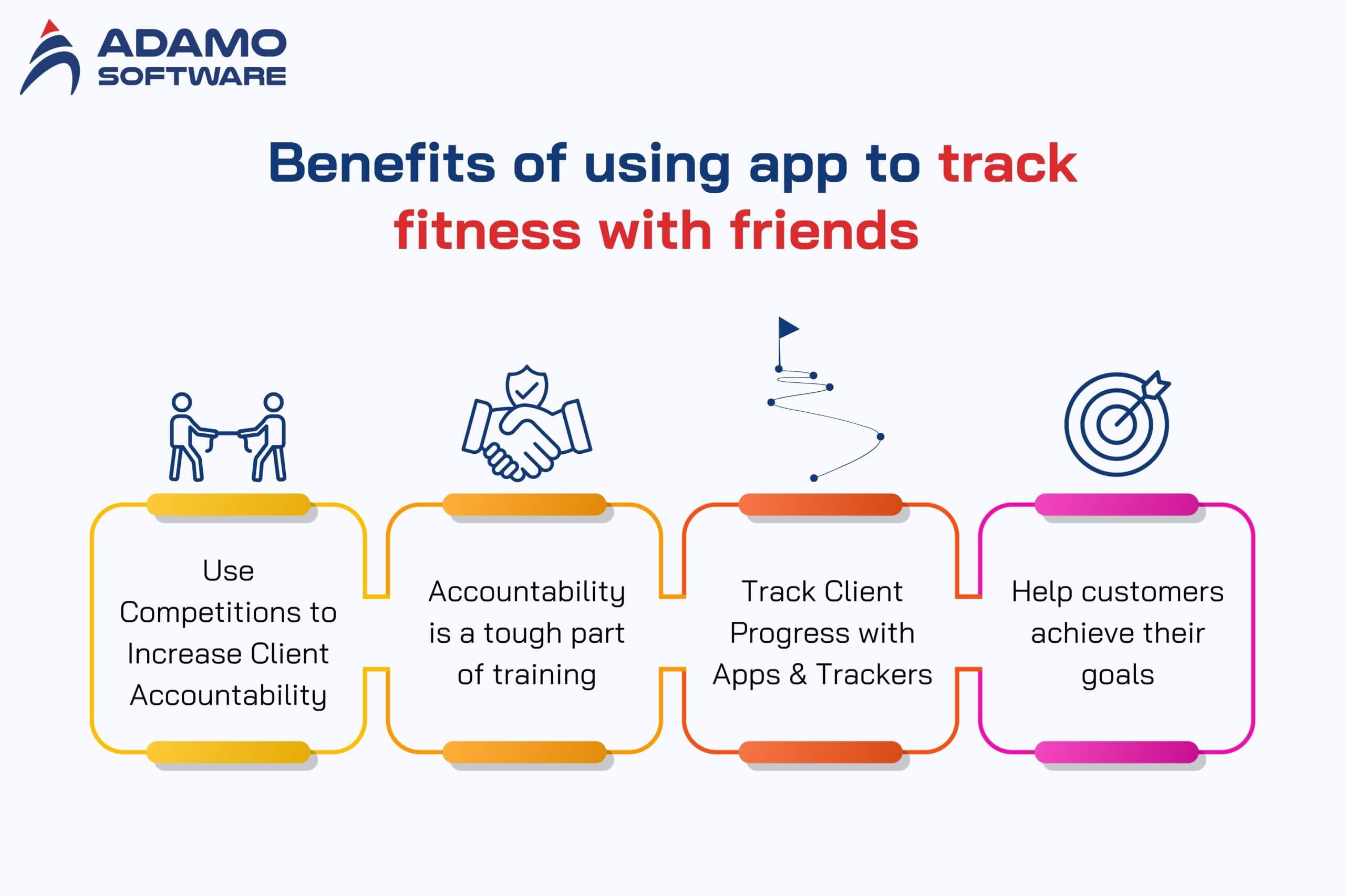
1. Use Competitions to Increase Client Accountability
Are your clients doing their cardio by running on the weekends? A fitness tracker with friends lets you know if you use trackers, apps, and friendly competitions.
2. Accountability is a tough part of training
Sometimes, your clients may feel tired and unmotivated to exercise. They may even give up on working out. However, these friend fitness games and apps, like step challenges, can improve results by increasing accountability.
3. Track Client Progress with Apps and Trackers
If everyone in your community uses the same app, you can organize information like reps, weight, and even heart rate in one place. Tracking your workout progress is important. It allows you to see what your clients are doing and what they’re struggling with so you can help them.
4. Help customers achieve their goals
The ultimate benefit of a friend fitness app is that it helps customers achieve their goals. With the app, customers can set clear goals for themselves. And, with the push from friends through the app or the chance to win a contest, they are more likely to achieve their goals sooner.
Explore Our Tailor-made Software Development Solutions
We are confident in providing end-to-end software development services from fully-functioned prototype to design, MVP development and deployment.
III. Top 6 best social fitness apps to consider in 2025
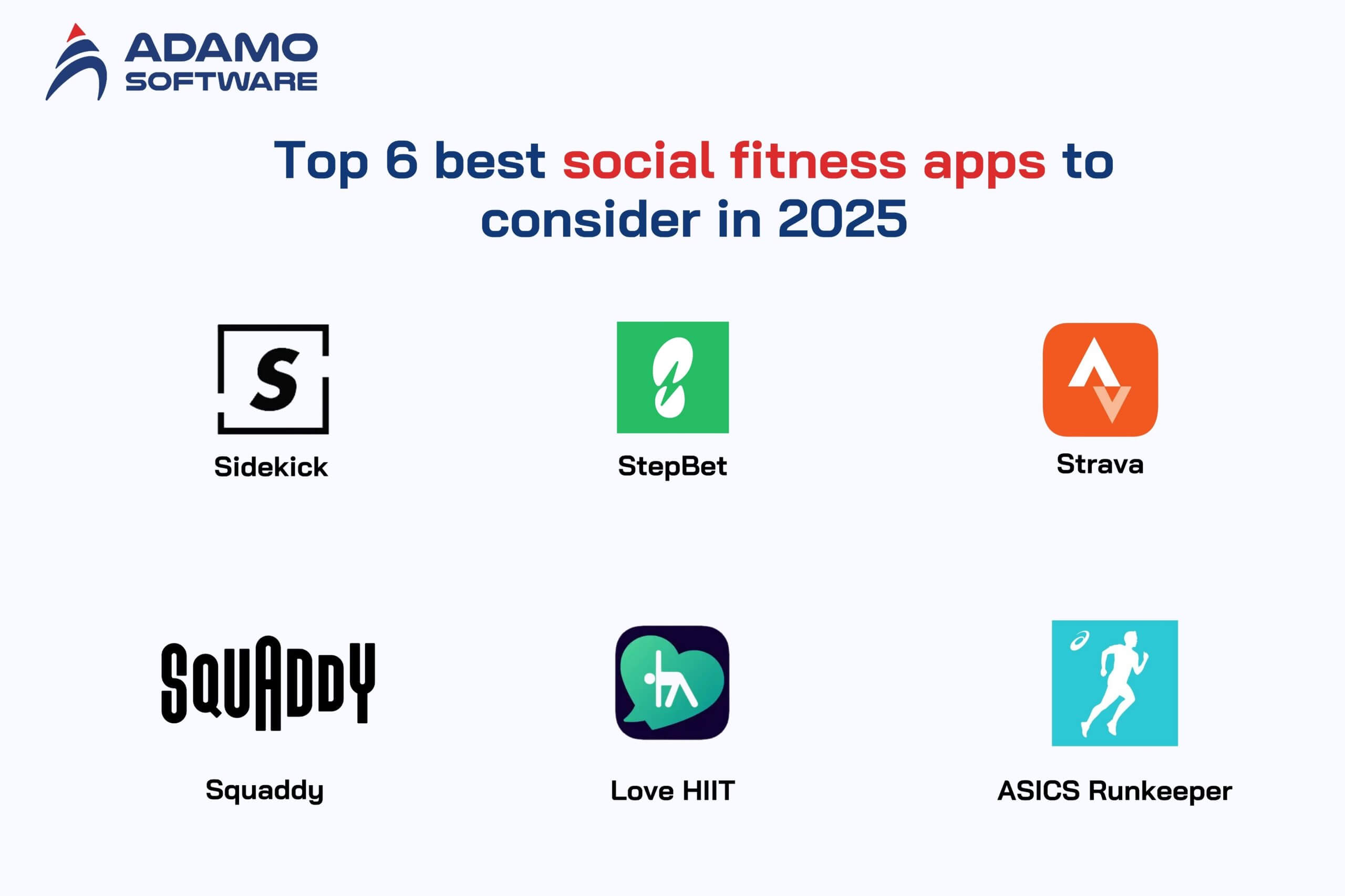
1. Strava
Strava is the leading app for tracking outdoor activities including cycling, running, hiking, and swimming. It uses GPS to map routes, record pace and distance, and upload activity data to the cloud. Strava’s signature feature is Segments, which are specific sections of routes where users can compete against each other and against their own previous times.
Strava’s Global Heatmap aggregates anonymized activity data from millions of users to show popular routes worldwide. Group challenges allow friends to set collective distance or elevation goals within a set timeframe. The app syncs with Google Fit, Apple Health, Garmin, Fitbit, and most major wearable platforms.
The trade-off: Strava’s free tier was significantly reduced in recent years. Route planning, segment leaderboards, and training analysis now require a paid subscription. The app is strongest for outdoor cardio activities but offers limited functionality for gym-based strength training.
2. Stridekick
Stridekick is a straightforward activity tracker focused on social connection. It syncs with GPS data from phones and wearables to track steps, distance, and active time. Users can join or create challenges, earn badges for milestones, and share workouts with a social feed.
Stridekick’s dashboard provides clear visualization of daily activity metrics. The challenge system is flexible enough for workplace wellness programs, friend groups, and family competitions. The app is free to use.
The trade-off: Stridekick’s tracking is limited to basic activity metrics (steps, distance, time). It does not support detailed workout logging for strength training, HIIT, or sport-specific activities. Users who need comprehensive workout tracking will need to pair Stridekick with a more detailed training app.
3. StepBet
StepBet introduces financial accountability to step counting. Each user places a bet (between $10 and $60), and the app calculates two personalized weekly goals based on historical step data: an Activity Goal (moderately challenging) and a Strength Goal (significantly harder). Users who hit both goals split the pot with other winners.
The personalization is the key differentiator. Because goals are calculated from each user’s own step history, the competition is balanced regardless of baseline fitness level. Groups allow users to connect, celebrate milestones, and motivate each other.
The trade-off: the betting element requires real money, which is a barrier for some users. StepBet focuses exclusively on step counting and does not track other workout types. The app requires connection to a supported tracker (Fitbit, Apple Health, Google Fit, Samsung Health, or Garmin).
4. Squaddy
Squaddy is designed specifically for group workout coordination. Users create “Squads” with friends, colleagues, or clients and share workout sessions within the group. The app supports a wide range of training styles including strength training, HIIT, Olympic lifting, bodybuilding, and powerlifting.
The workout library allows group admins to add new workouts that members can log and mark as completed. Completed workouts are visible to the entire group, creating built-in accountability. The app includes chat features for team communication and pre-defined movement templates for fast session logging.
The trade-off: the free plan limits users to basic exercise logging. Advanced features like circuits, supersets, and complexes require a premium subscription. Squaddy does not include GPS tracking for outdoor activities, so it complements rather than replaces apps like Strava for runners and cyclists.
5. Love HIIT
Love HIIT is a timer-based interval training app that makes it easy to create and share HIIT workouts. Users add exercises in sequence, set work and rest intervals, and specify the number of rounds. The app calls out each exercise, rest period, and finish time audibly.
The sharing functionality is its social strength: workouts can be shared via link, accessible through any web browser on both desktop and mobile. This makes it practical for group fitness sessions where participants have different devices and platforms.
The trade-off: Love HIIT is a workout timer, not a comprehensive tracking platform. It does not track calories, distance, or heart rate. There is no built-in social feed, leaderboard, or challenge system. Its value is in simplifying group HIIT sessions, not in long-term progress tracking.
6. ASICS Runkeeper
Runkeeper tracks running, walking, cycling, and other physical activities using GPS. It offers community challenges, team creation, and goal-setting features that make it effective as a social fitness app. Users can create Run Groups with specific goals, durations, and frequencies.
Runkeeper’s strength is its guided workout plans designed for specific goals (5K training, marathon preparation, general fitness improvement). Expert-designed training plans adapt to the user’s progress and provide audio coaching during runs.
The trade-off: Runkeeper’s social features are less developed than Strava’s. The community and team challenge functionality exists but is not the app’s primary focus. GPS tracking accuracy can vary depending on device and environment, a limitation shared with all GPS-based fitness apps.
IV. 6 Features That Drive Retention in Social Fitness Apps
In today’s fast-paced society, where staying fit is a top priority, technology, and fitness apps have become indispensable tools for individuals striving to achieve their goals.
However, the abundance of fitness platforms poses a challenge – how can people stay motivated and committed to a single app or program with many available options?
Let’s explore the mystery behind the most successful fitness apps out there. We’ve deciphered and compiled the top 6 features that they all have in common.
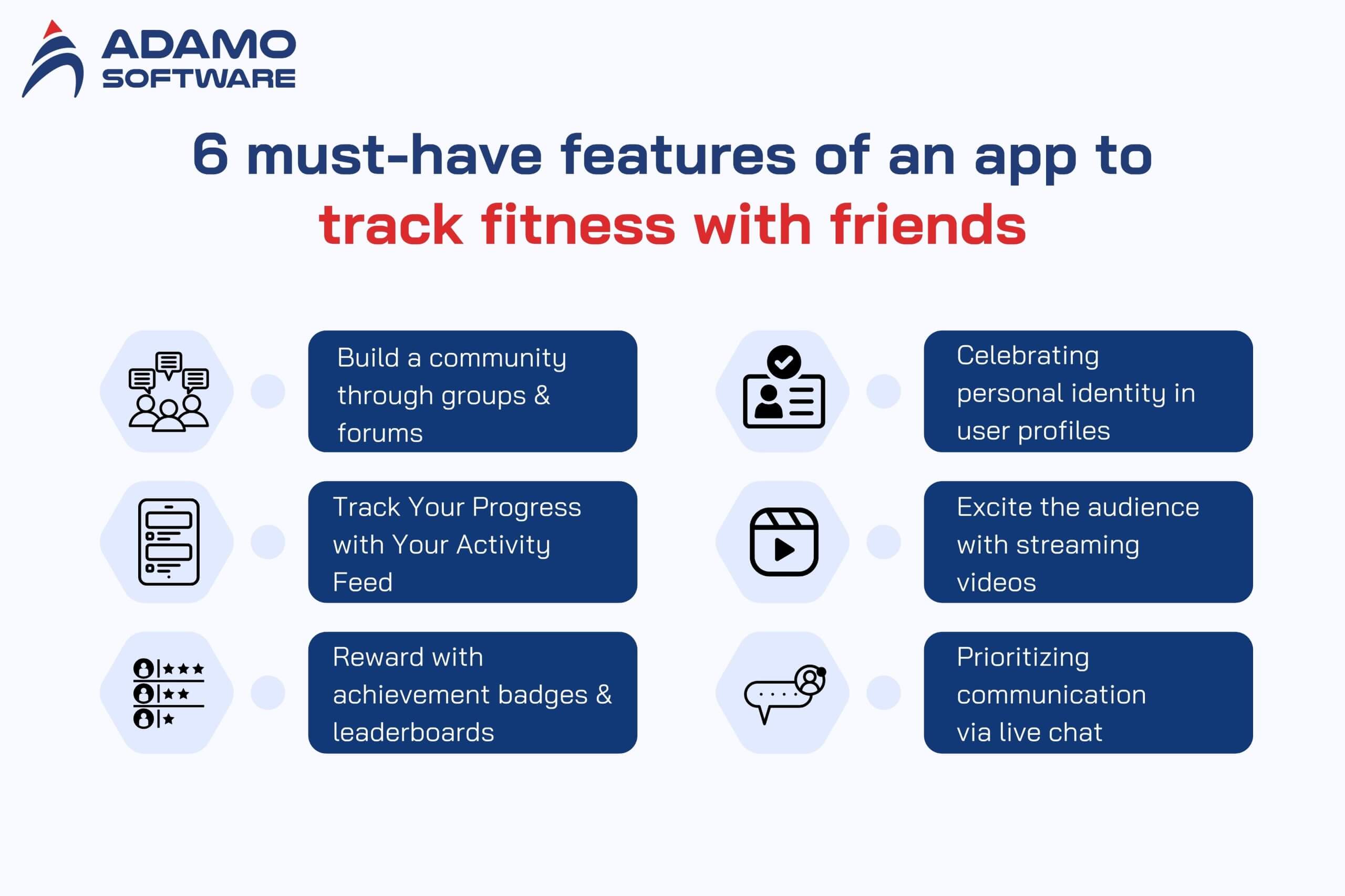
1. Community Groups and Forums
Community groups create a sense of belonging that keeps users engaged beyond individual workouts. Noom’s “Discover” feature, which lets users find interest-based groups like “Quick Meals for Busy Parents,” demonstrates how niche communities increase both engagement and retention. Users who participate in community groups return to the app more frequently than those who use it only for solo tracking.
For app developers, the implementation requires group creation and management tools, topic-based categorization, moderation controls, and notification systems that alert users to new activity in their groups without overwhelming them.
2. Activity Feed
A live activity feed turns individual workouts into shared experiences. When a user completes a 10K run and it appears in their friends’ feeds, it creates both social proof and motivation. The activity feed functions as a continuous stream of evidence that peers are active, which triggers reciprocal engagement.
Effective activity feeds display workout summaries (type, duration, distance, calories), allow reactions and comments, and surface relevant content from friends and group members rather than showing a firehose of all platform activity.
3. Achievement Badges and Leaderboards
Gamification directly impacts retention. Peloton’s leaderboard system, which includes filters, follower tracking, and user ratings, transforms solo workouts into competitive social experiences. Badges for milestones (first 5K, 100th workout, weekly streak) provide external recognition that reinforces habit formation.
The design principle is straightforward: visible progress markers and social comparison drive continued app usage. Leaderboards work best when they balance competitiveness with inclusivity, offering multiple ranking dimensions (total distance, improvement percentage, consistency) so users at different fitness levels can all find ways to succeed.
4. Personalized User Profiles
Strava exemplifies effective profile personalization. Users upload photos, set custom activity goals, create and share routes, and build a public record of their fitness history. This investment in profile customization creates switching costs. The more time users spend building their profile and activity history, the less likely they are to abandon the app.
For developers, this means building profile systems that capture fitness preferences, display achievement history, allow social connections, and give users control over their privacy settings.
5. Streaming Video Content
In-app video content keeps users engaged between workouts. Peloton offers over 1,000 on-demand classes plus daily live sessions across multiple device types. Video content creates a sense of participating in a real class, complete with the collective energy of other participants.
The key implementation consideration is content delivery infrastructure. Live streaming requires low-latency video architecture, while on-demand libraries need efficient content management and recommendation systems that surface relevant workouts based on user preferences and history.
6. Live Chat
Real-time communication enables direct connection between users, coaches, and community members. Live chat supports multiple use cases simultaneously: onboarding support for new users, real-time coaching feedback during workouts, group coordination for team challenges, and peer-to-peer motivation between workout partners.
For fitness apps targeting coach-client relationships or team-based training, live chat is not optional. It is the communication backbone that enables everything from form corrections to schedule coordination.
Ready to Outsource?
Discover how we can transform your business with expert IT solutions.
What It Takes to Build a Custom App to Track Fitness With Friends
The 6 apps reviewed above serve general consumer fitness needs. Businesses building fitness platforms for specific audiences, whether corporate wellness programs, coaching businesses, or sport-specific communities, need custom development that combines social features with domain-specific functionality.
Real-Time Activity Sync and Social Feed Architecture
A peer-to-peer fitness app requires a backend architecture that handles real-time data from multiple sources simultaneously. When a user completes a workout, the system must process the activity data, update the user’s stats, publish the activity to relevant social feeds, trigger notifications for connected friends, and update leaderboard rankings, all with minimal latency.
Adamo Software built an AI-powered fitness coaching application that tracks calorie expenditure across 500+ exercises using Android sensors and GPS. A background API call every few seconds ensures data is safely recorded even if the app closes during activity. This real-time data persistence architecture is the foundation required for any app that tracks fitness with friends, where activity data must be reliably captured, processed, and shared across the social graph.
AI-Powered Personalization
Generic workout plans do not retain users. Personalization engines that adapt to individual behavior, adjust difficulty based on progress, and recommend workouts based on past activity patterns are what separate high-retention apps from commodity trackers.
Adamo Software’s fitness coaching project uses GPT-4 to generate individualized workout plans that continuously refine based on user feedback and performance data. This same AI personalization approach applies to social fitness apps: recommending challenges matched to a user’s level, suggesting friends with similar goals, and adapting content feeds based on engagement patterns.
Wearable Integration and Cross-Platform Data Sync
Users expect their fitness app to sync with whatever device they already own. This means building integrations with Apple HealthKit, Google Health Connect, Fitbit API, Garmin Connect, and Samsung Health. Each platform has different authentication flows, data formats, and sync frequencies.
Adamo Software’s experience with ONEai Health, a stroke monitoring platform that passively collects vital signs from wearable devices with background sync that persists through app closure, demonstrates the type of robust wearable integration architecture required for a social fitness app where activity data must be captured reliably and shared with peers in real time.
Push Notifications and Engagement Systems
Social fitness apps live or die by their notification strategy. Users need to be notified when friends complete workouts, when challenge deadlines approach, when they are close to achieving a badge, and when group members post in their communities. But over-notification causes uninstalls.
The implementation requires a notification prioritization engine that considers user preferences, time of day, notification frequency caps, and content relevance. The goal is to send the right notification at the right time to drive re-engagement without creating notification fatigue.
Recommended Tech Stack
Based on Adamo Software’s healthcare and fitness app development experience:
- Frontend: React Native or Swift/Kotlin for native performance on iOS and Android
- Backend: Node.js or Python for real-time API processing and social feed management
- Database: PostgreSQL for user and workout data, Redis for real-time leaderboards and session caching
- Cloud: AWS or Google Cloud for scalable compute and ML model hosting
- Wearable APIs: Apple HealthKit, Google Health Connect, Fitbit API, Garmin Connect
- AI/ML: GPT-4 or similar LLMs for personalized workout generation, TensorFlow for activity recognition
- Real-time: WebSockets or Firebase for live activity feeds and chat functionality
- Video: CDN-backed streaming infrastructure for on-demand and live workout content
Conclusion
The social fitness app market is growing at 13.5% annually because peer accountability solves the fundamental problem of fitness apps: retention. Among the 6 apps reviewed, Strava leads for outdoor activity tracking with GPS and segment competition, StepBet offers unique financial accountability through step betting, and Squaddy provides the best group workout coordination for strength training. The 6 features that drive retention, from community groups and gamification to live chat and video streaming, are not optional add-ons. They are the core product. For businesses building fitness platforms that serve specific communities, whether corporate wellness, coaching businesses, or sport-specific training groups, the combination of real-time social architecture, AI personalization, and wearable integration is what separates a product that retains users from one that gets uninstalled after a week.
V. Why you should work with Adamo Software for the perfect Social Work Out App
If you’re thinking about creating a social workout app, Adamo Software is the perfect partner. Adamo Software has developed AI-powered fitness platforms including a GPT-4-driven coaching app with 500+ exercises and real-time calorie tracking, a wearable-integrated health monitoring system with passive data sync, and a pregnancy wellness app that achieved 10,000 users in two months through personalized content delivery. Whether you need real-time social feeds, gamification systems, or wearable integration for a peer-to-peer fitness platform, Adamo Software’s engineering team builds healthcare apps that retain users through community and personalization.
Whether you want to know about the cost of developing your healthcare solutions or need help assessing your app idea, our experts are here to guide you. We’ll choose the right technology and take care of the development process from start to finish.
Reach out to us today to bring your fitness app dream to life!

 adamosoft.com
 (+84) 373 11 44 88