
Agentic AI in Travel: What hotels and operators need to build
Agentic AI in travel goes beyond chatbots to autonomous booking and rebooking. A guide to building agentic travel software: architecture, MCP protocol, and graduated autonomy.
Agentic AI in travel is the most consequential shift in travel technology since the introduction of online booking engines. Unlike generative AI, which produces text and recommendations when prompted, agentic AI takes autonomous action. It searches inventory, compares options, makes decisions based on user preferences, executes bookings, processes payments, and handles disruptions, all without requiring the traveler to navigate a website or fill out a form.
According to IDC’s FutureScape 2026 predictions, hospitality and travel brands will operate in an environment where discovery, comparison, booking, and service are increasingly mediated by intelligent agents acting on behalf of guests (IDC, 2026). For hotels and tour operators building custom software, this is not a feature to add later. It is an architectural decision that needs to be made now.
Key Takeaways
- Agentic AI is fundamentally different from chatbots. Chatbots respond to prompts. AI agents autonomously plan, decide, and execute multi-step tasks like searching, booking, and rebooking without human intervention.
- Sabre, PayPal, and MindTrip are launching the travel industry’s first end-to-end agentic booking pipeline in Q2 2026, covering 420+ airlines and 2M hotel properties.
- Only 2% of travelers currently trust AI to book autonomously (Skift, 2025). The trust gap is the biggest barrier, not the technology.
- Building agentic capabilities requires LLM orchestration, tool-use APIs, real-time data feeds, and MCP (Model Context Protocol) compatibility.
- Hotels and tour operators that do not make their inventory machine-readable risk becoming invisible as AI assistants mediate more bookings.
What agentic AI actually is (and is not)
The term “agentic AI” is being applied broadly across the travel industry, often incorrectly. A chatbot that answers FAQ questions is not agentic. A recommendation engine that suggests destinations is not agentic. A dynamic pricing algorithm that adjusts rates is not agentic on its own. McKinsey defines agentic AI as systems that can autonomously make decisions, use multistep reasoning, call on external tools and APIs, store long-term structured memories, and carry out complex tasks end to end (McKinsey, 2025). The distinction is between AI that advises and AI that acts.
Here is a concrete example. A traditional chatbot interaction:
- Traveler: “My flight was cancelled. What are my options?”
- Chatbot: “I’m sorry to hear that. You can rebook through our website or call our support line at 1-800-XXX.”
An agentic AI interaction:
- Traveler: “My flight was cancelled.”
- AI agent: Checks the traveler’s itinerary. Identifies available alternative flights within 6 hours. Evaluates connecting hotel checkout times. Rebooks the traveler on the best available flight. Adjusts the hotel reservation. Sends updated confirmation. Notifies the traveler: “I’ve rebooked you on Flight SQ321 departing at 3:45 PM. Your hotel checkout has been extended to 2 PM. Updated confirmation is in your email.”
The difference is not just speed. It is autonomy, multi-system coordination, and the ability to execute transactions across multiple APIs without human input at each step.
The major moves in agentic AI in travel right now
The pace of agentic AI deployment in travel accelerated sharply in late 2025 and early 2026. These are the developments that matter most for companies building travel software:
- Sabre, PayPal, and MindTrip announced a partnership in February 2026 to build the travel industry’s first end-to-end agentic booking pipeline (OAG, 2026). A traveler describes their trip in natural language through MindTrip’s conversational interface. MindTrip queries Sabre’s Mosaic APIs, which provide access to over 420 airlines and 2 million hotel properties. PayPal’s agentic commerce infrastructure handles payment within the conversational flow. The entire search, book, and pay loop happens without the traveler leaving the conversation. Planned launch: Q2 2026.
- Google is developing agentic booking tools for flights and hotels within its AI Mode search feature, working closely with Booking.com, Expedia, Marriott, IHG, and Choice Hotels (Skift, November 2025). The goal is to turn AI Mode into a travel hub where users describe what they want and the AI handles comparison, selection, and eventually booking.
- Malaysia Airlines launched “Mavis,” an agentic customer service agent built on Ada’s ACX platform, that autonomously handles flight status checks, booking management, check-in assistance, and loyalty program queries across web, app, and email (OAG, 2026). This is not a chatbot that quotes FAQ pages. Mavis integrates directly with the airline’s operational systems to resolve issues autonomously.
- Booking.com launched its first customer-facing agentic AI features in October 2025: Smart Messenger and Auto-Reply. Early experiments showed a 73% increase in partner satisfaction compared to previous messaging tools (Booking.com, 2025). The platform also reports that 89% of consumers want to use AI in future travel planning.
- Amadeus, Microsoft, and Accenture collaborated on a trip-planning agent available inside Microsoft Teams through the Cytric Easy business travel platform, allowing employees to plan and book trips via natural language conversation (PYMNTS, 2025).
The trust gap: the real barrier
The technology is moving fast. Consumer trust is not. According to Skift’s State of Travel 2025 report, only 2% of travelers are currently willing to give AI full autonomy to make and modify bookings without human oversight (Skift, 2025). Skyscanner founder Gareth Williams noted publicly that he has been “really struck by how negative the public is towards AI compared to people inside the industry” (Skift, 2026).
This trust gap has practical implications for anyone building travel software. Agentic features need to be designed with graduated autonomy:
- Level 1 (suggest): The AI recommends an action and waits for human approval before executing. “I found a better flight. Shall I rebook?”
- Level 2 (act with notification): The AI executes the action and immediately notifies the traveler. “I’ve rebooked you on a better flight. Here are the details.”
- Level 3 (full autonomy): The AI manages the entire trip lifecycle proactively. The traveler only intervenes when they choose to.
Most travelers today are comfortable with Level 1. Business travel platforms (with corporate policy guardrails) are moving to Level 2. Level 3 remains aspirational for leisure travel. The software architecture must support all three levels and let users choose their comfort zone.
Technical requirements for building agentic travel software
Building agentic capabilities into a travel platform is not about adding a chatbot widget. It requires specific architectural patterns. Based on Adamo Software’s experience building AI-powered travel booking platforms, here are the core technical components:
LLM orchestration layer. The AI agent needs a reasoning engine that can break complex requests into subtasks, determine which tools to call, and chain actions together. This typically involves an LLM (GPT-4, Claude, Gemini) wrapped in an orchestration framework (LangChain, LlamaIndex, or a custom orchestrator) with tool-use capabilities.
Tool-use APIs. The agent must call real systems: search inventory, check availability, create bookings, process payments, send notifications. Each of these is a “tool” the LLM can invoke. The tool interface needs to be strictly typed, well-documented, and idempotent (safe to retry if a call fails).
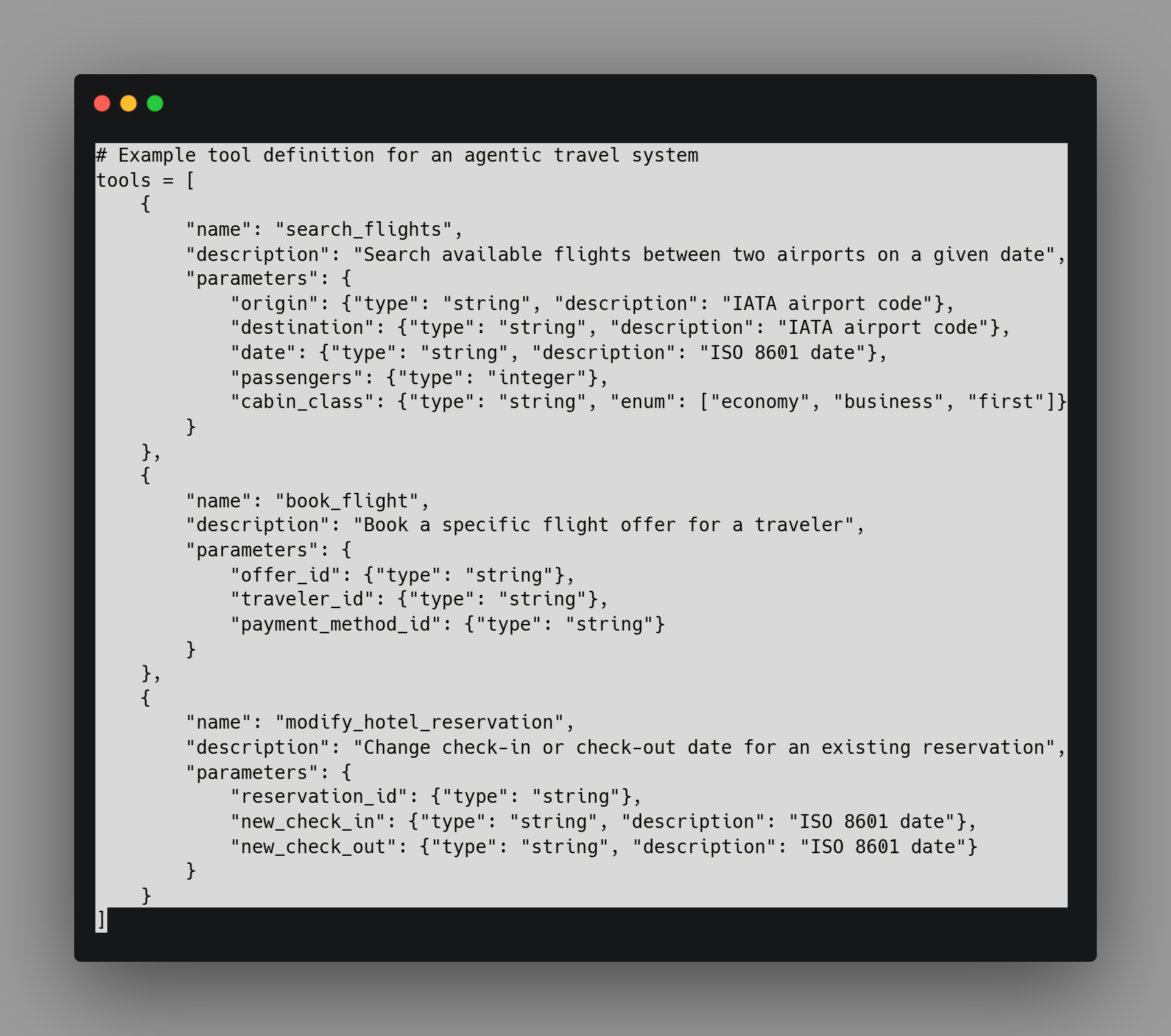
Real-time data feeds. Agentic AI cannot work with stale data. Flight availability, hotel inventory, pricing, and disruption status must be available in real time via APIs. This requires investment in GDS integration, supplier API connections, and a caching strategy that balances freshness with rate limits.
MCP (Model Context Protocol) compatibility. MCP is emerging as the standard protocol for AI assistants to interact with external services. RateGain launched the first MCP-enabled booking engine in late 2025. Hotels and travel platforms that expose their inventory via MCP allow AI assistants (ChatGPT, Claude, Gemini) to search and book directly. Platforms without MCP support become invisible to this growing channel.
Memory and context management. Unlike a chatbot that handles isolated requests, an agentic system needs to maintain context across the entire trip lifecycle. It must remember the traveler’s preferences, booking history, loyalty status, and current itinerary state. This requires a persistent memory store (not just in-context conversation history) that the LLM can query.
Guardrails and fallback logic. Every autonomous action needs a confidence threshold. If the agent’s confidence drops below the threshold, it must escalate to a human agent with full context. This is not optional. A booking error costs money and trust. The guardrail system must also enforce business rules: budget limits, policy compliance, blackout dates, and cancellation terms.
What hotels and tour operators should build now
The previous section covered the technical components of agentic AI systems in general. This section is specific: what should a hotel group or tour operator actually prioritize building (or commissioning) in the next 6 to 12 months to be ready for the agentic era? The following is ordered by implementation priority, starting with the foundations that everything else depends on.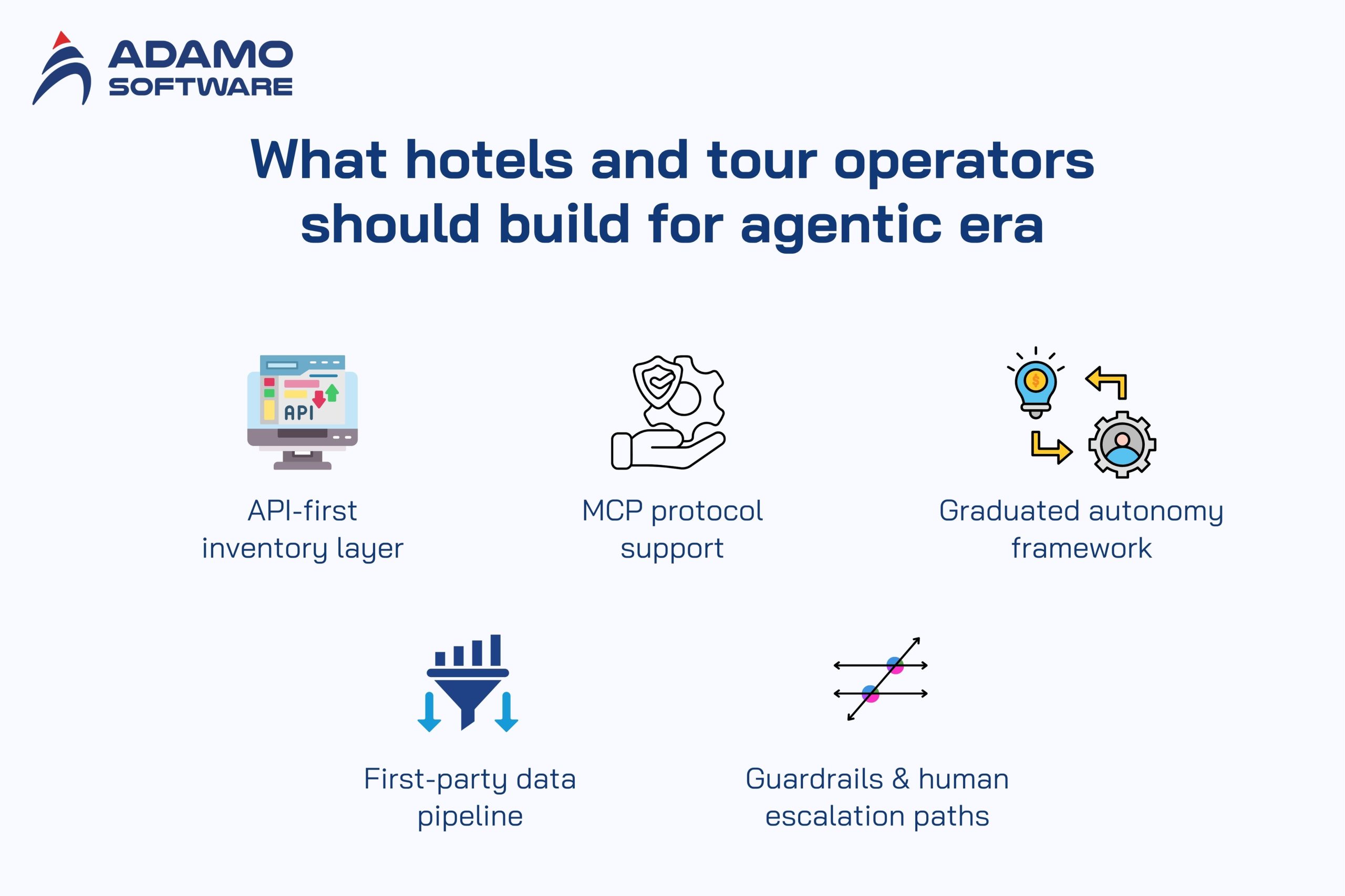
1. An API-first inventory layer
This is the single most important investment. If an AI assistant cannot programmatically access a property’s room availability, rates, cancellation policies, and booking capabilities, that property is invisible in agentic search. It does not matter how good the hotel’s website is. The AI agent never visits the website.
What “API-first” means in practice:
- Every room type, rate plan, and availability window must be queryable via a structured REST or GraphQL endpoint.
- Rates must update in real time. A 15-minute delay between a rate change in the PMS and the API response is enough to cause booking failures and guest frustration.
- The API must support not just read operations (search, availability) but write operations (create booking, modify reservation, process cancellation) with proper authentication and idempotency.
- Structured data must include amenities, photos, location coordinates, cancellation terms, and loyalty program eligibility in machine-readable format. AI agents do not parse marketing copy. They parse structured fields.
Hotels currently using closed SaaS booking engines without API access need to evaluate whether their vendor offers an open API tier, or whether a custom booking platform is the more strategic path. This decision alone will determine whether a property participates in the agentic distribution channel or misses it entirely.
2. MCP protocol support for AI assistant discoverability
MCP (Model Context Protocol) is becoming the standard way AI assistants discover and interact with external services. When a traveler asks ChatGPT, Claude, or Gemini to “find me a beachfront hotel in Da Nang for July,” the assistant needs a protocol to query hotel inventory, check rates, and create bookings. MCP provides that protocol.
What to build:
- An MCP server endpoint that wraps the hotel’s inventory API (from step 1) in MCP-compliant tool definitions.
- Tool definitions for search, availability check, booking creation, and booking modification, each with clear parameter schemas and descriptions that the LLM can interpret.
- Authentication via OAuth 2.0 so the AI assistant can act on behalf of authenticated travelers.
Hotels that deploy MCP endpoints in 2026 will have a structural advantage over competitors who wait. The parallel is mobile optimization in 2012: the early adopters captured disproportionate traffic before it became table stakes.
3. A graduated autonomy framework in the booking flow
The trust gap data (2% full autonomy acceptance per Skift) means building a fully autonomous agent today is premature for leisure travel. Instead, build a booking flow that supports three autonomy levels within the same architecture:
- Level 1 (suggest mode). The AI agent searches, compares, and recommends options but requires explicit traveler approval for every booking action. The UI shows the agent’s recommendation with a clear “Approve” or “Modify” prompt. This is appropriate for first-time users and high-value bookings.
- Level 2 (act-with-notification mode). The agent executes routine actions (rebooking a disrupted flight to the next available option, extending a hotel checkout by one hour) and notifies the traveler immediately. The traveler can reverse the action within a configurable window (e.g., 15 minutes). This is where business travel platforms are moving now.
- Level 3 (full autonomy mode). The agent manages the entire trip lifecycle proactively. It monitors pricing, rebookings disruptions, adjusts itineraries based on weather or schedule changes, and only surfaces decisions that exceed defined thresholds. The traveler sets preferences and budgets upfront, then receives a summary after the trip.
The technical implementation is the same across all three levels. The difference is a single configuration parameter (autonomy_level) that determines whether the agent pauses for approval, notifies after acting, or acts silently. Build the full pipeline once, gate it with approval logic.
4. A first-party data pipeline for personalization
Agentic AI’s value proposition is personalized, autonomous service. The quality of that personalization depends entirely on the data the agent can access. Hotels that own their guest data have a decisive advantage over those relying on OTA-mediated relationships.
What to collect and structure:
- Booking history. Past stays, room type preferences, length of stay patterns, seasonal preferences, average booking value.
- Behavioral data. Search queries on the hotel website, pages viewed, amenities clicked, abandoned carts, time-of-day booking patterns.
- Preference signals. Pillow type, floor preference, dietary restrictions, loyalty tier, preferred payment method, language.
- Feedback data. Review content, NPS scores, complaint history, compliment themes.
This data feeds into the AI recommendation engine and, eventually, into the agentic system’s memory layer. When a returning guest’s AI assistant queries the hotel, the system can respond with: “Your preferred room type (ocean view king, high floor) is available for your requested dates at a loyalty rate of $189/night. Shall I confirm with your card on file?” That level of personalization is impossible without first-party data.
The infrastructure requirement: a unified guest profile database (not siloed across PMS, CRM, and booking engine) that the agentic system can query in real time. PostgreSQL with a well-designed schema works. The key is consolidation, not sophisticated tooling.
5. Guardrails and human escalation paths
Autonomous actions carry real financial and reputational risk. A booking error, a double charge, or a wrong cancellation erodes trust faster than any AI feature builds it. Every agentic capability needs corresponding guardrails:
- Confidence thresholds. If the agent’s confidence on an action drops below a defined threshold (e.g., 85%), it pauses and escalates to a human agent with full context: the traveler’s request, the options evaluated, and the reason for low confidence.
- Business rule enforcement. The agent must respect blackout dates, minimum stay requirements, rate parity rules, cancellation deadlines, and corporate travel policies. These rules are hard-coded, not suggested. The LLM does not override them.
- Transaction limits. Set maximum booking values and maximum autonomous modifications per trip. A $200 hotel rebooking can be autonomous. A $5,000 suite upgrade should require approval.
- Audit logging. Every autonomous action must be logged with the agent’s reasoning chain, the data it accessed, and the decision it made. This is essential for dispute resolution and for improving the system over time.
- Graceful handoff. When escalating to a human agent, the system must transfer full conversation context, booking state, and the agent’s partial work. The traveler should never have to repeat information.
Prioritization roadmap
For a hotel group or tour operator starting from a traditional SaaS stack, the realistic sequence is:
- Months 1 to 3: Build the API-first inventory layer. Audit current systems. Design the API schema. Implement real-time availability and rate endpoints.
- Months 3 to 5: Deploy MCP protocol support. Wrap the inventory API in MCP tool definitions. Test with at least one AI assistant (Claude or ChatGPT).
- Months 4 to 6: Implement graduated autonomy in the booking flow. Start with Level 1 (suggest mode) only. Collect data on user acceptance rates.
- Months 5 to 8: Build the first-party data pipeline. Consolidate guest profiles. Connect to the agentic system’s memory layer.
- Months 6 to 9: Add guardrails, escalation paths, and audit logging. Move select user segments to Level 2 (act-with-notification).
This timeline assumes a dedicated team of 6 to 10 engineers. For companies without internal engineering capacity, partnering with a development team experienced in travel platform architecture is the more realistic path.
Conclusion
Agentic AI is not a chatbot upgrade. It is a new distribution paradigm where AI assistants become the primary interface between travelers and travel providers. The Sabre/PayPal/MindTrip pipeline launching in Q2 2026 is the clearest signal yet that autonomous booking is moving from prototype to production. With Google, Booking.com, Amadeus, and Malaysia Airlines all deploying agentic capabilities simultaneously, the pace is accelerating faster than most hotel groups and tour operators have planned for. The 2% trust figure from Skift will climb as agentic systems prove reliability. The question is whether your platform will be ready when it does.
Prepare Your Travel Platform for the Agentic AI Era
Adamo Software builds custom travel platforms with agentic AI readiness: LLM orchestration, tool-use APIs, MCP protocol support, and real-time GDS integration. Our engineering team helps hotels and tour operators architect systems that support graduated autonomy, from AI-assisted search to fully autonomous booking workflows. Contact us for a free AI development services consultation: https://adamosoft.com/contact-us/

 adamosoft.com
 (+84) 373 11 44 88