
Hospital Management Systems in 2026: Types, Key Features & Must-Know Insights
Hospital management system guide for 2026: definition, types, key features, architecture, cost breakdown, and selection criteria for healthcare leaders.
Healthcare delivery in 2026 depends on a coordinated software backbone, and the hospital management system (HMS) is that backbone for most facilities. An HMS combines registration, scheduling, EMR, billing, laboratory, pharmacy, and analytics into a single platform that lets every department work from the same data. Without it, hospitals operate as a collection of silos, with patient information scattered across paper records, spreadsheets, and disconnected systems.
This guide explains what a hospital management system does, the seven modules that matter most, the architecture patterns shaping new builds in 2026, realistic cost ranges, and how to choose between off-the-shelf and custom development. The audience is hospital administrators, IT leaders, and healthcare decision-makers evaluating or planning an HMS implementation.
Key Takeaways:
- The global healthcare IT market is projected to grow at 15.24% CAGR through 2029, with hospital management systems among the fastest-adopted categories driving that growth.
- Modern hospital management system builds in 2026 are predominantly cloud-native or hybrid, with microservices architecture, HL7/FHIR integration, and role-based access control as the new baseline.
- Custom HMS development typically ranges from $80,000 to $500,000+, depending on module scope, integration complexity, and compliance requirements.
- The seven core modules every hospital management system needs are EMR, billing, patient scheduling, laboratory management, inventory, analytics, and mobile access.
- Choosing between off-the-shelf and custom HMS depends less on cost and more on how unique the hospital’s clinical workflows are.
I. What is a Hospital Management System?
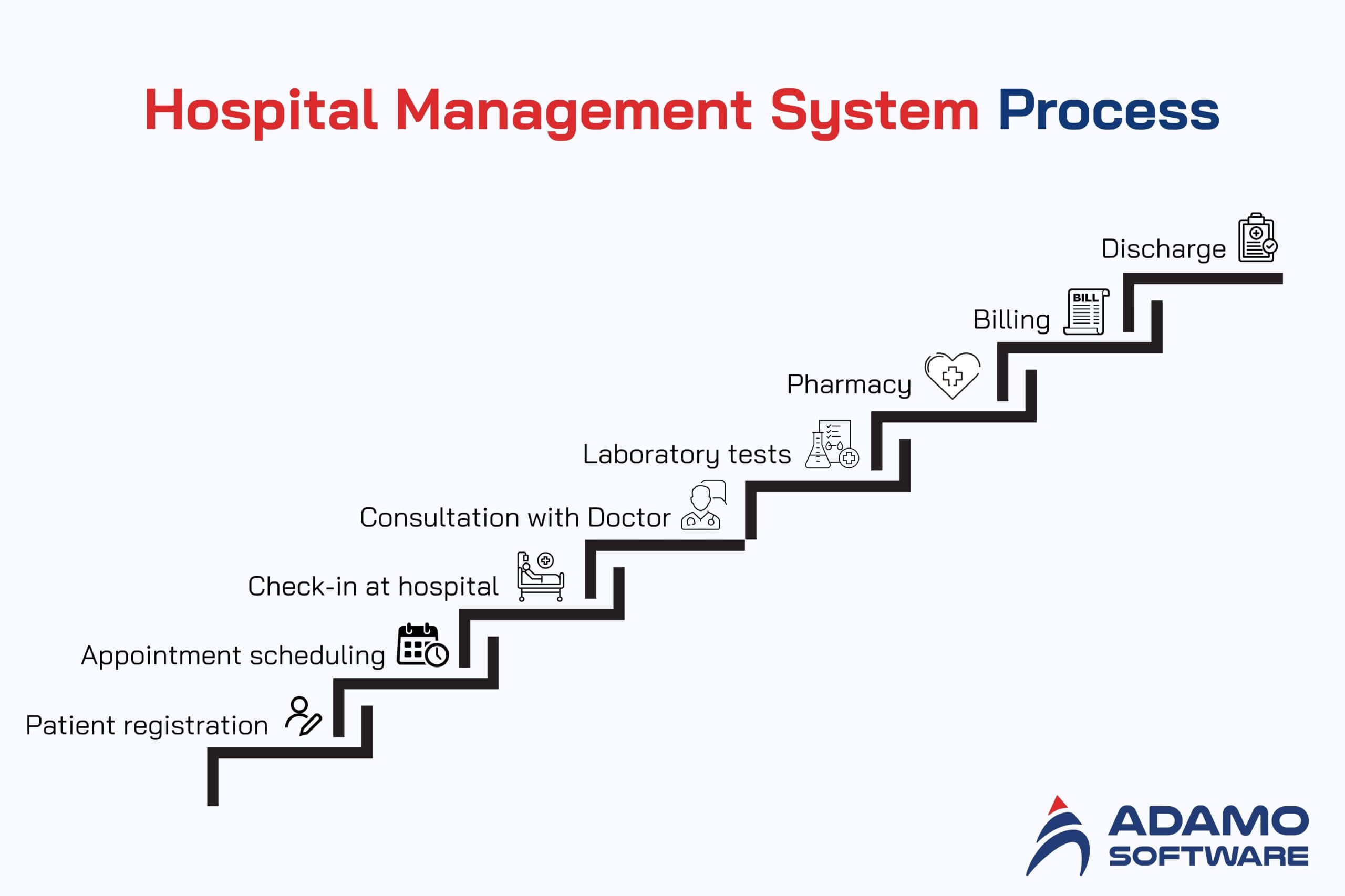
The hospital management system (HMS) is a digital operational platform that makes hospital processes more efficient. An HMS helps medical facilities handle patient enrollment and set appointments while taking care of payments and maintaining clinic documents. It creates higher efficiency by combining multiple functions under one system.
Specifically, the hospital management system automates activities involving patient intake, transmission of lab results, and medication administration. It also allows doctors to rapidly view patient medical records so they can provide prompt, appropriate treatment.
Additionally, different departments, including reception and billing, labs, and pharmacies, can securely exchange information through the HMS system. The system reduces errors while maintaining precise documentation and decreasing paperwork. As a result, hospital efficiency increases with better patient care. The global healthcare IT market is projected to grow at an annual rate of 15.24% from 2024 to 2029, reaching $728.63 billion (Mordor Intelligence, 2024). Within that broader category, hospital management systems are among the fastest-adopted segments, particularly in regions building new healthcare infrastructure.
II. Key features to consider when developing Hospital Management System
A proper hospital management system needs essential functionalities for operational enhancement. EMR and patient management, inventory management, billing, payment processing, and analytic tools are the core of a hospital management system.
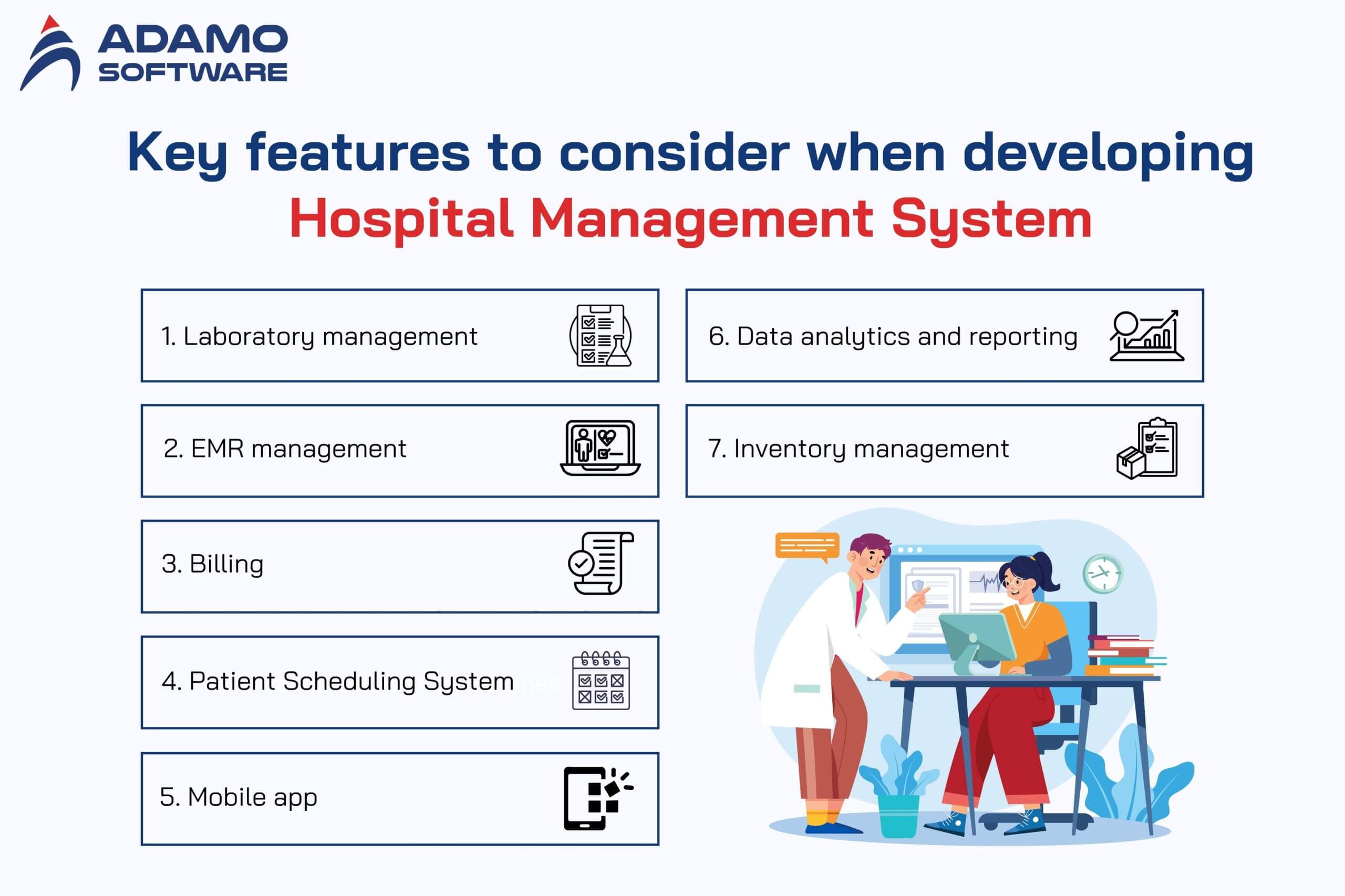
1. Laboratory management
A hospital management system operates as a platform for laboratory management through its processing of laboratory results and patient medical information. The connection of lab systems allows for improved workflow management and guarantees precise information delivery.
The system monitors samples and performs quality assurance tasks while streamlining report generation. As a result, the data gathering and organization approach creates additional value that improves each stage of patient treatment.
Also, the hospital management system connects laboratory information to patient databases to deliver complete healthcare solutions.
2. Electronic medical records (EMR) management
The hospital management system maintains essential patient information comprising comprehensive medical records, prescribing medications, and physician documentation. An EMR feature provides a centralized database that gathers all vital patient data for easy access.
Modern healthcare technology advances drive hospital management systems toward continuous development, which enables them to support contemporary clinical requirements. Also, because of the global pandemic, the hospital management system experienced an expedited need for advanced secure EMR and billing systems.
Modern high-performing systems connect detailed patient record management tools with standardized systems that ensure efficient operation and secure data storage.
3. Billing
The billing process becomes simpler because hospital management systems offer users easy payment methods. This feature helps to cut down on administrative work and generate better patient satisfaction results.
Healthcare organizations also need to conduct insurance eligibility verification as a crucial system capability. This functionality monitors health insurance policies to support correct billing procedures. For this, real-time eligibility (RTE) verification operates as a hospital management system component to auto-check insurance validity digitally.
Medical billing software helps verify if the insurance provider maintains legal status to ensure correct coverage processes and normal payment operations.
You can explore more about medical billing software cost for 2026 here.
4. Patient scheduling system
A hospital management system should contain scheduling features that enhance the communication process between patients and physicians. The system records visits and maintains a record of appointments alongside documentation of doctors’ patient notes.
Through healthcare patient scheduling software, patients can receive notifications, including follow-up messages and test result alerts, to achieve prompt scheduling of medical visits.
Overall, patient care improves through appointment scheduling features, which provide organized organizational structures for providers and patients.
5. Mobile app
Hospital management systems benefit substantially from mobile app additions because they extend access to clinicians at the bedside, patients at home, and administrators on the move.
Health technology development requires mobile healthcare applications for better access to care and improved treatment processes.
A user-friendly interface will boost the optimization of the illness management process and accelerate treatment efficiency. Additionally, application enhancements deliver better care practices, easing patient stress while creating superior experiences to prevent disease advancement.
6. Data analytics and reporting
The hospital management system uses analytics tools to analyze performance metrics, detect gaps, and identify useful insights to help improve the operation. Specifically, the systems evaluate massive data collections to present financial reports revealing budgetary problems and identifying payment errors and discrepancies.
Also, through cognitive analytics, the patient experience receives improvement by developing care optimization recommendations and healthcare delivery process streamlining suggestions.
The hospital management system’s automated form builder process makes collecting and examining patient data easier, enhancing overall decision-making capabilities.
The hospital management system’s automated form builder process makes collecting and examining patient data easier, enhancing overall decision-making capabilities. Adamo Software has delivered analytics pipelines in this category, including a system for My Emergency Doctor (MED) that processes every telehealth consultation through an automated pipeline, producing billing-ready reports, SLA tracking dashboards, and workforce planning analytics from raw consultation events.
7. Inventory management
Hospital management systems should integrate inventory control functions to improve medication prescription and purchase procedures.
Hospital management system features maintain treatment safety and compliance, including e-prescribing, medication tracking (eMAR in healthcare), and computerized physician order entry (CPOE). Healthcare Inventory Management System identifies prescription drug conflicts, generates warnings, and suggests appropriate treatments to create secure treatment strategies.
Automating inventory procedures within the hospital management system generates safer treatments and error-free medicine access that leads to superior healthcare results.
Explore Our Tailor-made Software Development Solutions
We are confident in providing end-to-end software development services from fully-functioned prototype to design, MVP development and deployment.
III. Main types of hospital management systems
Hospital management systems are essential for healthcare institutions to control different operational functions alongside workflow operations and operational tasks. Hospital information systems fall into various categories based on their functionality specifications. Here are some of the common types of hospital management system (HMS) categories in the medical industry:
1. On-Premise HMS
On-premise hospital management systems are installed on hardware physically located at the hospital. The facility owns the servers, controls the data, and employs the IT staff to maintain it. This deployment model offers maximum customization and full data sovereignty, which matters for facilities in jurisdictions with strict data residency requirements.
The trade-off is total cost of ownership. Hardware purchases, ongoing maintenance, software licensing, IT staffing, and periodic upgrades add up. On-premise also limits agility: scaling capacity for a new department means procuring and installing physical infrastructure.
2. Cloud-Based HMS
Cloud-based hospital management systems run on remote servers managed by the vendor or a cloud provider. Hospitals access the system through web browsers and mobile apps. The vendor handles infrastructure, scaling, and most security patches.
The benefits are lower upfront cost, faster deployment, and easier scaling. The trade-offs are ongoing subscription fees and dependence on internet connectivity. Cloud-based HMS has become the default choice for new builds, particularly for hospitals without strong in-house IT capacity. Data residency and HIPAA Business Associate Agreement coverage are the typical evaluation criteria.
3. Open-Source HMS
Open-source hospital management systems make the source code available, allowing facilities to customize the software to their workflows. This deployment model can dramatically reduce licensing costs and offers full transparency on how the system behaves.
The hidden cost is the technical capacity required to maintain it. Open-source HMS still needs developers, security patching, integration work, and ongoing support. For most hospitals, this means either hiring an internal team or engaging an implementation partner. Open-source makes sense for facilities with strong technical resources or specific customization needs that commercial products cannot meet.
4. Custom-Built HMS
A growing number of mid-size and enterprise hospital networks are moving toward custom-built or heavily customized HMS solutions in 2026. The reasons:
- Legacy commercial systems struggle to meet interoperability mandates like the 21st Century Cures Act requirement to support FHIR R4 APIs.
- Specialty care workflows (behavioral health, oncology, orthopedics, fertility) often need different module configurations than generic platforms provide.
- AI and automation features (predictive bed management, automated prior authorizations, AI-assisted documentation) demand modern architecture that legacy systems cannot easily accommodate.
Custom HMS development is not the right choice for every hospital. It works best when the hospital has either workflow requirements that off-the-shelf cannot meet, the budget to fund development properly, or strategic reasons to own the platform rather than rent it. Adamo Software has built platforms in this category, including ZenDXB, an at-home medical testing and telehealth platform with a multi-role system serving super admin, lab, doctor, and patient workflows.
IV. Hospital Management System Architecture in 2026
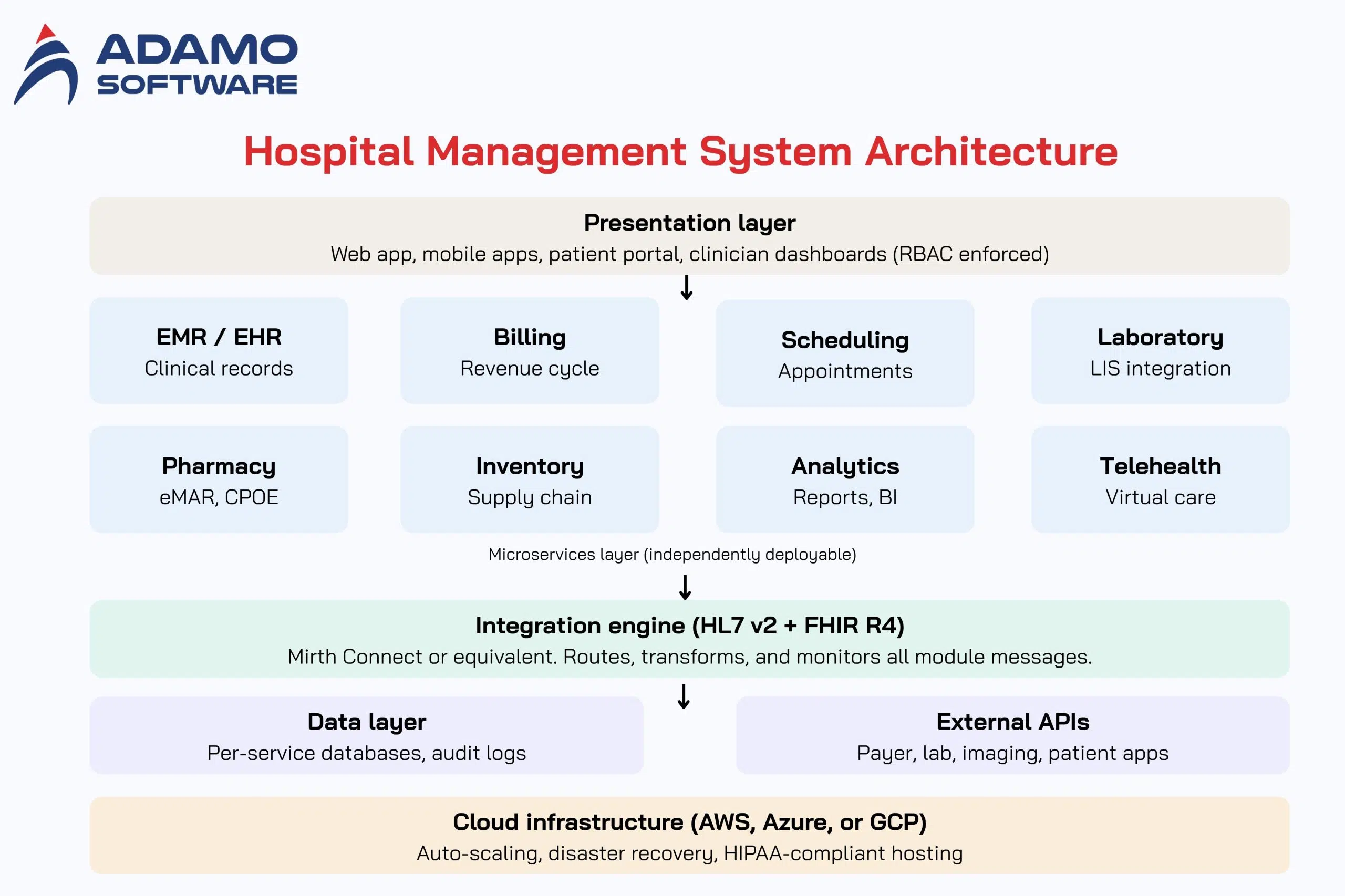
The architecture behind hospital management systems has shifted significantly in recent years. Systems built in 2018-2021 were typically monolithic applications with a single database. New HMS builds in 2026 follow a different blueprint, and understanding these patterns matters when evaluating vendors or planning a custom build.
- Microservices over monolith. Each module (billing, pharmacy, lab, scheduling) runs as an independent service with its own database. The pharmacy module can be updated, scaled, or restarted without touching the billing system. A failure in lab integration does not cascade into clinical documentation.
- HL7 and FHIR as the integration backbone. Every module talks to every other module through standard messaging protocols. HL7 v2 still dominates internal hospital messaging (ADT, ORM, ORU messages), while FHIR R4 has become the standard for external-facing APIs, patient applications, and regulatory compliance with mandates like the 21st Century Cures Act.
- Integration engine in the middle. Enterprise HMS deployments use an integration engine like Mirth Connect or a commercial equivalent to route, transform, and monitor HL7/FHIR messages between systems. Without one, hospital data flows become a tangled mess of point-to-point connections that break constantly.
- Cloud-native or hybrid deployment. New HMS builds in 2026 are predominantly cloud-native (AWS, Azure, or GCP), or hybrid with latency-sensitive clinical workflows on-premise and analytics in the cloud. Cloud deployment enables faster disaster recovery, automatic scaling during peak periods, and lower infrastructure maintenance burden.
- Role-based access control (RBAC). Every user, from a ward nurse to a billing manager to a CTO, sees only what they are authorized to see. Proper RBAC implementation is both a HIPAA compliance requirement and a critical security control. Audit logs must capture every read and write for compliance reporting.
- API-first design. New HMS platforms expose every capability through documented APIs. This is what allows the system to integrate with third-party tools (telehealth platforms, lab providers, payer systems, cloud-based healthcare solutions) without custom development for each connection.
These architecture patterns are not just engineering preferences. They directly affect scalability, compliance posture, and the cost of future feature additions. Hospitals evaluating an HMS in 2026 should weight architecture fit alongside feature checklists.
V. How Much Does Hospital Management System Development Cost?
Cost is the question every hospital administrator asks first and the question with the widest range of honest answers. Custom HMS development typically falls into one of four tiers:
- Basic HMS ($30,000 to $80,000): Single-facility deployment, 3-4 core modules (EMR, scheduling, billing, basic reports), web-only access, minimal integrations. Suitable for small clinics or pilots.
- Standard HMS ($80,000 to $200,000): 6-7 modules with mobile apps, basic analytics, HL7 integration with one or two external systems, role-based access. Suitable for mid-size hospitals.
- Enterprise HMS ($200,000 to $500,000): Full module set, FHIR integration, multi-facility deployment, advanced analytics, AI features, comprehensive compliance documentation. Suitable for hospital networks.
- Large enterprise HMS ($500,000+): Multi-region deployment, custom AI modules, deep integration with multiple payer and lab systems, extensive customization for specialty workflows.
These ranges reflect end-to-end build costs including discovery, design, development, integration, compliance work, testing, and initial deployment. Ongoing costs (cloud hosting, maintenance, feature additions, support) typically run 15-25% of the initial build cost per year.
Off-the-shelf HMS solutions follow a different pricing model: per-user or per-bed monthly subscriptions, often $30 to $300 per user per month depending on tier. Over a five-year horizon, off-the-shelf can either be cheaper or more expensive than custom depending on hospital size and module needs.
The cost question always reduces to: how much customization do you actually need, and how long do you plan to use the system? Hospitals that pick the wrong answer to either question typically rebuild within three to five years.
VI. Essential factors to consider when choosing the best HMS software
A hospital organization must select its HMS carefully because this choice shapes the quality of patient service and workplace performance alongside organizational achievement. Selecting the best HMS software becomes difficult since multiple options exist in the market. These elements below are some crucial considerations that help organizations identify their ideal hospital management system software:
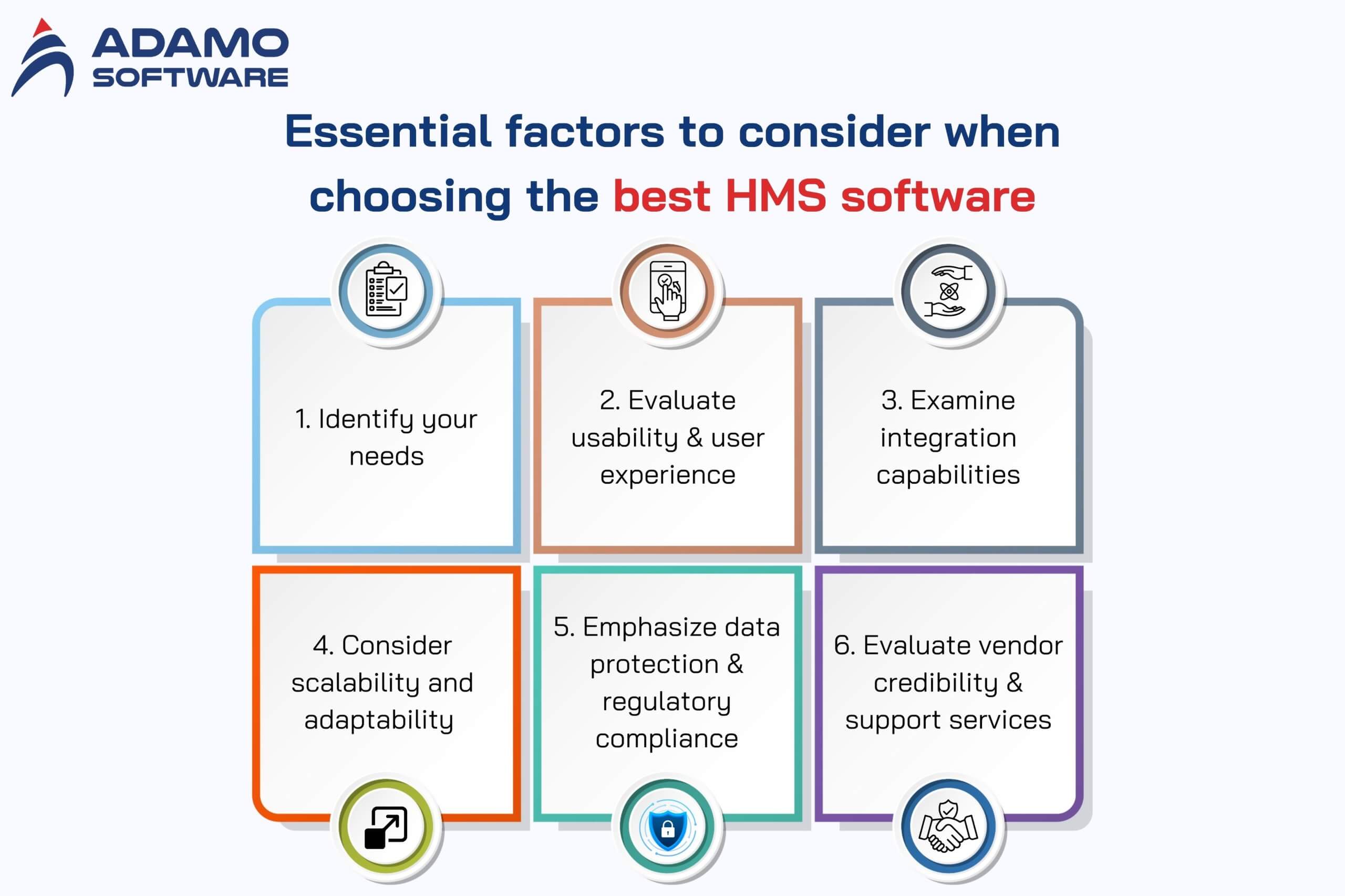
1. Identify your needs
Organization leaders must establish precise hospital management software requirements and goals before undertaking the search for new solutions. Your organization needs to examine its characteristics, including size, organization, specialty practice areas, workflow complexity, regulatory compliance requirements, and current system integration needs. Identifying essential features and necessary functions will help you select an HMS software system that matches your organization’s core targets.
2. Evaluate usability and user experience
A suitable HMS software system needs to have an intuitive interface that provides effortless navigation for both healthcare professionals and staff members. The modern interface, alongside customizable dashboards and automated workflow features should be present in your HMS software to reduce manual work while streamlining procedures.
User experience testing through software trial periods also enables hospitals to evaluate system usability and workflow compatibility between organizational needs and typical user behavior.
3. Examine integration capabilities
The essential requirement of any HMS system is integration capabilities, which ensure data exchange interoperability and workflow continuity. Test HMS software integration features to verify compatibility with all electronic health records (EHR) platforms and laboratory information systems (LIS). Additionally, ensure it works with billing systems and any other third-party applications your organization uses.
Look for HMS software that supports HL7 and FHIR, with customizable integration options tailored to your organizational needs.
4. Consider scalability and adaptability
The HMS software must follow your organization’s growth by adjusting to different requirements. Assess how potential hospital management system software handles increased capacity and future additions of users and functional requirements.
Organizations must seek vendors that offer modular solutions with customizable features. Additionally, these solutions should include adaptable licensing options that match the organizational growth trajectory and the size of the institution.
5. Emphasize data protection and regulatory compliance
Healthcare data security and compliance standards create essential requirements that force hospital management systems to adhere to strict standards. The regulatory standards protect patient information and enforce compliance with HIPAA, GDPR, and HITECH.
Since data protection must be assessed in HMS software solutions, it is important to evaluate their features for encryption technology and security protocols. Additionally, consider the access control systems, auditing capabilities, and updated schedules.
Select HMS software vendors who demonstrate dedicated security and compliance practices from development to implementation of their software products.
6. Evaluate vendor credibility and support services
Selecting an HMS software vendor who maintains a high reputation serves as a necessary step for achieving both deployment success and sustained partnership.
Assess HMS software vendor reliability through research of their credentials combined with review analysis of existing customers and detailed case studies. Ask the vendor about their available customer support options, together with training resources and maintenance services that they provide.
Such steps guarantee your organization will obtain the required support both during the implementation stage and after it is completed.
In short, investigate all HMS software options to ensure they meet your operational needs. Focus on intuitive user experiences and integrative features. Additionally, you should consider data protection, vendor reliability, and service quality.
The evaluation of these vital factors, together with extensive research, will enable you to select an HMS software system that matches your organizational objectives. Healthcare delivery to patients and operational efficiency will advance as a result of your selection in the current dynamic healthcare system.
VII. The future trends to look forward to for hospital management system
The emergence of healthcare technology innovations has transformed the way medical organizations handle their operations each day. Hospital management systems (HMS) continue to advance rapidly through changes, which enables better care quality and efficiency and helps reduce healthcare expenditures. Continuous advancements define the future development of this sector, and these patterns are what to follow:
1. Integration of AI and machine learning
Artificial intelligence (AI) and machine learning (ML) have emerged as practical components for hospital management systems. These technologies will determine the direction of the healthcare industry.
Healthcare institutions use AI through predictive analysis to forecast patient streams and automated systems for running administrative procedures. Implementing AI-boosted software for hospital management allows healthcare facilities to produce analytical-based decisions that generate enhanced care quality and operational savings.
2. Growing use of cloud technology
Cloud services provide a flexible storage system that allows users to handle large healthcare datasets in a budget-friendly manner. Hospital management software that operates on cloud infrastructure allows staff members to work from various locations. They can access it anywhere through web-based features, benefiting collaborative work environments.
Through this technology, hospitals can share data immediately, which enhances communication between departments and supports the delivery of coordinated patient treatment.
3. Improved data security
Modern cybersecurity threats demand that healthcare institutions take protective measures to safeguard their sensitive information database. The future hospital management systems will implement state-of-the-art security functions that integrate encryption across complete processes. They will also utilize multiple authentication methods and strict authorization systems to safeguard patient data against unauthorized access.
4. Advanced analytics and reporting
The next generation of hospital management systems will use data analytics to generate strategic planning support through advanced analytical systems. The healthcare administrator can effectively track performance, predict modeling, and conduct trend analysis and automated reporting through modern hospital management systems features. This implementation method gives healthcare providers direct access to evidence-based decision-making methodologies.
5. Incorporation of telemedicine features
Telemedicine solutions showed exponential growth during the COVID-19 pandemic, and medical practices expect it to remain permanent. Future hospital management systems will integrate telemedicine features, enabling virtual exams and meeting scheduling for healthcare institutions. They will also track remote patient progress via unified electronic medical databases.
VIII. Got in mind a healthcare software development idea? Contact Adamo

Adamo Software has healthcare software solutions expertise that will help you with your hospital management system development. We focus on end-to-end healthcare-specific development services throughout the entire process, including prototype creation and deployment.
Our skilled team provides hospital management software that meets HIPAA and GDPR standards for efficient healthcare management. Adamo’s main priority is to establish perfect code quality with logical software designs that create secure applications while enhancing user experience.
Additionally, our agile healthcare software development process includes client involvement throughout each development stage, so the final product will be just what you ask for.
The hospital management system from Adamo Software will improve operations, enhance patient care, and boost efficiency for healthcare institutions. Contact us now!
FAQs
1. What is a hospital management system?
A hospital management system (HMS) is an integrated software platform that coordinates clinical, administrative, and financial operations across a healthcare facility. It combines patient registration, electronic medical records, scheduling, billing, laboratory management, pharmacy, inventory, and analytics into one system, replacing the disconnected workflows that emerge when each department uses its own tools.
2. How is a hospital management system different from an EMR or EHR?
An EMR or EHR focuses on patient clinical records. A hospital management system includes EMR functionality as one module among many, also handling billing, scheduling, inventory, pharmacy, lab management, and administrative workflows. EMR is a subset; HMS is the broader operational platform.
3. How much does it cost to develop a custom hospital management system?
Custom HMS development typically ranges from $30,000 for basic single-facility deployments to over $500,000 for large enterprise multi-region platforms. Most mid-size hospital builds fall in the $80,000 to $200,000 range. Ongoing costs run 15-25% of the initial build per year. Off-the-shelf alternatives use per-user subscription models, often $30 to $300 per user per month.
4. Should I choose off-the-shelf or custom HMS?
Off-the-shelf HMS works for hospitals with standard workflows, limited customization needs, and tight initial budgets. Custom HMS works for hospitals with unique clinical workflows, complex integration requirements, long-term ownership plans, or specialty care models that generic platforms cannot serve. The decision is rarely about cost alone. It is about workflow fit and time horizon.
5. What architecture do modern hospital management systems use?
New HMS builds in 2026 are predominantly cloud-native or hybrid, with microservices architecture, HL7 v2 for internal messaging, FHIR R4 for external APIs, an integration engine like Mirth Connect in the middle, role-based access control, and audit logging throughout. This is a significant departure from the monolithic systems built in 2018-2021.

 adamosoft.com
 (+84) 373 11 44 88