
Generative AI Trends 2026: Top use cases, technologies & business impact
Explore Generative AI trends 2026, from enterprise use cases to emerging technologies shaping business impact across industries.
Generative AI is reaching a clincher for global enterprises. By 2026, these organizations will be less experimentation-focused and more business-aligned in scaling AI to satisfy business goals and do so securely and reliably. Generative AI is no longer on the cutting edge of innovation. Rather, it becomes ingrained in everyday processes, decision-making, and customer experience.
At the same time, Generative AI trends 2026 are pointing towards a bigger transformation in the way enterprises design, deploy, and govern AI systems. Businesses focus on being responsible, industry-specific intelligence, and the actual day-to-day context of operations. This evolution reconfigures not only technology strategies but also day-to-day work.
This shift is taking place in a number of key areas, which will be discussed in this article:
- Why 2026 is a turning point for generative AI in business adoption.
- The best generative AI technologies influencing enterprise systems and workflows
- How GenAI trends 2026 are being applied to real-world use cases across industries
- What these trends mean for governance, security, and responsible deployment
- Cost-related considerations when implementing generative AI
I. Why 2026 is a turning point for Generative AI in Business
2026 was a significant year in the adoption and scaling of generative AI technologies by businesses. Several structural, technological, and workforce changes converged during this time.
First of all, governments and enterprises put greater emphasis on ethics, transparency, and accountability. As a result, responsible frameworks influenced many of the Generative AI trends 2026 across industries.
Meanwhile, progress in computing power, cloud infrastructure, and data processing led to model improvement. Due to this, generative AI systems became easier to build, deploy, and scale in real-world environments.
At the same time, organisations sought professionals who used analytical skills in conjunction with business strategy. Therefore, human expertise was still essential to turn Gen AI trends 2026 into measurable business value.
Many South African companies invested heavily in developing tools that incorporate AI. In turn, these investments were intended to boost efficiency, reduce costs, and facilitate data-driven decision-making.
Finally, businesses and institutions incorporated AI in operations as well as in developing their workforce. This alignment made it possible for the future professionals to work effectively with a custom generative AI solution.
Looking to the future, the following ten Generative AI trends 2026 will shape industries, jobs, and innovation around the world.
II. Top Generative AI Trends That Will Shape Enterprises in 2026
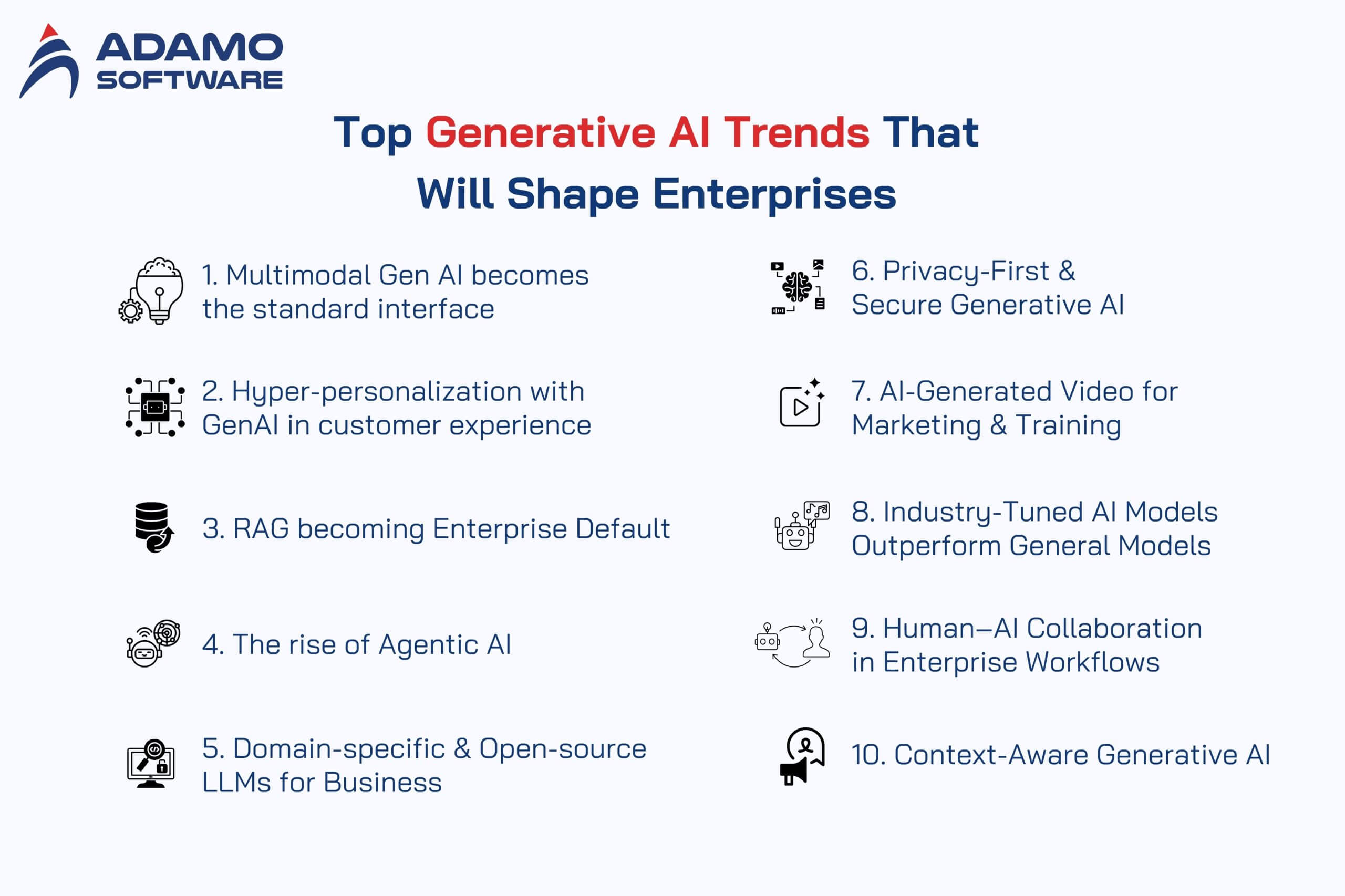
1. Multimodal Gen AI becomes the standard interface
Multimodal GenAI changed the way enterprises and AI systems interacted. Up until 2026, models processed text, images, audio, and video as a package.
As a result, AI developed a greater understanding of context by linking several types of data together. This shift led to enhanced accuracy of output and less misinterpretation in complicated business scenarios.
As a result, enterprises made use of multimodal systems for content production, customer interaction, and product design. This ability became one of the core components of Gen AI trends 2026.
2. Hyper-personalization with GenAI in customer experience
Hyper-personalization became one of the central business uses of Generative AI trends 2026. GenAI understood behavioral, transactional, and contextual data to personalize each interaction.
Therefore, enterprises sent messages, content, and recommendations in accordance with individual preferences. This approach resulted in higher involvement, satisfaction, and long-term customer loyalty.
With the growing adoption, custom generative AI solutions have replaced generic messaging in industries.
3. Retrieval Augmented Generation (RAG) becoming Enterprise Default
RAG targeted one of the biggest risks in generative AI adoption: the hallucinated outputs. As of 2026, most enterprises have implemented GenAI systems that are based on trusted inner data.
Through RAG, AI was able to access real-time information from policies, databases, and knowledge bases. For this reason, responses became accurate, auditable, and business-ready.
This approach had a strong hand in the Generative AI trends by adding reliability in regulated and mission-critical especially.
4. The rise of Agentic AI: From Assistant to Autonomous Co-workers
Agentic AI was a huge shift when it came to Gen AI trends 2026. These systems planned, performed, and optimized tasks requiring multiple steps with little human involvement.
Over time, agents learned from the feedback and collaborated with other agents from different platforms. As a result, the workflows became faster and more adaptive.
Enterprises changed roles with oversight and strategy, and AI took care of execution and coordination.
5. Domain-Specific & Open-Source LLMs for Business
Enterprises moved away from one-size-fits-all Artificial Intelligence Models. By 2026, more accurate and compliance GenAI for specific domains will replace general-purpose systems.
Industries embraced models customised for healthcare, finance, legal, manufacturing, as well as cybersecurity. At the same time, open source ecosystems drove down the costs while allowing for greater flexibility.
This trend created a higher demand for a trustworthy Generative AI development company with deep expertise in the industry.
6. Privacy-First & Secure Generative AI
Privacy-first design was at the forefront of Generative AI trends 2026. Enterprises mitigated the cloud dependency by running AI models on devices and private infrastructure.
As a result, sensitive data remained local, and performance went up through reduced latency. This approach ensured the development of Generative AI trusts.
Security and personalization went hand in hand, and not against each other.
7. AI-Generated Video for Marketing & Training
AI-generated video went mainstream in enterprise usage. By 2026, GenAI will be applied to marketing campaigns, onboarding, and internal training by businesses.
This shift allowed for quicker production time while allowing for quicker iteration and localization. Consequently, creative teams were more oriented toward strategy and storytelling.
Video generation became a high-impact application of custom generative AI solutions.
8. Industry-Tuned AI Models Outperform General Models
Industry-tuned GenAI has provided better results by learning rules and data specific to their industry. These models have reduced errors by relating closely to actual operational situations.
In healthcare, clinical standards were followed by AI. In the case of manufacturing, it accurately interpreted sensor and maintenance data.
This area of specialization helped to build trust and helped to speed enterprise-wide adoption.
9. Human–AI Collaboration in Enterprise Workflows
Human-AI collaboration replaced displaced workforce fear. In 2026, AI augmented employees by taking care of repetitive and operational tasks.
Meanwhile, experiential interfaces brought AI to the masses by having natural language interactions. This balance helped to improve productivity and job satisfaction.
Enterprises designed differently workflows to orchestrate human and digital teams together.
10. Context-Aware Generative AI (RAG + Agents + Memory)
Context-aware systems were the most advanced of Generative AI trends 2026. These platforms brought together LLMs, RAG, agents, and long-term memory.
As a result, AI comprehended business rules, historical data, and real-time context at the same time. This intelligence helped in improving accuracy where trust was critical.
Context awareness was the basis of scalable and reliable enterprise GenAI.
III. What do these Gen AI trends mean for enterprises?
AI Governance, Ethics, & Responsible Deployment
Trust was the key to AI adoption in the enterprise in 2026. As Generative AI trends took off, businesses realized that performance was less important without accountability.
Responsible deployment that is focused on bias mitigation, transparency, fairness, explainability, and clear ownership. Therefore, governance frameworks were built into the AI strategies from day one.
Notably, a research roadmap published on Cornell’s arXiv brought attention to the importance of making responsible AI auditable and consistent with human values. It also strongly emphasized having strong oversight mechanisms across the lifecycle of AI.
At the same time, governments increased the expectations of regulations. According to Reuters, the EU AI Act mandated detailed documentation, risk disclosures, and cybersecurity protections of advanced systems. This included mandatory assessments for systemic risk models.
As with cybersecurity in previous years, AI governance became the baseline for transformation. Without it, Generative AI development services brought risk instead of a competitive advantage.
The Copyright & Intellectual Property Conundrum
Intellectual property concerns increased with enterprise GenAI adoption. As AI-made content became big, who owned what and who was responsible for it became more and more murky.
Enterprises were confronted with tough questions on authorship issues, training data rights, and reuse of AI-created outputs. It is as a result, IP strategy became an inherent part of Generative AI trends 2026 discussions.
In late 2025, Reuters reported that India proposed to have strict rules of labeling AI-generated content. This policy was aimed at reducing misuse, protecting creators, and ensuring content traceability.
These efforts came amid a larger movement around the world to establish the ground rules on the lines between human creativity and machine-generated work. Throughout 2026, such debates still influenced regulatory and commercial decisions around the world.
Data Strategy, Security & Cyber Defense
One issue that turned out to be extremely important during Generative AI trends 2026 was security. While GenAI opened up the door to automation and insight, new attack surfaces opened up.
According to a report from Reuters based on UN analysis, cybercrime using artificial intelligence grew faster than conventional defenses. Deepfakes and automated misinformation became great enterprise threats.
As a result, companies were faced with a double responsibility. First, they locked internal resources such as training data, RAG pipelines, and agent permissions. Second, they secured the users through data safety and output integrity.
Till 2026 cybersecurity and AI strategy were inseparable. For any company of Generative AI development, secure design is defined for long-term enterprise trust.
For a deeper look at practical AI business applications across sectors, we’ve outlined key use cases separately.
IV. Generative AI use cases by industry in 2026
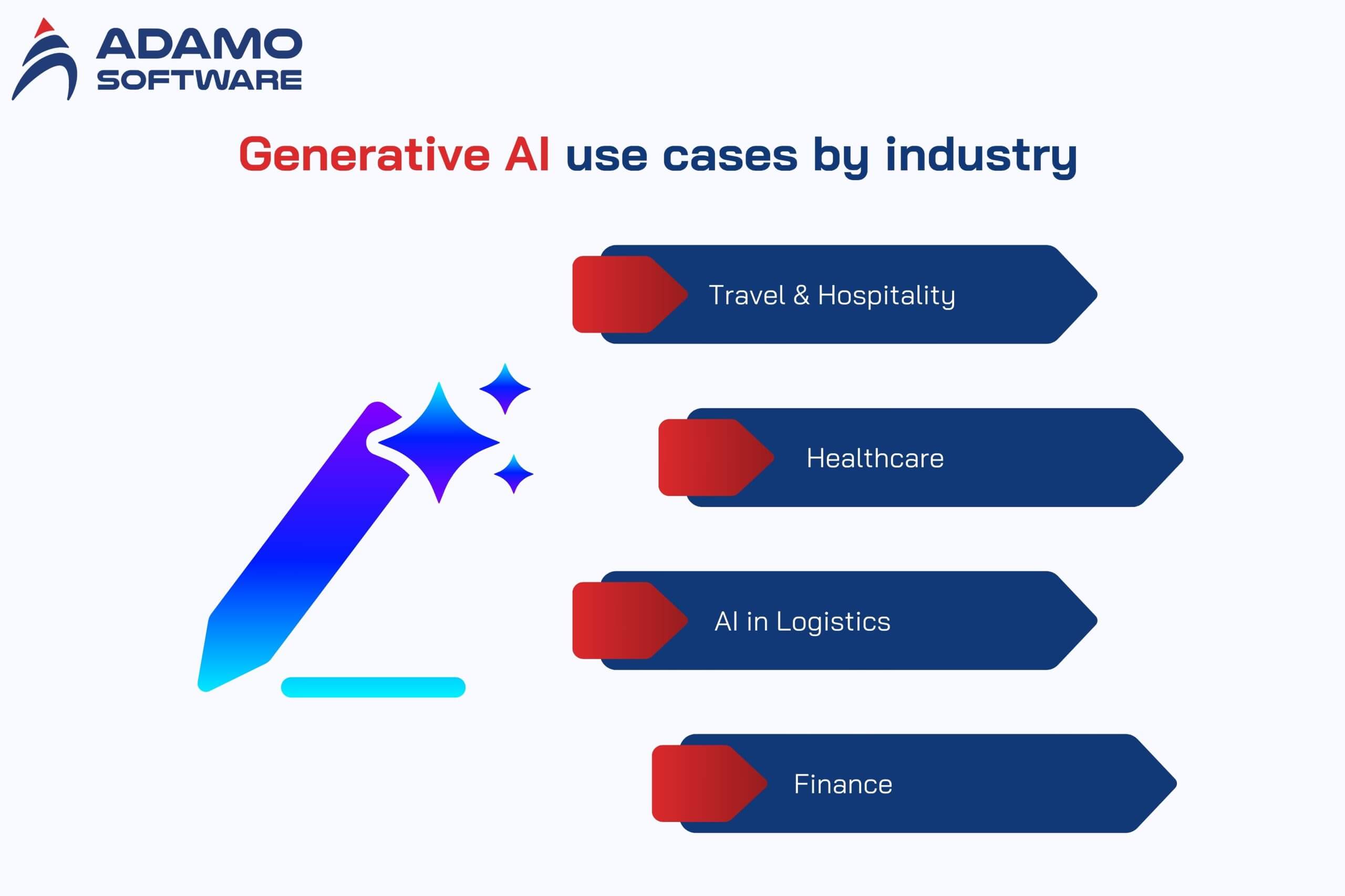
1. Future of Gen AI in Travel & Hospitality
Generative AI changed the way travel and hospitality companies managed their customer experience. By 2026, GenAI service will provide real-time personalization supporting booking, support, and on-site services.
Via data analysis and predictive insights, AI enabled custom recommendations of travel and pricing, and itineraries. As a result, guests were offered more relevant deals and smoother trips.
At the operational level, enterprises applied custom solutions of generative AI to automate customer inquiries, optimize staffing, and better predict demand.
This is especially relevant for businesses investing in travel software development to stay competitive.
2. Future of Gen AI in Healthcare
Generative AI contributed greatly to enhancing clinical productivity and patient experience. In line with Generative AI trends 2026, healthcare providers were focused on automation and decision support.
GenAI simplified the way to gather data and keep records up-to-date and accessible, keeping medical information current and accessible. As such, doctors and nurses spent less time moving through systems and more time with patients.
This balance of automation and human care characterised responsible GenAI adoption in healthcare environments.
Organizations building or upgrading their healthcare software are among the earliest adopters of these capabilities.
3. Future of Gen AI in Logistics
Logistics organizations used GenAI to have better visibility and coordination across complex supply chains. AI was used to assist route optimization, demand forecasting, and inventory planning by 2026.
GenAI used real-time data of shipments, warehouses, and suppliers to predict disruptions. Therefore, businesses responded quicker to delays and cost fluctuations.
These capabilities made Generative AI development services imperative for logistics companies that wanted to be resilient and efficient.
4. Future of Gen AI in Finance
Generative AI changed how financial decisions and reporting are made and handled. In 2026, GenAI enabled wealth and asset managers to access relevant data quicker.
As a result, financial reports were produced at a faster pace so that decision-makers could act earlier. In addition, GenAI was used to extract real-time insights using pattern detection and predictive modelling.
Many institutions adopted proprietary models because they did not want to store sensitive data off-site. For example, GenAI was used by SS&C Technologies in conjunction with a digital workforce to accelerate the processing of credit agreements.
Enterprise agents uploaded agreements, and GenAI extracted and structured unstructured data. After validation, agents completed the entries, making sure to report accurately and on time in every cycle.
For institutions looking to modernize, partnering with a fintech software development team accelerates this transition.
V. Generative AI Development: Cost & Investment Considerations
Implementing generative AI is not just about choosing a model and calling an API. For enterprises, generative AI is a long-term system investment that involves data, infrastructure, security, and continuous optimization. Understanding what drives the cost is critical to avoid budget overruns and unrealistic expectations.
1. What drives the Cost of Generative AI Projects?
Several key factors directly influence the total cost of a generative AI initiative.
a. Use Case Complexity
The complexity of the business use case is the primary cost driver. A simple internal AI assistant for knowledge search is fundamentally different from an enterprise-grade AI system that supports real-time decision-making, customer interactions, or multimodal inputs (text, images, voice). The more business-critical and real-time the use case is, the higher the technical and operational cost.
b. Data Volume and Data Preparation
Data is the real foundation of generative AI. Enterprises often underestimate the cost of:
- Cleaning and structuring internal data
- Labeling and enriching datasets
- Ensuring data quality and consistency
In many projects, data preparation accounts for a significant portion of total effort, sometimes more than model development itself.
c. Model Strategy
The choice between open-source and commercial models has major cost implications. Open-source models may reduce licensing fees but require more engineering effort for deployment, fine-tuning, and maintenance. Commercial APIs reduce setup time but introduce ongoing usage costs. In addition, decisions such as fine-tuning versus prompt engineering and cloud versus on-premise deployment will significantly affect long-term expenses.
d. System Architecture
Enterprise generative AI systems rarely operate in isolation. Typical architectures include:
- RAG pipelines for knowledge grounding
- Vector databases for semantic search
- API orchestration layers
- Monitoring and logging systems
The more integrated the system is with existing platforms like CRM, ERP, or data warehouses, the higher the architectural complexity and development cost.
e. Security and Compliance Requirements
For industries such as healthcare, finance, and travel, security is not optional. Encryption, access control, audit logs, and compliance with regulations (GDPR, HIPAA, PCI) add both technical and operational overhead to the total investment.
2. Hidden costs enterprises often underestimate
Many generative AI projects exceed budgets due to overlooked hidden costs:
- Data governance and compliance management
- Model drift and periodic re-training
- Infrastructure scaling as usage grows
- AI monitoring and human-in-the-loop validation
- Legal and regulatory reviews
These costs typically emerge after the initial deployment phase and become critical for long-term sustainability.
3. Build in-house vs outsource generative AI development
Enterprises typically face two strategic options.
Building in-house offers full control but requires heavy investment in AI talent, infrastructure, and long-term capability building. Outsourcing to a specialized generative AI development partner allows faster implementation, access to experienced AI engineers, reduced technical risk, and more predictable costs.
For most organizations, especially outside big tech, partnering with an experienced AI vendor is the most efficient path to production-ready generative AI systems. Many enterprises choose to start with a dedicated development team model to balance control and speed.”
VI. Conclusion: Is your business ready for Generative AI in 2026?
Generative AI is no longer an experimental technology – it is becoming a core capability for modern enterprises. By 2026, organizations that fail to integrate AI into their products, operations, and decision-making processes will struggle to remain competitive in a rapidly evolving digital landscape.
The real question is not whether to adopt generative AI, but how prepared your business is to scale it responsibly and effectively. Success depends on more than choosing the right model. It requires a clear strategy, high-quality data, secure system architecture, strong governance, and a development partner who understands both technology and real business impact.
This is where Adamo Software comes in. With deep experience in building enterprise-grade AI solutions across industries such as travel, healthcare, and SaaS, Adamo helps organizations move beyond experimentation to production-ready generative AI systems. From AI consulting and architecture design to secure development and long-term optimization, Adamo supports every stage of your AI journey.
Enterprises that act early, by aligning generative AI with real business goals and building the right foundations, will gain a lasting competitive advantage. If your organization is ready to turn generative AI into measurable business value in 2026 and beyond, Adamo Software is ready to help you get there.
FAQs
1. Which generative AI is best?
There is no one generation AI that is best for all business use cases. The right one depends on your goals, workflows, and data environment.
Some of the tools are better at text and code generation, while others are better at images or video. For this reason, enterprises assessing Generative AI trends 2026 should match tools and tasks.
In practice, many organizations do not need to choose between generative AI solutions based on a single platform because they often test out several platforms before settling on custom generative AI solutions to meet their needs.
2. What is the next big thing after Gen AI?
The next phase is offset from individual tools and aims at deeper integration. According to Gen AI trends 2026, the use of AI will be combined with automation, robotics, and connected systems.
As a result, the line between digital and physical work will keep getting blurred. The real move will be the way enterprises use AI to solve complex and cross-domain problems.
Progress will come more from impact rather than a single breakthrough technology.
3. Will Generative AI replace coders?
Generative AI will not totally replace coders. Instead, it works as a productivity partner to increase the speed of repetitive tasks and code generation.
However, critical thinking, architecture design, and problem-solving still require the expertise of human beings. Therefore, developers will adjust themselves by working with AI tools.
This collaboration embodies how Generative AI development services are for efficiency and not replacement.

 adamosoft.com
 (+84) 373 11 44 88