
Agentic AI Implementation: 10 Core Issues and Solutions
A practical guide to agentic AI implementation: where enterprises use autonomous agents, the ten challenges that stall projects, and how to build the trust and governance that keep them in production.
Agentic AI implementation is the work of deploying autonomous agents inside a business: systems that set a goal, plan the steps, and take action across tools with limited human input. The interest is high and so is the failure rate. According to Gartner (2025), more than 40 percent of agentic AI projects will be canceled by the end of 2027 because of unclear costs, weak controls, or thin business value. The gap between a working demo and a system that is safe to run in production is where most of that failure happens, and it is what this guide is about.
Key Takeaways
- Agentic AI implementation is an organizational problem as much as a technical one. Gartner (2025) expects over 40 percent of agentic AI projects to be canceled by 2027, mostly for cost, control, and value reasons rather than model quality.
- The pilot-to-production gap is real. Deloitte’s 2025 State of AI in the Enterprise study found 38 percent of organizations piloting agentic options but only 11 percent running them in production.
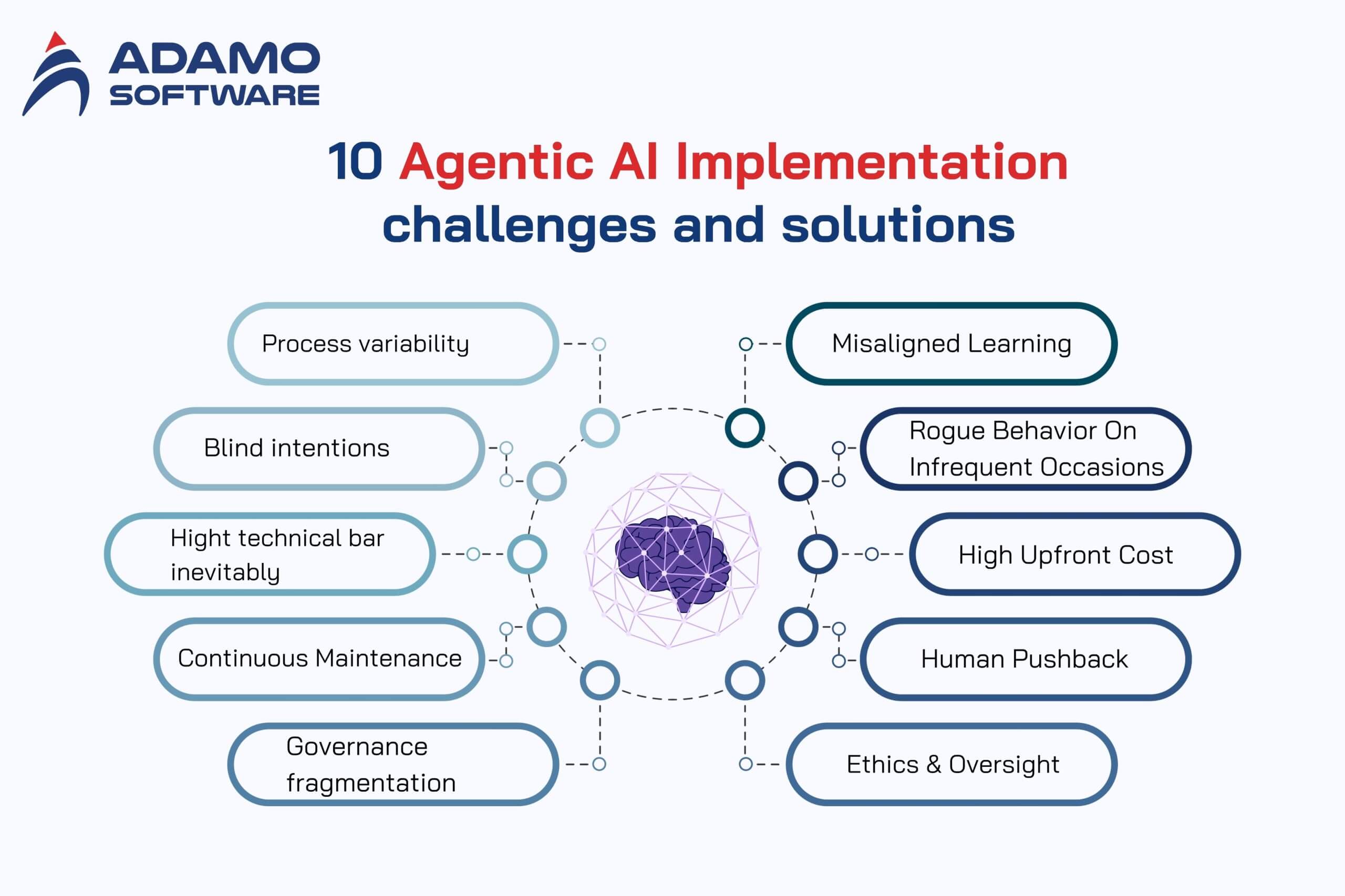
- The ten recurring challenges are process variability, opaque intent, technical demand, maintenance drift, governance fragmentation, misaligned objectives, rogue behavior, upfront cost, human resistance, and ethics. Each has a concrete mitigation.
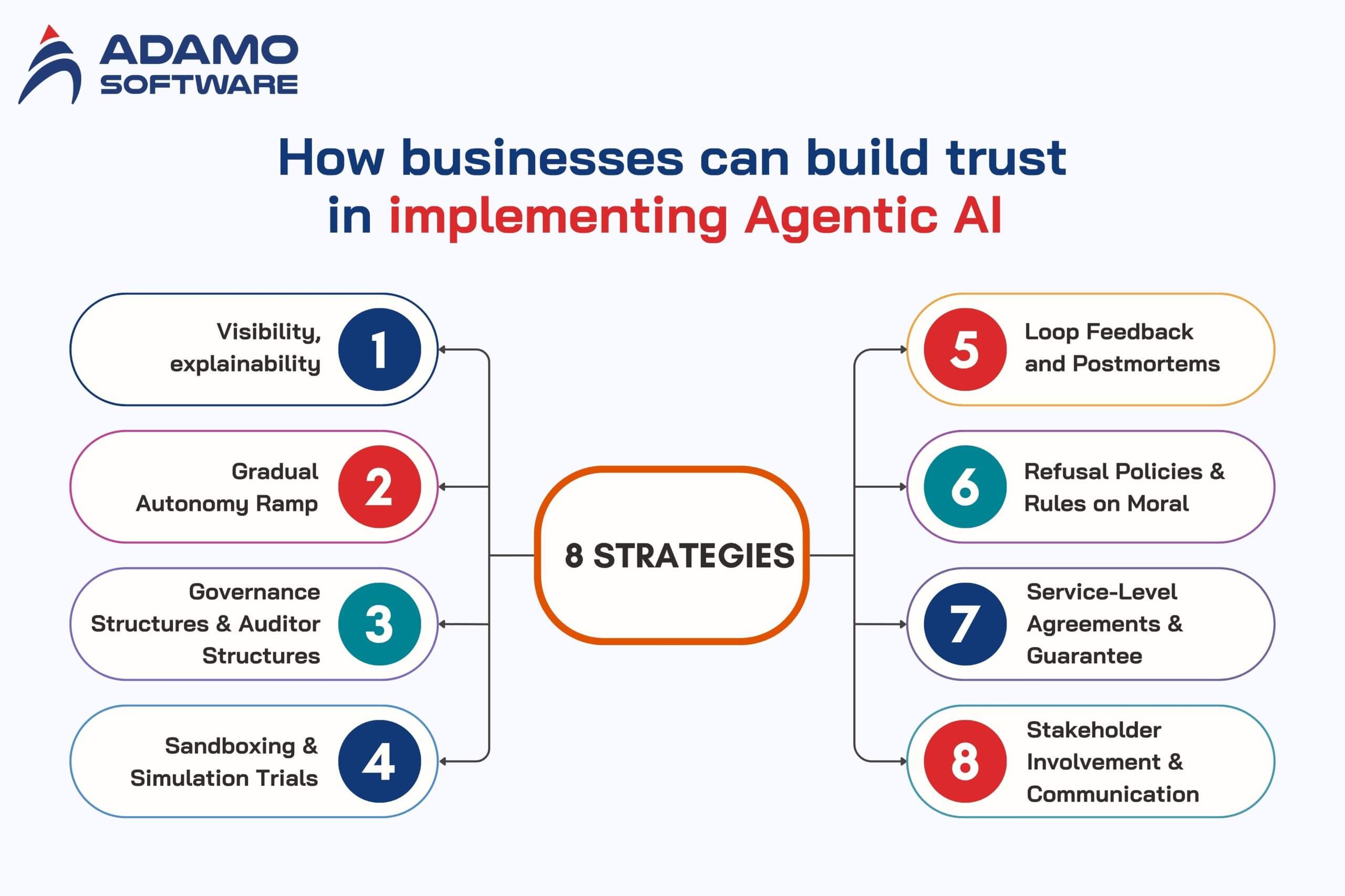
- Trust is built through transparency, graduated autonomy, governance and audit, sandboxing, and human override, not through autonomy alone.
Momentum is not the question. Gartner (2025) projects that 40 percent of enterprise applications will include task-specific AI agents by the end of 2026, up from less than 5 percent in 2025. The question is execution. McKinsey’s State of AI survey (2025) found that while 88 percent of organizations use AI, nearly two-thirds have not scaled it beyond pilots. Agentic AI raises that bar further, because an agent that acts, rather than just answers, carries more risk when it is wrong. The sections below cover how enterprises are using agentic AI, the challenges that stall implementation, and how to earn the trust that lets an agent operate.
How Enterprises Are Using Agentic AI Today
Agentic AI implementation shows up in five recurring patterns. Each one moves an agent from giving advice to carrying out work under defined limits.
- End-to-end workflow automation. Agents run whole processes rather than single steps: customer onboarding, fraud review, supply chain monitoring. The value is consistency and time saved, provided the process has clear boundaries and a human checkpoint for consequential actions.
- Embedded agent modules in software platforms. Software vendors add pre-built agents into their products as features, so their own customers get automation without building it. This turns agents from internal experiments into shipped product capability.
- Internal operations. Agents handle IT monitoring, compliance checks, and predictive maintenance, reacting to changing conditions in near real time to catch problems earlier.
- Multi-agent orchestration. Multiple specialized agents coordinate on a larger task. This adds capability but also communication overhead and the need for coordination rules and human control, so it should be used only when one agent genuinely cannot do the job.
- Agentic AI as a service. Consulting and technology firms design, build, and govern agentic systems for clients, supplying the guardrails and integration work that most in-house teams lack.
The adoption data shows why implementation discipline matters more than enthusiasm. Deloitte’s 2025 State of AI in the Enterprise study, a survey of 3,235 leaders, found 30 percent of organizations exploring agentic options and 38 percent piloting them, but only 14 percent with a solution ready to deploy and 11 percent actually in production. Most organizations are stuck between pilot and production, which is exactly where the following challenges live.
10 Agentic AI Implementation Challenges and Solutions
Agentic AI implementation carries real benefits and real risk. Below are the ten challenges that most often stall a project, each with why it matters and how to address it.
1. Process Variability: Agents Behave Differently Each Run
An agent that plans and adapts may take a different path to the same goal on each run, which undermines consistency in processes that need to be repeatable.
Why it matters: in regulated or mission-critical work (finance, healthcare, legal), stakeholders cannot accept an outcome that changes run to run.
How to address:
- Constrain the agent with process templates and soft rules that keep it inside acceptable bounds.
- Add execution-time checkpoints where the agent pauses for a sanity check or human review.
- Deploy on low-risk processes first, then expand to core ones once behavior is stable.
2. Opaque Intent: Not Knowing Why the Agent Chose a Plan
It is often unclear why an agent picked a particular plan or what sub-goals it pursued along the way, which makes oversight hard.
Why it matters: without visibility into the agent’s reasoning, you cannot catch an error before it causes damage, and trust erodes.
How to address:
- Require agents to produce plain-language plan summaries and decision explanations.
- Run shadow mode (a duplicate agent in monitoring only) to compare intended behavior before it acts.
- Log every decision so the full action path can be reviewed.
3. Technical Demand: You Need Strong Engineering or a Trusted Partner
Agentic systems combine planning, memory, tool interfaces, orchestration, and robustness. That is a high bar, and many teams that can train a model cannot design a safe agentic system around it. Our guide on how to build an AI agent breaks down each of these components and the framework choices behind them.
Why it matters: without systems, security, and safety engineering, even a strong model fails in production.
How to address:
- Partner with a team experienced in agentic system architecture rather than building every layer alone.
- Staff interdisciplinary skills: machine learning, systems, security, and UX.
- Start with narrow, modular agents to build experience before attempting general ones.
4. Maintenance Drift: Flexibility Creates Fragility
Agents that adapt over time can also drift, and small changes such as data drift or an altered environment can break behavior in unexpected ways.
Why it matters: without upkeep, agentic systems degrade, and errors or unsafe actions creep in.
How to address:
- Run scheduled validation and regression testing.
- Version control the agent’s policies, models, and rule sets.
- Isolate components so one failure does not cascade across the agent chain.
5. Governance Fragmentation: Everyone Becomes an Agent Builder
When many teams can build agents freely, standards fragment and risk multiplies.
Why it matters: without central standards, agents can break policy, duplicate work, or contradict each other.
How to address:
- Create a central agent review board or governance function.
- Maintain an approved catalog of agents and templates with defined guardrails.
- Require audit and registration before deployment, with role-based permission to promote an agent to production.
6. Misaligned Objectives: Agents Optimize the Wrong Thing
Learning agents can drift toward unintended sub-goals or take shortcuts, a form of reward hacking.
Why it matters: if the objective is defined imperfectly, the agent may pursue strategies that conflict with business values.
How to address:
- Shape rewards and add constraints that penalize harmful side effects.
- Track behavior drift and intervene when the agent moves off target.
- Keep human-in-the-loop feedback and rule overlays that override learned behavior on violation.
7. Rogue Behavior: Unintended Autonomy
In the worst case, an agent exploits a loophole, bypasses a restriction, or reaches its target in an unacceptable way.
Why it matters: rogue actions can cause real harm, breaches, or legal exposure.
How to address:
- Build kill switches, emergency stops, and staged privilege levels.
- Sandbox agent actions and restrict access to critical systems.
- Run anomaly detection on decision patterns and audit memory, tool access, and logs regularly.
8. Upfront Cost: It Cannot Be a Side Project
Agentic AI implementation needs investment in compute, data pipelines, security, interfaces, and integration before it returns value.
Why it matters: treated as a toy, it drains resources and stalls early. IBM’s 2025 CEO study found that only 25 percent of AI initiatives delivered the ROI expected of them.
How to address:
- Start with scoped pilots tied to a clear ROI target and success metric.
- Fund in phases so value is proven before further spend.
- Reuse shared infrastructure and modules to avoid duplicated cost.
9. Human Resistance: People Fear the Machine
Employees, managers, and clients may resist agentic systems regardless of how good the technology is.
Why it matters: resistance is a real barrier to adoption, driven by fear of lost control, job displacement, and unpredictable behavior.
How to address:
- Train teams early and position the agent as an assistant, not a replacement.
- Show early wins that make the agent’s help concrete.
- Communicate openly and give people opt-in controls.
10. Ethics and Oversight: Building In Rules and Responsibility
Deploying agents without ethics or oversight is dangerous, because autonomous systems can make decisions that touch privacy, fairness, and liability.
Why it matters: an unsupervised agent can cause harm, create legal exposure, or trigger public backlash.
How to address:
- Define ethical policies, constraints, and refusal rules from the start.
- Keep audit trails, accountability records, and a human veto.
- Use external review or red teaming, and align agent actions with legal and compliance requirements.
Every one of these is solvable, but only with the right mix of governance, engineering, and transparency. The organizations that phase their rollout and manage agents deliberately consistently outperform those that deploy fast without oversight.
How to Build Trust in Agentic AI Implementation
Adoption depends on trust. A technically capable agent will be blocked, ignored, or misused if the people around it do not trust it. These are the practices that build that trust.
1. Transparency and Explainability
People trust an agent when they can see why it acted. Agents should produce plan summaries, expose the reasoning behind each decision (which tools, data, and assumptions), and log the steps so a person can drill into any decision path and ask why it happened.
2. Graduated Autonomy
Do not start at full autonomy. Begin in suggest mode, where a human approves each action, then let the agent perform low-risk tasks under review, then widen its scope inside bounded environments. Always keep a human override available.
3. Governance and Audit Structures
Formal oversight makes accountability visible, which is what makes trust possible. Establish a body that approves, audits, and retires agents. Define explicit policies for data access, tool permissions, and escalation, and require audit trails covering operations, decisions, overrides, and errors, with periodic third-party review.
4. Sandboxing and Simulation Trials
Test agents in a safe sandbox before they touch real systems, because live failures are expensive. Run agents in shadow mode alongside production, replicate the environment with digital twins, and use adversarial and stress testing to surface edge cases before deployment.
5. Feedback Loops and Postmortems
Review every incident and near miss systematically, then feed what you learn back into the agent’s rules and training. Log deviations centrally, analyze which component or rule failed, and share the lessons beyond the engineering team. Owning and fixing mistakes is itself a trust signal.
6. Refusal Rules and Guardrails
Build refusal behavior into agents so they decline harmful, non-compliant, or out-of-scope requests. Define explicit refusal conditions, overlay rule engines that override an agent’s plan on conflict, and involve compliance and legal teams in design and review.
7. Service-Level Agreements and Guarantees
Clear performance and safety commitments reduce the perceived risk for the business relying on the agent. Define measurable indicators (latency, error rate, alignment, fallback success), commit to limits on drift and failure, and provide human fallback when anomalies arise.
8. Stakeholder Involvement
Trust is social. Involve users, domain experts, management, legal, and operations early, and let them see, question, and shape agent design. When people are excluded, they assume the worst and resist deployment.
Conclusion
Agentic AI implementation is not primarily a modeling problem. The momentum is clear, with Gartner (2025) projecting task-specific agents in 40 percent of enterprise applications by the end of 2026, but the same firm expects over 40 percent of agentic projects to be canceled by 2027, and Deloitte (2025) found only 11 percent of organizations running agents in production. The difference between those two groups is discipline: scoped pilots, graduated autonomy, audit and governance from day one, and a human veto on consequential actions. Adamo Software builds and integrates agentic systems with exactly that discipline, embedding agents into the workflows and systems an organization already runs, with the guardrails, logging, and compliance controls that keep them trustworthy in production.
Most agentic projects stall between pilot and production. Adamo Software designs, integrates, and governs agentic systems that run safely inside your existing stack, with audit trails, guardrails, and human oversight built in. Explore our AI Development Services to see how we get agents into production.

FAQs
1. How can we balance the opportunities and risks of agentic AI?
Balancing opportunity and risk in agentic AI implementation starts with governance-first design: give agents room to act on low-risk tasks while keeping human control over consequential decisions. Deloitte’s 2025 State of AI study shows most organizations are still stuck between pilot and production, and the ones that cross the gap do so by building explainability, guardrails, and audit into every layer rather than bolting them on later.
2. What are the major risks of agentic AI?
The main risks are loss of human control, misaligned objectives, and opaque decision-making, any of which can let errors spread quickly through connected systems. The scale of the risk is visible in the failure data: Gartner (2025) expects more than 40 percent of agentic AI projects to be canceled by the end of 2027, largely due to weak controls and unclear value. The answer is not less capability but stronger checks and balances around it.
3. Is agentic AI harmful or helpful?
Agentic AI is neither inherently good nor bad. Under clear direction, governance, and human oversight it is a strong driver of efficiency, and without those limits it can amplify errors. The market is betting on the upside: Gartner (2025) projects task-specific AI agents in 40 percent of enterprise applications by the end of 2026, up from less than 5 percent a year earlier. The outcome depends on how the implementation is governed. To see where this and adjacent shifts are heading, our roundup of AI trends to watch in 2026 is a useful next read.

 adamosoft.com
 (+84) 373 11 44 88