
AI in tourism: Benefits, challenges and top applications
AI in travel and tourism now spans assistants, personalization, dynamic pricing, forecasting, and operations. Here are the main uses across the sector, the measurable benefits, the risks and ethics to manage, and real industry examples.
AI in travel and tourism is the use of machine learning, natural language processing, and predictive analytics to plan trips, serve travelers, price inventory, and run operations. It has moved from novelty to normal behavior: 40 percent of travelers already use AI tools for trip planning (Statista, 2025), and AI usage for travel doubled from 11 percent to 24 percent between October 2024 and mid-2025 (Global Rescue, 2025). For travel and hospitality businesses, AI is now a core capability rather than an experiment, and this guide covers where it is applied, what it delivers, and what to watch out for.
Key Takeaways
- AI in travel and tourism spans the whole journey: assistants and chatbots, personalization, itinerary planning, dynamic pricing, demand forecasting, and back-office operations.
- Adoption is now mainstream. 40 percent of travelers use AI for trip planning (Statista, 2025), and 94 percent of AI users trust AI recommendations at least as much as traditional sources (TakeUp, 2026).
- The clearest returns are operational and customer-facing: faster service, personalization at scale, better pricing, and lower manual workload.
- Privacy, the EU AI Act, transparency, and bias are real constraints. Responsible deployment with clear consent and human oversight is what sustains traveler trust.
How AI Is Transforming the Travel and Tourism Industry
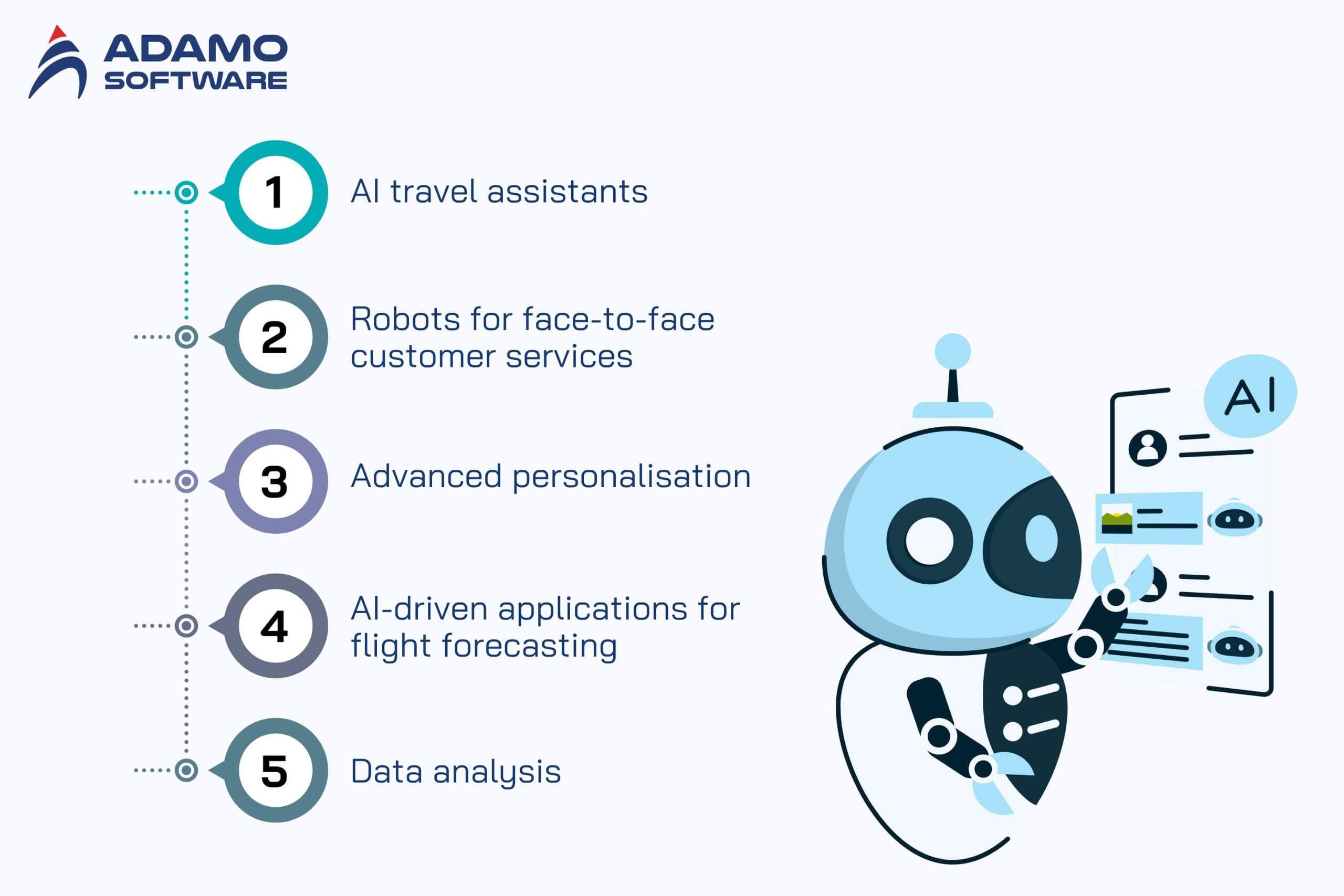
The shift is broad. Travel companies, from small operators to global brands, use AI to deliver faster and more personalized digital experiences, and the underlying market is expanding quickly: the global AI market is projected to approach USD 1.85 trillion by 2030 (Statista). AI in tourism now shows up in a few recurring roles. It powers assistants that plan and support trips, chatbots and service robots that handle inquiries, personalization engines that tailor recommendations, forecasting systems that predict demand and flight patterns, and analytics that turn traveler data into decisions. The common thread is that AI in tourism removes friction for the traveler while giving the business better data and lower operating cost. Each of these roles is covered below.
The Main Uses of AI in Travel and Tourism
AI reaches almost every part of a travel business. These are the uses with the clearest value, from the traveler-facing front end to back-office operations, including hospitality.
AI travel assistants and chatbots. Assistants plan trips, search and book across suppliers, and support travelers through disruptions, while chatbots handle high-volume questions around the clock. This is the most visible use, and we cover it in depth in our guide to AI travel assistants.
Personalization and recommendations. By analyzing search behavior, booking history, and preferences, AI matches travelers with the right destination, stay, and activities. Recommendation engines lift engagement and conversion by surfacing relevant options instead of a generic list. Our guide on the travel recommendation engine covers how this works.
Itinerary planning. Instead of stitching together information from many sources, travelers can receive an optimized itinerary in seconds, built from destinations, transport, duration, and budget. See our guide to the AI-powered itinerary planner.
Dynamic pricing and demand forecasting. AI predicts when demand will rise or fall from search trends, booking history, and events, then adjusts pricing and resourcing. Airlines and hotels use this to plan capacity and set fares, and revenue-management platforms such as IDeaS apply it across thousands of properties. Our guide on AI dynamic pricing goes deeper.
Customer service and operations. AI resolves routine service inquiries in multiple languages at any hour and streamlines back-office work from data entry to reconciliation. AI in hospitality is a distinct strength here: service robots and voice assistants handle check-in, guide guests to rooms, answer questions, and take in-room requests, which reduces front-desk load during peak periods. Hilton’s Connie robot is an early, well-known example of AI in hospitality in a hotel front-of-house role, and in-room voice assistants extend the same idea to the guest stay.
Facial recognition and security. At airports and hotels, facial recognition speeds check-in and boarding and supports security screening. This use is powerful but sits under the strictest regulatory scrutiny, discussed in the risks section below.
Marketing and analytics. AI segments audiences, personalizes campaigns, and analyzes social and review data to surface sentiment and trends. Platforms such as Sojern and Navan’s Ava apply this to targeting and to streamlining the booking experience.
Benefits of AI in Travel and Tourism
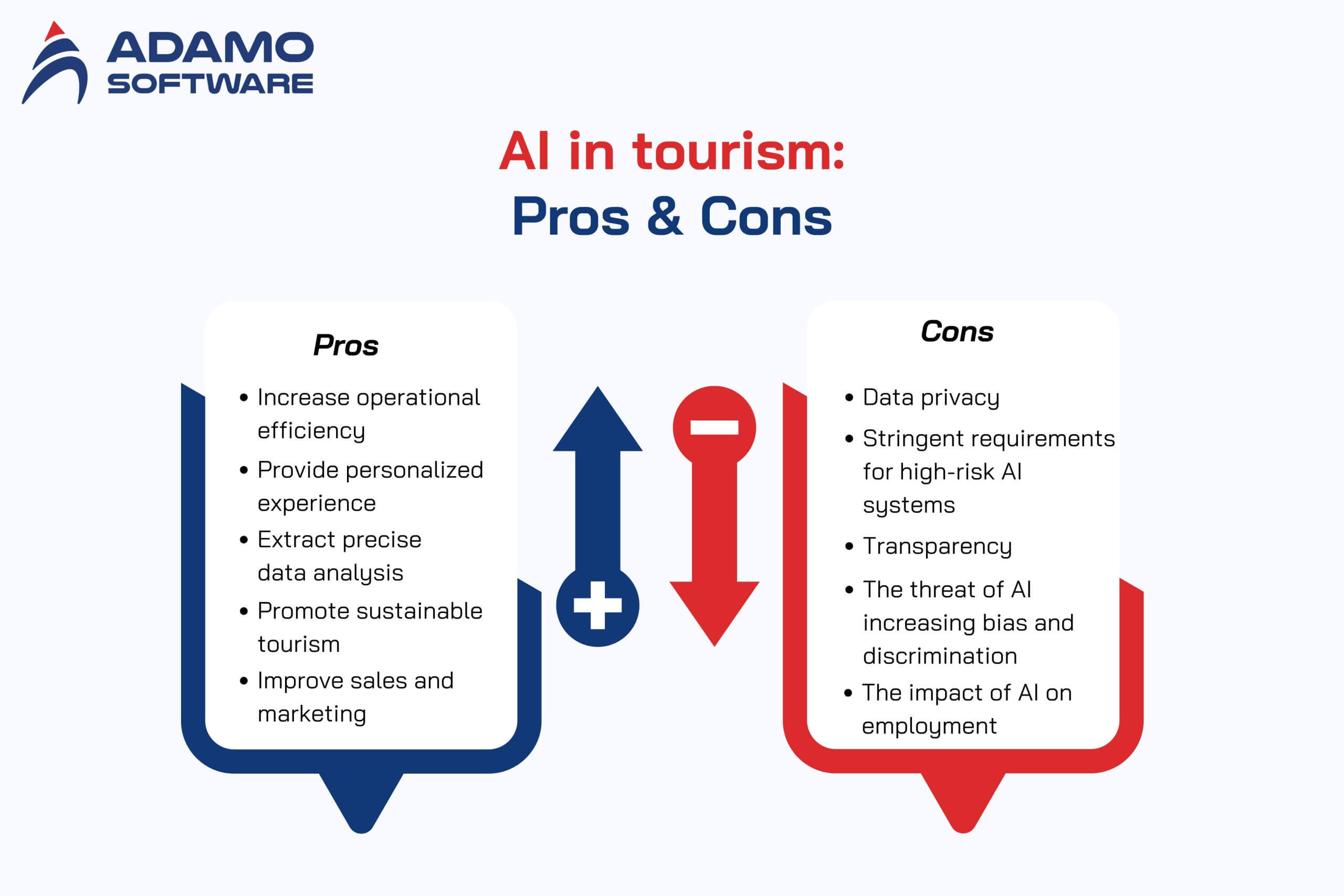
Higher operational efficiency. Predictive analytics optimizes resource and inventory allocation, and automation removes routine work so staff can focus on complex, high-value tasks, reducing both workload and error.
Personalization at scale. AI tailors destinations, stays, and offers to each traveler’s history and stated preferences, which deepens engagement and drives loyalty and repeat bookings.
Sharper decisions from data. Machine learning surfaces trends and correlations across large data sets, letting companies forecast shifts, manage risk, and respond to demand faster than manual analysis allows.
Stronger sales and marketing. Recommendation engines and predictive targeting identify high-value segments and optimize campaign timing and messaging, improving conversion and return on marketing spend.
Support for sustainable tourism. Route and resource optimization can cut fuel use and waste, and AI monitoring helps operators track energy and water metrics and reduce their footprint.
Risks and Ethical Considerations
The benefits are real, and so are the obligations. Responsible AI in travel and tourism means managing the following.
Data privacy. AI systems need large volumes of personal data, and travelers share sensitive details when they book. Companies must comply with regimes such as GDPR, encrypt data, set clear privacy policies, and keep security current to hold traveler trust.
Regulation of high-risk systems. The EU AI Act sets strict requirements for high-risk AI, including testing and certification before deployment. High-risk travel uses such as facial recognition at airports or behavioral analysis fall under this scrutiny and must be assessed before going live.
Transparency. Travelers should know when they are interacting with AI and understand its limits, which supports accountability and lets people make informed decisions.
Bias and fairness. Models trained on skewed data can carry those biases into recommendations and treatment. Regular audits and updates are needed to keep outcomes fair across groups.
Workforce impact. AI creates new roles but can displace repetitive ones such as data entry and basic service. Responsible adoption pairs automation with retraining and clear transition support.
Challenges of Implementing AI in Travel
Beyond ethics, teams hit practical hurdles when they deploy. AI expertise is scarce and expensive, so many companies partner with specialists rather than build every capability in-house. Data is usually fragmented across booking systems, CRM, and social platforms, so integrating it into a clean, centralized source is a prerequisite for models to work well. Systems must be built to scale with demand, which favors cloud infrastructure and a modular architecture. Each of these is solvable, but each needs to be planned before a project starts, not discovered midway.
Conclusion

AI in travel and tourism has moved from optional to expected. It personalizes experiences, sharpens pricing and forecasting, automates service and operations, and gives businesses a clearer view of their travelers, with adoption now mainstream at 40 percent of travelers using AI to plan trips (Statista, 2025). The companies that benefit most treat it as a capability to build deliberately, with the privacy, transparency, and human oversight that keep travelers’ trust intact. For a look at where the technology is heading next, see our guide on agentic AI in travel.
Adamo Software helps travel and hospitality companies adopt AI the right way, from strategy and custom development to integration with existing systems, security, and compliance. Explore our AI development services and travel and hospitality software development to see how we can help.
FAQs
1. How is AI used in travel?
Travel businesses use AI to plan and personalize itineraries, predict demand, adjust pricing, and streamline operations. It also handles customer questions around the clock, speeds up booking, and improves service across web, app, and voice channels.
2. What is the future of AI in travel and tourism?
AI is moving toward more autonomous, agentic systems that do not just answer questions but plan and complete bookings end to end, alongside smarter personalization, real-time translation, and virtual guides. The near-term direction is assistants that act on the traveler’s behalf under human oversight.
3. What is the role of AI in the travel industry?
In the travel industry, AI improves the efficiency and productivity of operations, widens access to service, and enables new products, letting businesses serve travelers at a level that manual processes cannot match.
4. What are the main risks of AI in tourism?
The main risks are data privacy, compliance with regulations such as GDPR and the EU AI Act, lack of transparency, and bias in AI models. Managing them with clear consent, security, audits, and human oversight is what keeps AI adoption safe and trusted.

 adamosoft.com
 (+84) 373 11 44 88