
Vibe Coding is real – And so is the Technical Debt it creates
Vibe coding speeds up prototyping but exposes serious gaps at scale. Learn when AI-generated code needs professional developers to survive production.
Vibe coding – the practice of building software by prompting AI tools like Cursor, Lovable, or v0 instead of writing code manually – is no longer experimental. Non-technical founders are shipping MVPs in days, and product teams are bypassing engineering bottlenecks that used to take weeks. According to a 2024 GitHub survey, 92% of developers in the US now use AI coding tools in some capacity, and the adoption curve among non-developers is accelerating. But the real question for businesses is not whether vibe coding works – it is what happens after it works, when the product needs to grow, integrate, and survive real users.
What Vibe Coding Actually Gets Right
Vibe coding tools have genuinely closed a gap that previously required thousands of dollars and several months of development time. For early-stage validation, the value is concrete and hard to dismiss.
AI-assisted development tools reduce initial prototyping time by 30–55% compared to traditional development workflows, according to McKinsey’s 2023 analysis of software productivity benchmarks. For founders who need to test a hypothesis before committing to a full build, this is a meaningful acceleration.
Tools like Lovable and v0 generate frontend components, data models, and basic API structures that are production-adjacent — not just wireframes. A non-technical product manager can now ship a functional demo without waiting for an engineering resource to become available.
For internal tools, simple automation workflows, and single-feature web apps with limited user load, vibe-coded products can operate in production without professional intervention. The ceiling is real, but it is higher than most engineers expected two years ago.
The mistake is not using vibe coding. The mistake is assuming the ceiling does not exist.
Where Vibe-Coded Products Break Down
The failure modes of vibe-coded software are not random – they are predictable, and they tend to appear at the same stages of a product’s lifecycle.
- At scale: AI-generated code is optimized for correctness on the happy path. It rarely accounts for concurrent users, database indexing at volume, or caching strategies. A startup that vibe-coded its MVP and grew to 10,000 daily active users reported in a 2024 Hacker News post-mortem that their PostgreSQL queries, written entirely by AI, caused full table scans on every request. The rewrite took three months.
- At integration: Enterprise clients and regulated industries require API contracts, authentication standards (OAuth 2.0, SAML), and data exchange formats (HL7 FHIR for healthcare, GDS protocols for travel) that AI tools do not handle reliably out of the box. Vibe-coded integrations with third-party systems frequently break under edge cases that only experienced engineers anticipate.
- At security audit: According to a 2024 Snyk report, AI-generated code introduces security vulnerabilities at a rate comparable to junior developers, including SQL injection risks, improper input validation, and insecure direct object references. For any product handling personal data or financial transactions, shipping AI-generated code without a security review is a liability, not just a technical risk.
- At ownership transfer: When a business tries to hand vibe-coded software to an engineering team for maintenance or expansion, the team inherits a codebase with no documentation, inconsistent naming conventions, and architectural decisions that reflect what the AI defaulted to – not what the product actually needs. Onboarding time increases significantly, and refactoring costs can exceed the original build cost.
The Shift Vibe Coding Creates for Outsourcing
Vibe coding does not eliminate the need for professional software development. It changes the point in the product lifecycle where professional developers add the most value – and it makes that need more urgent, not less.
Before vibe coding became viable, businesses hired custom software development partners to build from scratch. The outsourcing partner was responsible for architecture, implementation, and delivery. That model still applies for complex products. But a new pattern is emerging: companies that used vibe coding to validate and launch are now looking for a professional team to take over – to audit what was built, refactor what is unsustainable, and architect what comes next.
According to a 2024 Deloitte survey on IT outsourcing trends, 67% of companies that expanded their use of AI development tools also increased their outsourcing spend in the same period. The reasoning is direct: AI tools raise the floor for what a small team can build, but they also raise the ceiling of what a product needs to do to compete.
Adamo Software works with businesses at exactly this inflection point. Whether a company needs to bring a vibe-coded MVP to production-ready standards, integrate with enterprise systems, or build a dedicated engineering team to own the product long-term, Adamo Software’s engineers operate with the technical depth that AI tools cannot replicate.
Don't let vibe-coded foundations slow you down
Adamo Software audits, refactors, and scales AI-generated codebases into production-ready systems that last.
What Professional Developers Do That AI Cannot
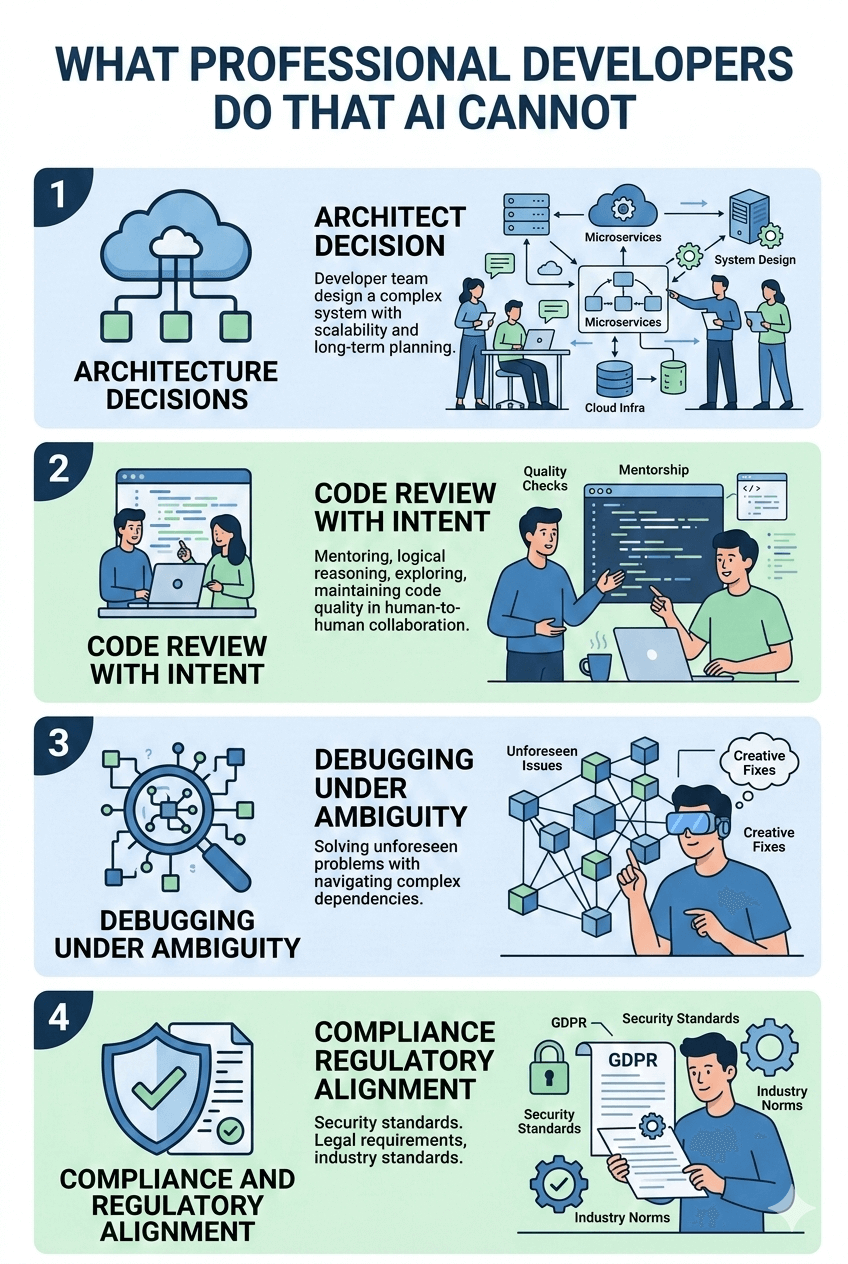
The distinction is not about writing syntax. AI tools write syntax well. The distinction is about engineering judgment – decisions that require understanding context, constraints, and consequences across the full system.
- Architecture decisions: Choosing between a monolith and microservices, designing a data model that will still make sense at 100x the current volume, deciding where to introduce a message queue – these are judgment calls that depend on knowing what the product will become, not just what it is today.
- Code review with intent: A professional developer reviewing AI-generated code is not just checking for bugs. Adamo Software’s engineering teams evaluate whether the AI’s implementation reflects the right tradeoff for that specific product – performance vs. simplicity, flexibility vs. consistency, speed of delivery vs. long-term maintainability.
- Debugging under ambiguity: AI tools are strong at generating code for well-specified problems. They are weak at diagnosing failures in production environments where the error message is misleading, the logs are incomplete, and the root cause is a race condition that only appears under specific concurrency conditions.
- Compliance and regulatory alignment: For healthcare platforms, travel booking systems, and fintech products, code correctness is not enough. Engineers must understand HIPAA requirements, PCI-DSS standards, GDPR obligations, and industry-specific data handling -rules and translate those requirements into implementation decisions that hold up under audit.
When To Bring In A Professional Development Team
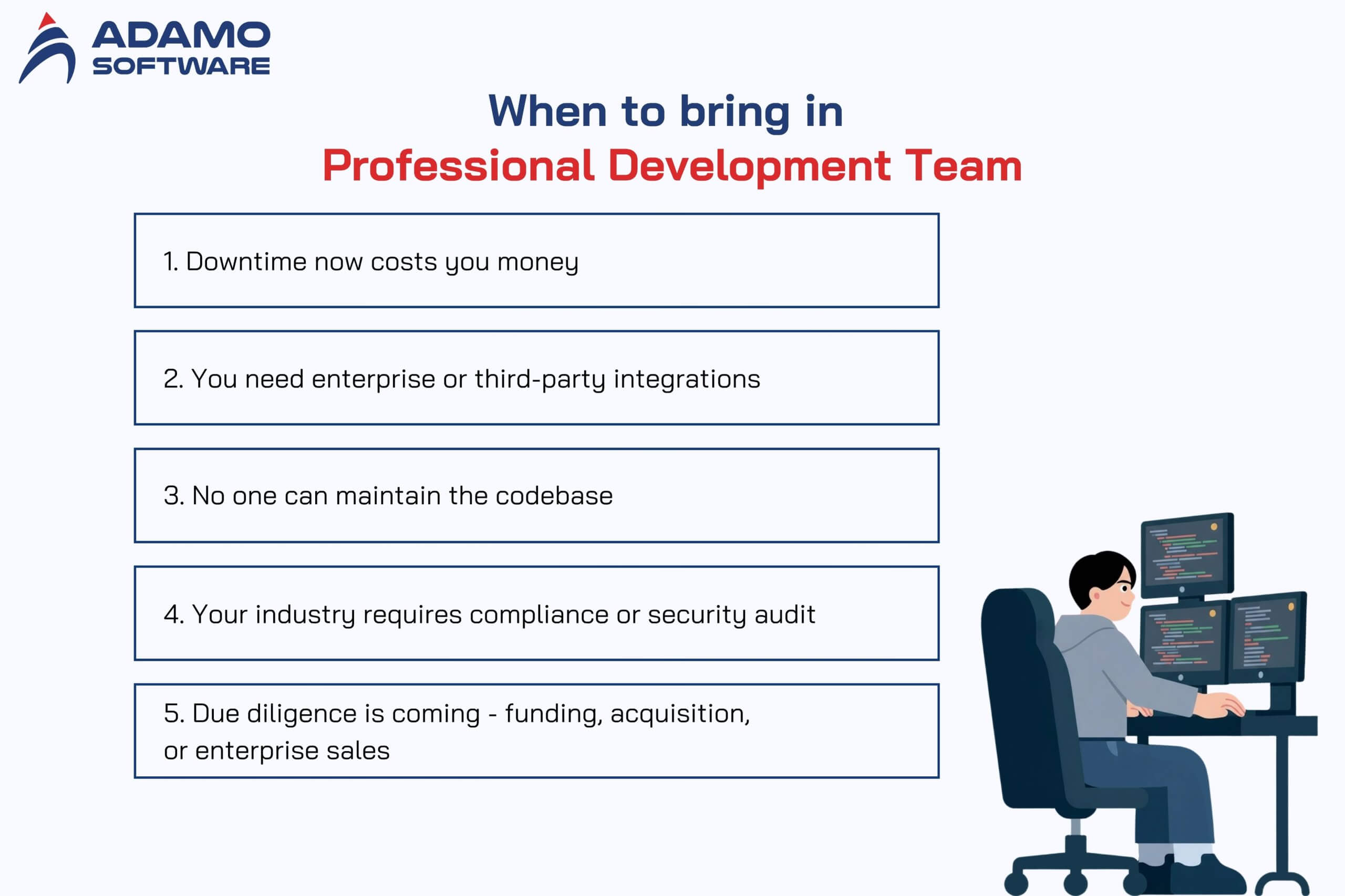
Not every vibe-coded project needs an immediate handoff to a professional development team. The signal is specific. Understanding the benefits of the dedicated team model helps determine whether a full handoff or a hybrid approach is right for your stage.
- The product has real users and downtime now has a business cost.
- The codebase needs to integrate with an enterprise system, a regulated data source, or a third-party platform with strict API requirements.
- The team needs to onboard new engineers and the current codebase has no documentation or consistent structure.
- The product is in a regulated industry – healthcare, finance, travel with payment processing – and has not had a security or compliance review.
- The business is preparing for a funding round, an acquisition, or an enterprise sales process that will require a technical due diligence audit.
At any of these points, the cost of delaying professional involvement is higher than the cost of engaging it. Technical debt compounds. A codebase that needs two weeks of refactoring today will need two months in six months.
Conclusion
Vibe coding is a legitimate productivity tool, and dismissing it is the wrong response. The right response is understanding where it ends and where professional engineering begins. For businesses building products that need to scale, integrate, comply, and last, AI tools are the starting line – not the finish line. The companies that will win are the ones that use vibe coding to move fast early, then bring in the engineering depth to make what they built sustainable. That transition point is where Adamo Software operates.
Scale Your Engineering Capacity With Adamo
Adamo Software provides dedicated development teams that integrate directly into your workflow. Hire vetted engineers in Vietnam with experience in web, mobile, cloud, and enterprise systems – at significantly lower cost than equivalent talent in the US or Western Europe. Contact us to get free IT consultation!

 adamosoft.com
 (+84) 373 11 44 88