
How to Create SaaS Application: 8-Step Guide
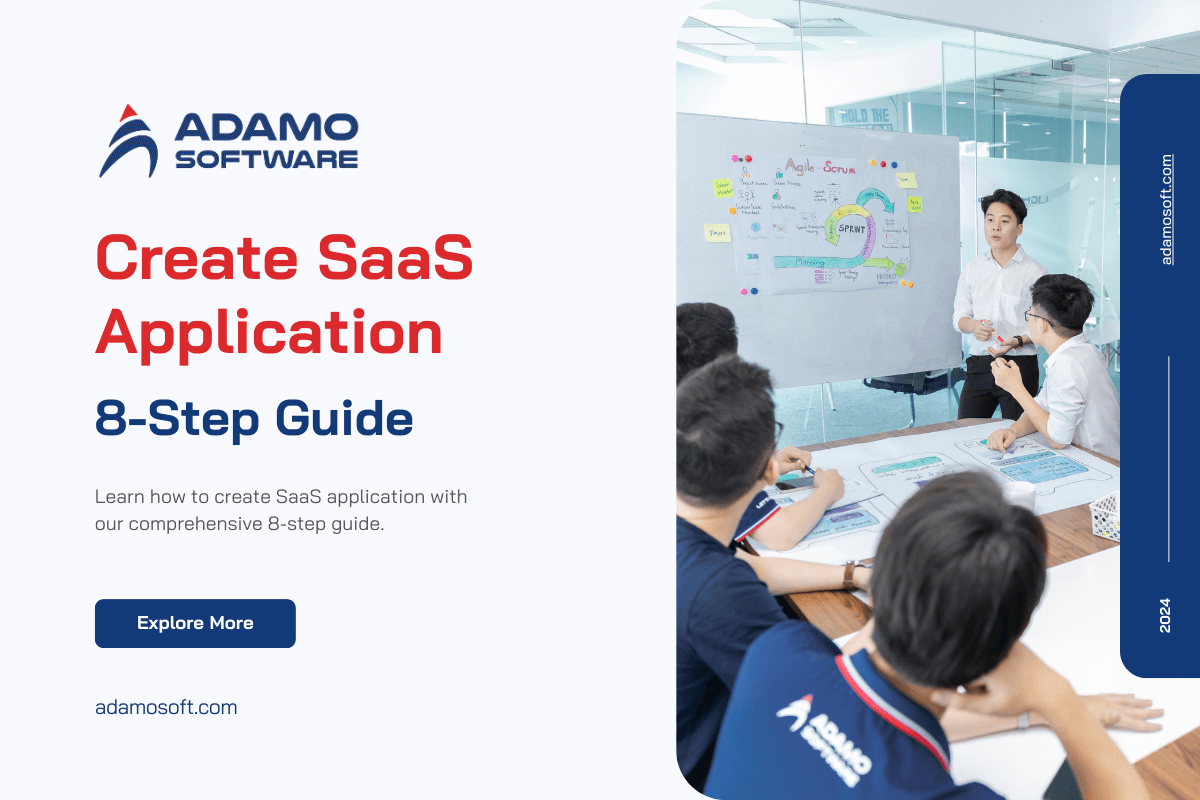
Learn how to create a SaaS application in 2026: the 8-step development process, architecture, tech stack, cost ranges, and key build decisions for founders.
To create SaaS application, you design, build, and host a cloud product that users reach over the internet and pay for on a recurring subscription, then improve it through ongoing releases. The model is attractive for a clear reason: it produces predictable, compounding revenue. The global SaaS market is valued at roughly $375.6 billion in 2026 by Fortune Business Insights and nearer $465 billion by Precedence Research, and Statista placed the 2025 figure around $390.5 billion. The methodologies differ, but the trajectory is the same: sustained double-digit growth, with North America still accounting for about 46.9% of revenue (Fortune Business Insights, 2025).
That opportunity is also why the field is crowded. A strong idea is not enough. What determines whether a SaaS product survives is execution: the architecture you choose, how you price, how quickly you validate with real users, and how disciplined you are about scope. This guide covers the entire process end to end, and points you to deeper resources on cost, tech stack, and outsourcing where you need them.
Key Takeaways:
- The global SaaS market sits between roughly $375.6 billion (Fortune Business Insights, 2026) and $465 billion (Precedence Research, 2026), with double-digit annual growth across every major estimate.
- A reliable way to create a SaaS application follows eight stages: market research, discovery, monetization design, UX/UI, MVP build, testing, launch, and maintenance.
- Architecture (multi-tenant or single-tenant) and monetization model are decisions you make early, because reversing them after launch is expensive.
- Build cost in 2026 ranges from about $15,000 for a low-complexity product to $500,000 or more for a complex, compliance-heavy platform, before ongoing maintenance and marketing.
- AI now touches most of the development lifecycle: 85% of professional developers regularly use AI tools (JetBrains State of Developer Ecosystem, 2025), which is reshaping both timelines and budgets.
What Is SaaS Application Development?
SaaS application development is the process of building cloud-hosted software that customers access through a browser or app and pay for by subscription, rather than buying and installing it once. The provider owns the infrastructure, handles updates and security, and serves many customers from shared or dedicated environments.
Three characteristics define a SaaS product:
- Subscription billing: Customers pay monthly or annually, often only for the tier or features they use, which turns revenue into a recurring stream rather than a one-time sale.
- Cloud delivery: The application runs on the provider’s servers and is reachable from any internet-connected device, so there is no local installation to manage.
- Centralized maintenance: The provider pushes updates, patches, and new features to everyone at once, so customers always run the current version.
SaaS products generally fall into two families. Horizontal SaaS serves a function across many industries, such as a CRM or a project management tool. Vertical SaaS solves a problem inside one industry, such as a platform built only for clinics or only for tour operators. Vertical products tend to command higher switching costs and clearer ROI, which is why they are an increasingly popular entry point for new SaaS founders.
The SaaS Market in 2026: Why the Opportunity Is Still Real
SaaS has moved from a procurement option to the default way businesses buy software. Adoption is close to universal across organizations, and large enterprises now run anywhere from one hundred to several hundred SaaS applications across their teams. As far back as 2023, 73% of organizations already used SaaS applications (Fortune Business Insights), and that share has only widened as cloud migration and remote work became permanent.
Two forces are reshaping how SaaS gets built in 2026:
- AI in the development cycle: AI is no longer experimental tooling. According to the JetBrains State of Developer Ecosystem 2025, 85% of professional developers regularly use AI tools for coding and review, and McKinsey has found 33% to 36% reductions in code-related time at scale. For founders, this changes both delivery speed and the conversation about budget, though the gains are uneven and depend on disciplined workflows rather than the tool alone.
- The shift toward vertical and AI-native products: General-purpose tools face saturation, while industry-specific platforms and products with AI built into the core, not bolted on, are where new entrants find room. This is where a focused MVP can still win against larger incumbents.
The takeaway is practical. The market is large and growing, but the bar for a credible product is higher than it was five years ago. Speed of validation and depth of fit matter more than feature count.
How to Create a SaaS Application in 8 Steps
The process to create a SaaS application has its own rhythm because of its cloud-based, subscription nature. The eight stages below run in sequence, and skipping or rushing the early ones is the most common reason budgets blow out later.
1. Market and Competitor Analysis
Before any design work, validate that the problem is real and that people will pay to solve it. Identify your target users, map how they solve the problem today, and study the competitors already serving them. The goal is to find a gap specific enough to defend: a segment, a workflow, or an integration that incumbents handle poorly. Weak research at this stage is one of the leading causes of budget overruns of 40% to 60% later in the project.
2. Discovery Phase
Discovery turns the validated idea into a plan your development team can execute. Working with a business analyst, you produce the documents that govern the build:
- Software requirements documentation that defines features, technical specifications, user groups, and scope.
- A risk assessment and mitigation plan that names what could go wrong and how to limit it.
- A feature breakdown with time estimates for each item.
- A cost estimate that becomes the baseline budget.
A good business analyst also defines the optimal team structure to deliver within your budget and timeline. This phase feels slow, but it is where you remove the ambiguity that becomes expensive once code is being written.
3. Choose Your Monetization Model
How you charge shapes product decisions, so decide early. The subscription model is the standard, but it carries a known tension: you spend on acquiring customers now and recover that spend gradually over months. That makes retention as important as acquisition. Common variants include flat-rate tiers, per-seat pricing, usage-based pricing (increasingly popular for AI features), and freemium with paid upgrades. The right choice depends on how your customers perceive value and how your costs scale with usage.
4. UX/UI Design Phase
Once the scope is clear, design something users can actually interact with. SaaS users have alternatives and abandon products that feel confusing, so usability is a commercial concern, not a cosmetic one. Design moves from wireframes (basic monochrome layouts) to visual design (color, typography, components) to an interactive prototype that stakeholders and early users can test before a line of production code is written. Prototyping here is cheap insurance against building the wrong thing.
5. Build a Successful MVP
The Minimum Viable Product is the first usable version, containing only the features needed to prove the core idea. An MVP lets you test the concept with real users, pitch a working version to investors, and validate functionality before committing to full development. The discipline is in saying no: every feature you add to the MVP delays the moment you learn whether the product resonates. In 2026, an MVP typically costs between $15,000 and $80,000 depending on complexity and team.
6. Testing and Iteration
Testing answers two questions at once: is the idea viable for users, and is the implementation clear enough for them to use without friction. This is where you talk to real users intensively. The feedback you gather feeds directly into the next iteration, and the loop of build, measure, learn is what turns an MVP into a product people keep paying for.
7. Launch Your SaaS Application
Make the product available through the channels your audience actually uses: your website, relevant app stores, and integration marketplaces where appropriate. Use the launch to set up the mechanics that drive adoption, such as onboarding flows, in-app prompts, ratings, and a clear path from free trial to paid. Marketing is not a post-launch afterthought. It often costs one to two times your development spend, so plan it into the budget from the start.
8. Maintenance and Continuous Improvement
A SaaS product is never finished. After launch, you monitor usage, fix bugs, ship improvements, and decide which requested features earn a place on the roadmap. Ongoing maintenance typically runs 15% to 25% of annual recurring revenue, and it is what keeps churn low and the product competitive. Each stage connects to the next, so a successful release depends on completing each one properly rather than racing to ship.
Choosing Architecture, Monetization, and Security
Beyond the build sequence, three decisions deserve attention before you start, because they are hard to change later.
Multi-Tenant or Single-Tenant Architecture
A SaaS application runs on one of two tenancy models. In a multi-tenant architecture, many customers share the same database and application instance while their data stays isolated and secured. It is scalable, cheaper to maintain, and the default for products like CRMs and marketing tools. In a single-tenant architecture, each customer gets a dedicated instance, which offers stronger isolation and customization and suits products handling highly sensitive data, such as financial or healthcare platforms. The right model depends on your security needs, customization demands, and cost tolerance, and it is a decision a software architect should make with you.
Security and Compliance
Because SaaS products hold customer data in the cloud, security is a core requirement rather than a feature. Cloud providers supply the building blocks, such as firewalls, access controls, encryption, and monitoring, but configuring them correctly is your responsibility. If your product touches regulated data, compliance frameworks like HIPAA in healthcare or GDPR in the EU add real work, and typically increase development cost by 25% to 40%. Budgeting for that early prevents an unpleasant surprise during an enterprise sales cycle.
Third-Party Integrations
Most SaaS products rely on functions that already exist as services, such as payments, maps, communication, or analytics. Integrating proven third-party services instead of building everything from scratch saves time and money and reduces risk. The judgment is in deciding what is core to your product (build it well) and what is supporting (integrate it).
The Tech Stack to Build a SaaS Application
Your tech stack is the set of tools and technologies your team uses to build and run the product. At a high level it spans the front end (often a JavaScript framework such as React, Angular, or Vue), the back end (Node.js, Laravel, or Ruby on Rails are common choices), a database, and a cloud provider such as AWS, Google Cloud Platform, or Microsoft Azure. The right combination depends on your product’s performance needs, your team’s expertise, and how you expect to scale. Because this decision has long-term consequences, it belongs with your technical leads. For a detailed breakdown of frameworks, databases, and infrastructure choices, see our guide on the best SaaS tech stack for 2026.
How Much Does It Cost to Build a SaaS Application?
The honest answer is a wide range, because cost tracks complexity, team location, and compliance requirements. As a 2026 orientation, build cost falls into rough tiers:
- Micro or low-complexity product: about $15,000 to $25,000.
- Basic SaaS: about $25,000 to $50,000.
- Medium-complexity platform: about $50,000 to $150,000.
- Complex, compliance-heavy product: $150,000 to $500,000 or more.
Team location moves these numbers significantly. Hourly rates in 2026 run roughly $120 to $200 in North America versus $15 to $50 across much of Asia, which is why outsourcing is a common way to extend a budget without cutting scope. Beyond the build, plan for the hidden costs that catch founders off guard: maintenance at 15% to 25% of annual recurring revenue, and marketing at one to two times your development spend.
For a full breakdown of factors, hidden costs, and ways to control your budget, read our dedicated guide on SaaS development cost. If you are weighing how to assemble a team, our analysis of outsourcing SaaS development compares the build options in detail.
Common Types of SaaS Applications
SaaS spans many product categories, and understanding where your idea fits helps you study the right competitors and integrations. Common types include:
- Accounting and finance tools such as QuickBooks and Xero, which automate invoicing and bookkeeping for small and mid-sized businesses.
- Enterprise Resource Planning (ERP) systems such as SAP and Oracle, which consolidate budgeting, compliance, and operations in one place.
- Customer Relationship Management (CRM) platforms such as Salesforce and HubSpot, which centralize customer data and sales activity.
- Project management tools such as Asana, Trello, and Jira, which keep teams aligned on tasks and timelines.
- Communication platforms such as Slack, Zoom, and Microsoft Teams, which replaced email and phone as the default for distributed work.
- HR platforms such as Rippling, which handle the employee lifecycle from hiring to offboarding.
- Payment gateways such as Stripe and PayPal, which process transactions securely and report on activity.
This is also where the vertical opportunity lives. A focused product built for one industry’s workflow, such as clinics, tour operators, or logistics firms, can outperform a general tool by fitting the way that industry actually works.
Key Benefits of SaaS Application Development
The model has endured because the advantages are structural, not cosmetic:
- Recurring, predictable revenue: Subscriptions create compounding income and a clearer view of future cash flow than one-time sales.
- Lower entry cost for customers: There is no large upfront license or hardware purchase, which widens your addressable market.
- Built-in scalability: A well-architected SaaS product can add users and capacity without major rework.
- Automatic updates: Every customer runs the latest version, which reduces support load and security risk.
- Global reach: A cloud product is available anywhere, making international and remote customers reachable from day one.
- Faster time to value: Customers can start using the product shortly after signing up, which shortens your sales cycle.
These benefits are why SaaS remains the default for companies looking to scale efficiently, but they only materialize if the product is built on sound architecture and validated demand.
How Adamo Software Helps You Build a SaaS Application
If you decide to build with an external partner, the priority is a team with a real delivery record, not just a sales deck. Adamo Software has delivered more than 300 projects across verticals including travel, healthcare, fintech, media, EdTech, and eCommerce, which means our teams have built and scaled SaaS products under the constraints that matter: compliance, multi-tenancy, and integration with existing systems. Here is how we work:
- Custom development: Our team starts from your business challenge, not a template, and builds a product designed around the workflows and economics that are specific to your market.
- Multi-tenant architecture: We design and operate the multi-tenant infrastructure that lets your product serve many customers efficiently, so you scale without adding servers or capacity manually.
- API development: We build the internal and external APIs your SaaS product needs to integrate cleanly with the systems your customers already use.
As a Vietnam-engineered partner, we pair senior engineering with cost structures that let founders extend their runway, and we work under NDA so client specifics stay protected. To see how the full delivery model works for product teams, explore our custom software development and dedicated development team services.
Conclusion
Creating a SaaS application in 2026 is less about the idea and more about disciplined execution across eight stages, from validating demand before you design to maintaining the product at 15% to 25% of recurring revenue after launch. The two decisions that shape everything else, tenancy architecture and monetization model, are made early and are costly to reverse, so they deserve real attention up front. With the market between roughly $375.6 billion and $465 billion and growing at double digits, the opportunity is genuine, but so is the competition. A focused MVP, validated with real users and built on sound architecture, remains the most reliable path from idea to a product that people keep paying for.
 adamosoft.com
 (+84) 373 11 44 88