
Top 12 AI Solution Providers in 2026, Compared by Category
The top 12 AI solution providers in 2026, grouped by consultancy, hyperscaler, software vendor, and offshore engineering partner. What each one is best at, and what it costs you.
Key Takeaways
- Adoption is not the constraint. Stanford HAI’s AI Index 2026 reports organizational AI adoption at 88 percent, and McKinsey’s State of AI survey in 2025 reached the same figure.
- Delivery is the constraint. MIT NANDA’s The GenAI Divide: State of AI in Business 2025 found roughly 95 percent of generative AI pilots produced no measurable P&L impact, and of the enterprise-grade tools organizations evaluated, only about 5 percent reached production.
- The same MIT study found AI tools purchased from specialist vendors, or built in partnership with them, succeeded about 67 percent of the time, while internal builds succeeded roughly one third as often. The provider decision is the project.
- Providers fall into five categories: global consultancies, hyperscaler platforms, enterprise AI software vendors, data and evaluation specialists, and offshore engineering partners. They are not substitutes, and comparing them on day rate produces bad decisions.
- Two providers on this list changed materially in 2026. C3 AI is mid-restructuring under a returning founder-CEO. Scale AI operates under a 49 percent non-voting Meta stake. Both belong in a risk register, not a footnote.
- The decisive procurement questions concern model ownership, data residency, evaluation methodology, and who maintains the system eighteen months after launch.
I. What is an AI Solution?
An AI solution is a system that performs a task previously requiring human judgement: processing data, drawing inferences, making predictions, and in some cases acting on them with limited human involvement. Most enterprise AI solutions combine machine learning, natural language processing, and automation tooling, and they are built to reduce cycle time, improve accuracy, or surface information a person would not find at scale.
Almost every AI system in commercial use today is narrow AI. It is built to do one thing: detect fraud, route a support ticket, read a medical image. General AI, capable of transferring competence across unrelated domains, remains a research goal rather than a product category. The distinction matters commercially, because it defines the real choice in front of a buyer: adopt an off the shelf tool built for a general case, or commission a system built for yours.
That choice is where AI solution providers enter. To see where AI is already producing results in practice, read AI business applications: 10 use cases you cannot ignore.
Why AI Solutions Matter Now
Adoption is close to universal. Stanford HAI’s AI Index 2026 reports organizational AI adoption at 88 percent, up from the 78 percent its 2025 edition recorded for 2024, which itself was up from 55 percent in 2023. McKinsey’s State of AI survey, published in 2025, arrived at the same 88 percent figure for organizations regularly using AI in at least one business function.
Impact is not. In that same McKinsey survey, only around one third of organizations reported scaling AI beyond isolated functions, and just 39 percent reported any measurable EBIT contribution from it. The gap between using AI and profiting from AI is now the central problem of enterprise AI, and it is a delivery problem rather than a technology problem.
II. Top 12 AI Solution Providers in 2026
Place a plain numbered list of names directly under this H2, before any prose. Google is currently rendering a numbered list block above the People Also Ask panel for this query. That block is extracted from clean, unadorned lists. This is the only formatting decision in the article with a direct shot at the position-one block that is currently absorbing your clicks.
- Accenture
- IBM
- Microsoft Azure AI
- Google Cloud AI
- Amazon Web Services
- Palantir Technologies
- Databricks
- C3 AI
- Infosys
- EPAM Systems
- Scale AI
- Adamo Software
How we selected these providers
This list is not ranked. Ranking a hyperscaler against a 170-person engineering firm produces a number that means nothing, because they are not substitutes.
Providers were grouped into four categories and selected on three criteria: they operate at commercial scale outside a single national market, their AI offering is a stated business line rather than a marketing page, and their status can be verified from public filings, company statements, or certification registries. Every fact below is sourced from those. No performance metric appears unless the source is named in the same sentence.
Two entries carry material changes from 2026 that most competing lists have not updated. They are flagged.
Category A. Global consultancies and systems integrators
Buy from these when the AI project is really a change programme, when the board needs to see a name it recognises, or when the regulatory exposure is large enough that shared accountability matters more than the invoice.
1. Accenture
Incorporated as Accenture in 2001, headquartered in Dublin, listed on the NYSE. Sells AI strategy, data foundation work, and implementation, usually as part of a wider transformation mandate rather than a standalone build.
Best for: enterprise-wide programmes touching multiple business units, regulated industries, organisations where procurement requires a tier-one name.
Trade-off: the highest cost per engineer on this list, and the senior team that wins the pitch is rarely the team that writes the code. Ask which named individuals are contractually committed to your delivery.
2. IBM
Founded in 1911, headquartered in Armonk, New York, listed on the NYSE. Combines IBM Consulting with the watsonx platform, and is strongest where models must run inside a hybrid or on-premises environment rather than a public cloud.
Best for: regulated sectors with data residency constraints, organisations already running IBM infrastructure, governance-heavy deployments.
Trade-off: slower and more expensive on greenfield projects than a specialist. The platform and the consulting arm are sold together, which is convenient until you want to change one.
3. Infosys
Founded in 1981, headquartered in Bengaluru, listed on the NYSE. Delivers AI through the Topaz offering, at a rate structure well below the tier-one consultancies.
Best for: large-volume delivery, application modernisation with AI attached, organisations with mature vendor management.
Trade-off: team quality varies significantly across accounts. The engagement is only as good as the account leadership assigned to it, so ask to meet them before signing.
4. EPAM Systems
Founded in 1993, headquartered in Newtown, Pennsylvania, listed on the NYSE. Engineering-led rather than consulting-led, with delivery concentrated in Central and Eastern Europe.
Best for: complex builds where the engineering is the hard part, clients who want a partner rather than an advisor.
Trade-off: priced between a consultancy and an offshore partner, without the cost advantage of either.
Category B. Hyperscaler platforms
These are not services firms. They sell infrastructure and models, and route implementation to a partner network. Choosing one is an architecture decision that outlasts the project.
5. Microsoft Azure AI
Azure AI Foundry, Azure OpenAI Service, and the Copilot family. The default choice for organisations already committed to Microsoft 365 and Azure identity.
Best for: enterprises where the AI has to reach knowledge workers inside tools they already use.
Trade-off: the architecture locks to Azure. Migrating a production AI system to another cloud two years later is a rebuild, not a move.
6. Google Cloud AI
Vertex AI and the Gemini model family. Strongest data and machine learning tooling of the three hyperscalers, and the most coherent path from data warehouse to deployed model.
Best for: data-heavy organisations, teams where the machine learning work matters more than the office integration.
Trade-off: the same lock-in, plus a smaller enterprise partner network than Microsoft or AWS in most regions.
7. Amazon Web Services
Amazon Bedrock for model access and SageMaker for the training and deployment lifecycle. The broadest set of primitives, and the least opinionated about how you assemble them.
Best for: teams with strong internal platform engineering who want maximum control.
Trade-off: breadth is the cost. AWS gives you components, not a solution, and the assembly work is yours or your partner’s.
Category C. Enterprise AI software vendors
These sell a platform with AI applications on top. You are buying software, not a delivery team, and the implementation still has to happen.
8. Palantir Technologies
Founded in 2003, headquartered in Denver, listed on the NASDAQ. Foundry and the Artificial Intelligence Platform, delivered through a forward-deployed engineer model in which Palantir staff embed inside the client.
Best for: defence, intelligence, large industrial operations where data is fragmented across incompatible systems and the integration itself is the product.
Trade-off: among the most expensive options available, and the forward-deployed model creates deep operational dependency. Exit planning is not optional.
9. Databricks
Founded in 2013, headquartered in San Francisco, privately held. The lakehouse architecture plus Mosaic AI for model development and serving.
Best for: organisations consolidating data engineering and machine learning onto one platform.
Trade-off: it is a platform, not a partner. You still need engineers who can build on it, and those engineers are scarce and expensive.
10. C3 AI
Flagged: material change in 2026.
Founded in 2009, headquartered in Redwood City, listed on the NYSE. Sells the C3 Agentic AI Platform and a portfolio of industry-specific enterprise AI applications.
C3 AI is in the middle of a leadership and cost reset. According to the company’s own announcement in May 2026, founder Thomas M. Siebel resumed the role of Chief Executive Officer effective 8 May 2026, with Stephen Ehikian, CEO since September 2025, moving to President. The company reported fiscal 2026 revenue of 250.3 million dollars, a GAAP loss from operations of 498.5 million dollars, and 575.4 million dollars in cash and investments, alongside a restructuring plan targeting roughly 135 million dollars in annualised cost savings.
Best for: industrial and federal use cases where a pre-built application removes eighteen months of development.
Trade-off: vendor stability is a live question, not a theoretical one. If you are signing a multi-year platform commitment, the 2026 restructuring belongs in your risk register. Ask about support continuity and data portability in writing.
Category D. Data and evaluation specialists
11. Scale AI
Flagged: material change in 2026.
Founded in 2016 by Alexandr Wang and Lucy Guo, headquartered in San Francisco. Supplies training data, human annotation at scale, and model evaluation infrastructure to frontier labs and enterprises.
In June 2025, Meta took a 49 percent non-voting stake for approximately 14 billion dollars. Alexandr Wang left to lead Meta’s superintelligence lab and was succeeded by Jason Droege, previously chief strategy officer. Scale continues to operate as an independent entity, and in March 2026 launched Scale Labs, an expanded research division covering evaluation, agentic systems, and risk oversight.
Best for: organisations that need labelled training data at volume, or an independent evaluation harness for a model they did not build.
Trade-off: Scale supplies inputs and measurement, not a finished application. And if your business competes with Meta, the ownership structure is a conversation to have with your legal team before, not after.
Category E. Offshore engineering partners
Buy from these when you need the whole lifecycle built and maintained, at a rate structure that lets you fund three years of it rather than one.
12. Adamo Software
Founded in 2018, headquartered in Hanoi, with hubs in Singapore and Australia. 170 engineers across AI, data, and product teams. Holds ISO 27001:2022 for information security and ISO 9001:2015 for quality management, both externally audited. Rated 4.8 out of 5 on Clutch. Recognised by VINASA with Sao Khue awards in 2024 and 2025, and named to Vietnam’s Top 10 Tech companies in 2025.
AI work spans custom AI software, machine learning, generative AI, and multimodal systems, with healthcare and travel as the deepest verticals. Every engagement opens with a feasibility assessment rather than a build estimate, and if the data will not support the target performance, that is said before the project starts.
Best for: organisations that need the data pipeline, the model, the integration, and the drift monitoring built and maintained by the same team, without a tier-one rate card.
Trade-off: Adamo is not Accenture, and does not pretend to be. There is no global delivery footprint, no board-level advisory practice, and no name your procurement committee will recognise without a reference call. Time zone overlap with North America is limited to early or late hours and has to be scheduled rather than assumed.
The four provider types, at a glance
| Type | Buy when | Real cost |
|---|---|---|
| Global consultancy | The AI project is a change programme and shared accountability matters | Highest rate. Pitch team is not delivery team |
| Hyperscaler platform | Infrastructure is already committed to one cloud | Architecture locks in. Later migration is a rebuild |
| Enterprise AI software vendor | A pre-built application removes a year of development | Vendor risk and exit cost. You still need implementers |
| Offshore engineering partner | The full lifecycle must be built and maintained on a sustainable budget | Time zones must be planned. Governance must be verified, not assumed |
III. The five main types of AI Solutions
Most commercial AI systems are built from five families of technique. Understanding which one your problem needs is the first filter you can apply to a prospective provider.
| Type | What it does | Typical use |
|---|---|---|
| Machine learning | Infers rules from historical data rather than having them written | Fraud detection, forecasting, recommendation, risk scoring |
| Natural language processing | Reads, interprets, and produces human language | Chatbots, document classification, retrieval over company knowledge |
| Computer vision | Turns images and video into structured data | Defect detection, medical imaging, identity verification |
| Predictive analytics | Uses historical signal to anticipate future states | Demand planning, maintenance scheduling, risk exposure |
| Robotic process automation | Executes deterministic, rule-based work | Data entry, invoice matching, system-to-system transfers |
IV. Why the Provider Decision Is the Project
The strongest available evidence on this question is uncomfortable. MIT’s NANDA initiative published The GenAI Divide: State of AI in Business 2025, drawing on structured interviews with enterprise leaders, a survey of senior respondents, and an analysis of 300 public AI deployments. It found that roughly 95 percent of generative AI pilots produced no measurable P&L impact.
The attrition is visible at every stage. In that study, around 60 percent of organizations evaluated enterprise-grade AI tools, roughly 20 percent reached a pilot, and only about 5 percent went live. The reported cause was not infrastructure, regulation, or talent. It was that most systems could not retain feedback, adapt to context, or improve after deployment.
One finding in that report should reshape how you think about procurement. MIT found that AI tools purchased from specialist vendors, or built in partnership with them, succeeded about 67 percent of the time, while tools built entirely in-house succeeded roughly one third as often. Buying beat building by a wide margin, and the gap was widest in regulated sectors where firms most often insisted on building alone.
That is the honest case for working with an AI solution provider. Not that external teams are smarter, but that they have already made the integration mistakes your team is about to make, and they carry the operational habits that keep a model accurate after the launch announcement.
If you are still weighing an internal build, How to Build AI Software sets out the steps and decisions involved before you commit.
Ready to Outsource?
Get top-tier IT talent without the hassle. Contact us now!
V. The Four Types of AI Solution Providers
The phrase “AI solution provider” covers four commercially distinct kinds of company. Comparing them on price alone produces bad decisions, because they are not selling the same thing.
| Provider type | Best fit | Main trade-off |
| Global consultancies | Enterprise-wide transformation, heavily regulated industries, board-level change programmes | Highest cost per engineer. The senior team that wins the pitch is rarely the team that writes the code |
| Cloud platform partners | Teams already committed to AWS, Google Cloud, or Azure who want the build native to that stack | Architecture tends to lock to one cloud. Migration later is expensive |
| Boutique AI specialists | Research-grade modelling in a narrow domain, novel problems without an off the shelf answer | Limited capacity. Many build the model and hand it over rather than maintaining it in production |
| Offshore engineering partners | Full lifecycle delivery at a sustainable cost, including the data pipelines and post-launch monitoring | Time zone overlap must be planned. Governance and certification scope must be verified, not assumed |
Adamo Software sits in the fourth category. Founded in 2018 and operating from Hanoi with hubs in Singapore and Australia, it employs 170 engineers across AI, data, and product teams, holds ISO 27001:2022 and ISO 9001:2015, both externally audited, and is rated 4.8 out of 5 on Clutch. Every engagement opens with a feasibility assessment rather than a build estimate, and if the data does not support the target performance, that is said before the project starts.
For a closer look at this category, including how to shortlist within it, see AI Development Companies: The Best Outsourcing Partners from Vietnam.
VI. How to Evaluate Top AI Solution Providers
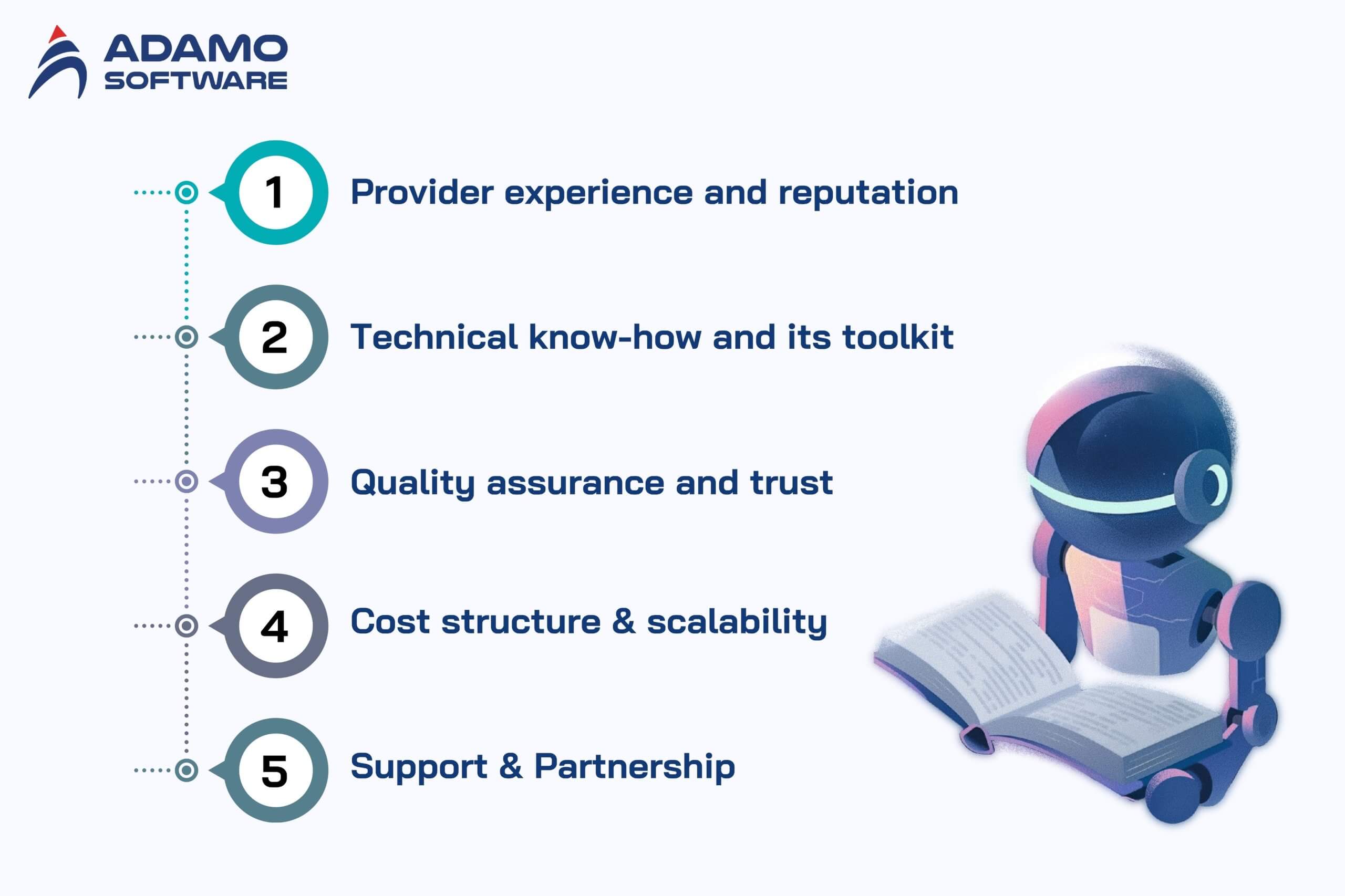
Five criteria separate providers who will deliver from providers who will present. Apply them in order, because failing the first makes the rest irrelevant.
1. Evidence, Not Experience
Years in business tells you nothing. Ask for a project in your industry with a stated metric, a named constraint, and an explanation of what went wrong. Providers who have shipped AI to production can describe a failure in specific terms. Providers who have not will describe their methodology instead.
2. Technical Scope Matched to the Problem
A team that is excellent at computer vision is not automatically competent at retrieval-augmented generation. Ask which technique the provider intends to use and why, and ask what they would use if that one failed. A provider with only one answer has only one tool.
3. Data Practice and Model Ownership
This is the clause that costs money later. Establish who owns the model weights, the training artefacts, and the fine-tuned checkpoints when the contract ends. Establish whether your training data leaves your infrastructure. Ask for the ISO 27001 certificate number and its scope, and check that the scope covers the legal entity you will actually contract with, not a parent company.
4. Evaluation and Monitoring, Not Accuracy Promises
A provider who guarantees an accuracy figure before seeing your data is guessing or lying. What a serious provider commits to is an evaluation methodology: how output quality will be measured, how bias will be tested, what monitoring runs after deployment, and what triggers a retrain. Models degrade as data distributions shift. A provider without a drift plan is selling you a snapshot.
5. Who Is Still There in Eighteen Months
AI systems require ongoing maintenance in a way that conventional software does not. Ask whether the engineers who build the system will be available to maintain it, what the maintenance contract covers in working days per year, and what the service level agreement says about response time when a model starts producing nonsense on a Friday evening.
VII. Ten Questions to Ask Before You Sign
Send these in writing. The quality of the written answers, and the speed at which they arrive, tells you more than any pitch deck.
- Which client in our industry have you delivered an AI system for, what metric moved, and by how much?
- What went wrong on that project, and what did you change afterwards?
- Which AI technique do you propose for our problem, and what is your second choice if it underperforms?
- Does our training data leave our infrastructure at any point? If so, where does it go and for how long?
- Who owns the model weights, the training artefacts, and the fine-tuned checkpoints when the contract ends?
- What is your ISO 27001 certificate number, and does its scope cover the entity we will contract with?
- How will output quality be measured, and what is the evaluation rubric we will both agree to?
- What monitoring runs after deployment, and what triggers a retrain?
- How is pricing structured as usage, data volume, and user count grow?
- Will the engineers who build this system still be assigned to it in eighteen months?
A provider who answers all ten plainly is not necessarily the cheapest. They are the one whose project has a chance of joining the 5 percent that reach production.
VIII. Conclusion

The evidence is now consistent across the major surveys. Adoption is near universal, at 88 percent by both Stanford HAI’s AI Index 2026 and McKinsey’s 2025 State of AI survey. Production impact is rare, with McKinsey finding only 39 percent of organizations reporting any EBIT contribution and MIT NANDA finding roughly 95 percent of generative AI pilots delivering none at all.
What separates the two groups is not model quality. It is integration, evaluation, and maintenance, and those are supplied by the partner rather than the platform. MIT’s finding that vendor-built systems succeed roughly twice as often as internal builds is the clearest instruction available to anyone starting an AI project in 2026.
Adamo Software delivers AI development services across the full lifecycle: feasibility assessment, data preparation, model development, integration, deployment, and the drift monitoring that keeps a system accurate after launch. If the data will not support your target, we say so before the build rather than after.
FAQs
1. What is an AI solution provider?
An AI solution provider is a company that designs, builds, and maintains an artificial intelligence system inside another organisation’s operations. The category covers four commercially distinct kinds of firm: global consultancies that sell transformation programmes, hyperscaler platforms that sell infrastructure and models, enterprise software vendors that sell pre-built AI applications, and engineering partners that build and maintain custom systems. They are not substitutes for one another, and comparing them on day rate alone produces bad decisions. The right question is not which provider is best, but which category matches the problem, the budget, and the level of control the organisation needs to retain.
2. What does an AI solution provider actually do?
A provider takes a business problem and delivers a working AI system inside your existing software. That covers feasibility assessment, data preparation and labelling, model development and evaluation, integration into your platform, deployment, and post-launch monitoring. The model is a fraction of the work. Most of the effort, and most of the failures, sit in the data pipeline and the integration layer.
3. Should we buy from a provider or build the system in-house?
The evidence favours buying. MIT NANDA’s State of AI in Business 2025 found that AI tools purchased from specialist vendors, or built in partnership with them, succeeded about 67 percent of the time, while internal builds succeeded roughly one third as often. The gap was widest in regulated industries, where firms most often chose to build alone. An internal build makes sense when the model is your product. It rarely makes sense when the model supports your product.
4. Why do so many AI projects fail after the pilot?
Because pilots are evaluated on demo quality and production systems are evaluated on workflow fit. MIT NANDA found around 60 percent of organizations evaluated enterprise AI tools, roughly 20 percent reached a pilot, and only about 5 percent went live. The barrier they identified was learning: most systems could not retain feedback, adapt to context, or improve over time once deployed.
5. How do we reduce bias in an AI system?
Bias enters through data, not through malice. Ask a prospective provider three things before contracting: how the training data was collected and what populations it under-represents, how fairness is tested and against which definition of fairness, and what human review sits between the model output and a consequential decision. A provider who cannot answer the second question has not tested for bias, whatever the proposal says.
6. What ongoing maintenance does an AI system need?
More than conventional software, and for a different reason. Code does not degrade, but models do, because the world they were trained on keeps changing. A production AI system needs drift detection, output anomaly monitoring, scheduled retraining, and regression testing whenever an underlying foundation model updates. Budget for it as an annual commitment rather than a warranty period, and confirm which engineers are assigned to it.

 adamosoft.com
 (+84) 373 11 44 88